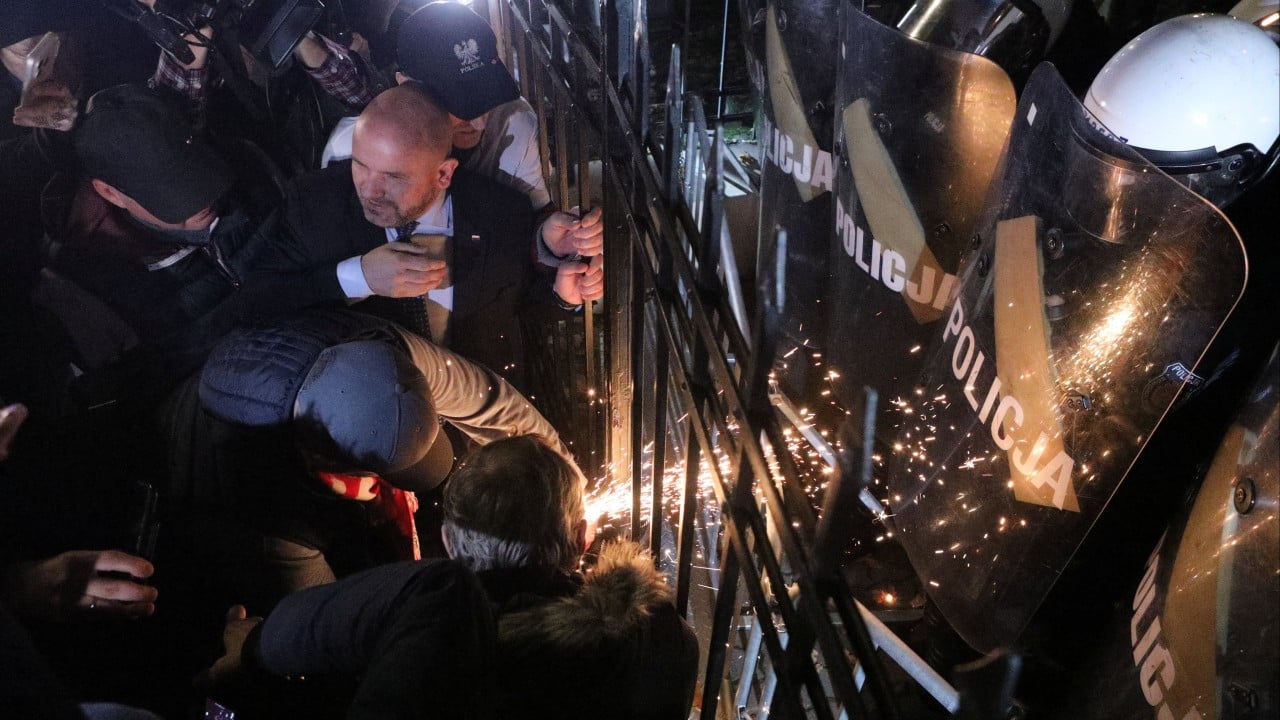
Riot police standing shoulder-to-shoulder outside a courthouse in Warsaw makes for dramatic television. It also makes it way too easy for foreign commentators to lazily slap a "banana republic" label on Poland and move on.
That's a massive mistake.
When Poland deployed riot police after the ousting of a top court chief sparked a constitutional crisis, the surface-level takeaway was all about street protests and political theater. If you actually look at how Polish institutions operate, though, the real story isn't about batons and barricades. It's about a decade-long collision between two irreconcilable legal realities that finally ran out of road.
To understand why armored police vans end up parked outside judicial buildings in a major European Union member state, you have to stop treating this like a standard left-versus-right political squabble. It isn't. It's a structural paralysis where both sides genuinely believe the other is operating outside the law—and both sides can point to actual legal texts to back themselves up.
Why Poland Deploys Riot Police When Judicial Battles Boil Over
You don't send riot units to a courthouse just because people are holding signs. In Warsaw, police deployments around the Supreme Court or the Constitutional Tribunal happen for one very specific reason: physical control of the building equals institutional legitimacy.
Think about how a dual legal system works in practice. When a government ousts a court chief—or declares their term invalid due to procedural flaws in their original appointment—that chief doesn't always just pack a box and leave. Sometimes they show up to work the next morning anyway.
Suddenly, you have two different people claiming the exact same office, the exact same administrative stamp, and the exact same authority to assign cases.
Police get deployed to prevent rival political factions, activist groups, and competing judicial entourages from physically storming the hallways to enforce their version of the law. I've watched European political crises play out for years, and the Polish dynamic is uniquely tense because street mobilization is baked into the political DNA. From the Solidarity movement in the 1980s to the massive judicial protests starting in 2017, Poles don't just wait for the next election cycle when they think the courts are being hijacked. They show up in the thousands.
And when thousands of furious citizens surround a courthouse while rival lawmakers try to force their way past security guards inside, the Ministry of the Interior doesn't take chances. Riot gear goes on. Metal barriers go up.
The Root Cause Nobody Wants to Explain Properly
If you only read breaking news alerts about a court chief getting ousted, the whole thing looks arbitrary. Why would a government suddenly remove a high-ranking judge? Why would that single firing trigger a full-blown constitutional crisis?
Because in Poland, the judiciary isn't a neutral referee anymore. It's the primary battlefield.
Between 2015 and 2023, the Law and Justice (PiS) party fundamentally overhauled how judges are appointed, promoted, and disciplined. They reshaped the National Council of the Judiciary (KRS)—the body responsible for nominating judges—by having parliament choose its judicial members instead of judges picking their own peers.
The European Court of Justice (ECJ) and the European Court of Human Rights (ECHR) repeatedly ruled that these changes compromised judicial independence. According to Brussels and Strasbourg, judges appointed through this revamped body—often called "neo-judges" in Warsaw—lacked the legal standing of an independent tribunal.
Then came the political shift. When Prime Minister Donald Tusk's pro-EU coalition took power in late 2023, they inherited a legal system stuffed with appointees whose legitimacy the European courts didn't recognize, alongside a Constitutional Tribunal still loyal to the previous administration and a president, Andrzej Duda, wielding veto power over any legislative fix.
You see the trap, right?
If the new government passes a law to remove contested court chiefs, the president vetoes it or sends it to the Constitutional Tribunal, which kills it. If the government ignores those rulings because the Tribunal itself includes unlawfully appointed judges, the opposition screams that the government is acting like a dictatorship.
When you reach that kind of institutional dead end, executive actions—like Justice Minister Adam Bodnar suspending or dismissing court presidents—become the only tool left in the box. And every single time that tool gets used, the crisis explodes back onto the streets.
How a Single Court Chief Ousting Paralyzes the Entire Legal System
Most people outside legal circles don't realize how much raw power a court chief actually holds in Poland. A court president isn't just a ceremonial figurehead who cuts ribbons and manages vacation schedules.
They control the machinery of justice.
Depending on the specific court—whether it's a regional appellate court, the Supreme Court, or a specialized chamber—the chief oversees case distribution, administrative discipline, and internal audits. If you're a government trying to restore adherence to EU rule-of-law standards, leaving a fiercely partisan chief in charge of a major court means they can bottleneck politically sensitive cases, protect allies from prosecution, or refuse to recognize rulings from European tribunals.
On the flip side, when a Justice Minister moves to oust that chief without waiting for a green light from a judicial council that Brussels deems illegitimate, it looks like raw political interference.
Here's what actually happens the day after an ousting triggers a standoff:
- Rulings immediately get challenged. Any lawyer who loses a case in that court will instantly appeal, arguing the presiding judge or administrative leadership wasn't lawfully seated.
- Lower courts freeze up. Regional judges stop knowing which appellate rulings carry actual legal weight, leading to massive delays in ordinary civil and criminal trials.
- International extradition stalls. Courts in Germany, the Netherlands, and Ireland have previously hesitated to honor European Arrest Warrants from Poland because they couldn't verify if the issuing Polish court was genuinely independent.
- The police become the arbiters of access. Instead of bailiffs and clerks running the building, uniformed officers decide whose ID badge works at the front door.
It's messy. Honestly, it's exhausting even for people who follow Polish politics for a living.
The Biggest Myths About Poland's Constitutional Crisis
Whenever riot police appear in Warsaw, social media fills up with terrible takes from people who clearly haven't read a single EU treaty or Polish constitutional article. Let's clear up the three biggest misconceptions right now.
Myth 1 This is just a normal partisan squabble
In the United States or the UK, when a new administration takes over, they appoint new cabinet secretaries, shift policy priorities, and maybe nominate a judge when a vacancy opens up. That's normal politics.
Poland isn't dealing with policy disagreements. It's dealing with a disagreement over what constitutes a valid law. One side believes parliamentary sovereignty and presidential prerogatives override European court rulings. The other side believes EU treaty obligations and constitutional checks invalidate the previous government's judicial appointments. You can't compromise when you don't even agree on the rulebook.
Myth 2 Deploying riot police means Poland is sliding back into authoritarianism
Watching riot police surround a courthouse looks terrifying if you don't understand European crowd-control protocols. In countries like France, Germany, and Poland, deploying specialized riot units (like Poland's Oddziały Prewencji Policji) is standard operating procedure whenever political rallies happen near critical state infrastructure.
Having officers in helmets outside a building doesn't automatically mean the state is crushing dissent. In fact, during several recent standoffs in Warsaw, the police were deployed specifically to keep opposing groups of protesters—and rival groups of politicians—from physically clashing on the courthouse steps. Heavy security presence is a symptom of extreme polarization, not proof of a police state.
Myth 3 Brussels can just step in and fix this overnight
The European Commission can freeze cohesion funds, launch infringement procedures, and refer cases to the ECJ. What Brussels cannot do is march into Warsaw, rewrite the Polish constitution, or force a Polish president to sign a bill he hates.
External pressure from the EU gives domestic reformers leverage, sure. It unlocked billions of euros in frozen recovery funds once Warsaw presented an action plan to restore judicial independence. Money talks. Still, the actual mechanics of replacing contested court chiefs and untangling years of disputed judicial appointments have to happen inside Poland, through brutal, unglamorous political trench warfare.
What Really Happens Behind Closed Doors During a Judicial Standoff
If you've ever wondered what it's actually like inside a contested court building when the cameras are outside filming the police lines, it's way less cinematic and way more bureaucratic than you'd think.
It comes down to IT systems, keys, and official stamps.
When a court chief refuses to recognize their dismissal, the immediate battle is over administrative control. Who has administrator access to the court's internal docket software? Who controls the official round stamp required to validate outgoing court orders? Who holds the keys to the secure archives?
In past Polish judicial standoffs, ousted officials have literally locked themselves in their offices, held press conferences from their desks, and continued issuing administrative memos while the newly appointed acting chief operated out of a different room down the hall. Meanwhile, clerks and administrative staff are stuck in the middle, terrified that obeying the wrong boss will get them fired—or worse, charged with exceeding their authority—depending on which faction wins the next legal round.
That's why the police get called. Not to arrest judges, which rarely happens because of judicial immunity, but to secure the perimeter while state officials enforce administrative transitions and prevent political allies from turning the lobby into a campsite.
Why Foreign Investors and Everyday Citizens Actually Care
You might think a fight over who chairs a high court is strictly inside-baseball stuff for lawyers and political junkies. It isn't.
When a country's top courts are locked in a legitimacy crisis, everyday life slows down. Divorce settlements, inheritance disputes, commercial contract enforcement, and criminal appeals all get caught in the crossfire. If a losing party can argue that the judge who heard their commercial dispute was unlawfully appointed, they can drag litigation out for years.
Foreign investors hate uncertainty way more than they hate high taxes. Poland has been one of Europe's biggest economic success stories over the past three decades, drawing massive manufacturing, tech, and logistics investments. Legal predictability is the bedrock of that growth. If international companies start worrying that a contract dispute in Warsaw could end up stuck in a jurisdictional black hole where two different courts claim authority, they start looking at Prague, Bucharest, or Vilnius instead.
How to Follow Poland's Rule-of-Law Crisis Without Falling for Clickbait
Media coverage of Polish politics tends to swing wildly between breathless panic and total indifference. If you want to actually understand what's happening the next time a court chief gets ousted and riot police hit the streets of Warsaw, stop looking at the protest photos and track the real levers of power instead.
Watch the presidential calendar. Until a president aligned with the parliamentary majority is in office—or until a legislative supermajority exists to override vetoes—every judicial reform in Poland has to rely on executive decrees, ministerial suspensions, and creative interpretations of existing statutes. Those maneuvers will always trigger legal challenges and street protests.
Keep an eye on the European Court of Justice docket. Rulings from Luxembourg aren't just symbolic scoldings; they carry massive daily financial penalties and directly dictate whether other EU nations recognize Polish court verdicts. When Brussels speaks, Warsaw's Ministry of Justice adjusts its strategy within days.
Pay attention to the National Council of the Judiciary (KRS) reforms. Until Poland establishes an appointment process for judges that satisfies both the Polish Constitution and European human rights standards, every single judge promoted today carries a question mark over their head. Fixing the court chiefs is just triage; fixing the appointment pipeline is the actual cure.
Finally, separate the street optics from the institutional reality. Riot police outside a courthouse in Warsaw means the political temperature has hit a boiling point, not that democracy has collapsed. Keep your focus on the courtrooms, the vetoes, and the legal rulings—that's where the real battle for Poland's future is actually being decided.