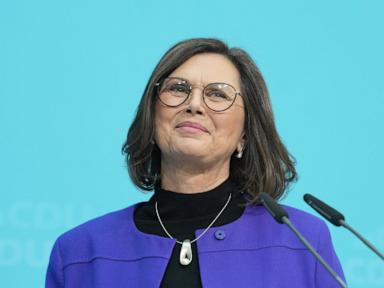
Angela Merkel ran Germany for sixteen years. Ursula von der Leyen heads the European Commission. Annalena Baerbock spent years shaping German foreign policy on the global stage. So when headlines broke about Germany finally getting its first female president, plenty of casual observers blinked in confusion.
Didn't they already have one?
No. Not even close. And if you confuse Germany's Chancellor with its Federal President, you're missing the entire point of how power actually works in Berlin.
Germany's governing coalition parties uniting around a former cabinet minister to become the country's first female Bundespräsidentin isn't just a ceremonial box-checking exercise. It's a massive political signal about consensus, historical blind spots, and who gets to represent the German state when domestic politics turn ugly.
The Power Split Most Outsiders Completely Miss
To understand why this nomination matters, you have to strip away American or French assumptions about what a president does. In Washington or Paris, the president runs the show. In Berlin, the president is the moral referee while the chancellor plays the game.
I've watched international commentators trip over this distinction during every single German election cycle. They treat the presidency like a consolation prize for retired politicians. That's a lazy read of the German constitution, known as the Grundgesetz.
After World War II, the drafters of West Germany's constitution had one overriding obsession: preventing another authoritarian takeover. They looked back at the Weimar Republic, where a directly elected president held sweeping emergency powers that helped dismantle democracy from within. Their solution was radical. They stripped the presidency of day-to-day executive authority and handed real governing power to the Chancellor and the parliament, the Bundestag.
Does that make the German president powerless? Hardly.
The president signs bills into law—and can refuse to sign them if they appear unconstitutional. They formally appoint and dismiss the chancellor and cabinet ministers. They represent Germany abroad at state visits, setting the diplomatic tone when coalition partners are bickering at home. Most importantly, they hold the bully pulpit. A well-timed speech from Bellevue Palace in Berlin can shift the national debate overnight, forcing parliament to confront issues politicians would rather bury.
Twelve men have held that office since 1949. From Theodor Heuss to Frank-Walter Steinmeier, every single one of them was male. For a country that prides itself on modernizing its political institutions, that seventy-seven-year streak had become an embarrassing anachronism.
Why Coalition Unity Around an Ex-Minister Changes the Math
Usually, picking a German president involves messy backroom horse-trading that drags on for months. The Federal Convention—known as the Bundesversammlung—doesn't even meet regularly. It's the largest parliamentary body in Germany, assembling solely to elect the head of state every five years. Half of its members come from the Bundestag, while the other half are delegates chosen by Germany's sixteen state parliaments. That second half isn't limited to career politicians; parties routinely nominate athletes, actors, scientists, and activists to score cultural points.
Because no single party ever wins an outright majority in modern German politics, winning the presidency requires building a broad coalition across ideological lines. When governing parties unite early behind a former minister, they're doing two things at once.
First, they're locking down the math before opposition parties—especially the far-right Alternative for Germany (AfD)—can turn the vote into a circus. In past conventions, fragmented party loyalties led to multiple rounds of voting and unexpected defections. Presenting a unified front eliminates that drama.
Second, choosing a former minister signals that the coalition wants someone who knows how the machine works. Academics and activists make great symbolic candidates, sure. An ex-minister knows where the bodies are buried. They understand constitutional guardrails, parliamentary procedure, and how cabinet ministries actually operate under pressure. When a crisis hits—whether it's a hung parliament after a fractured election or a constitutional standoff over budget rules—you don't want someone learning the rulebook on the job.
The Unspoken Political Calculation
Let's be honest about how Berlin operates. Nothing happens purely out of altruism.
Nominating a high-profile female ex-minister solves multiple headaches for a governing coalition simultaneously. It neutralizes criticism about gender representation at the highest ceremonial tier of the state. It rewards a veteran politician with immense institutional prestige while removing a potential rival from active party politics. And it projects stability to European allies and financial markets at a time when German economic growth and coalition cohesion have both faced relentless scrutiny.
Think about the contrast with Merkel's rise. Merkel had to claw her way through the male-dominated hierarchy of the Christian Democratic Union (CDU), outmaneuvering rivals who underestimated her at every turn. A consensus presidential nomination works the opposite way. It requires rivals to actively agree that one specific woman embodies the shared values of competing parties.
What the Presidency Actually Demands Behind Closed Doors
People love to talk about the ribbon-cutting. They rarely talk about the constitutional tightrope.
The Bundespräsident is legally barred from taking partisan sides once in office. The moment they take the oath, they suspend their party membership. For a former cabinet minister—someone whose entire adult life revolved around winning partisan arguments and defending party platforms—that psychological shift is brutal.
You go from fighting daily media battles to biting your tongue while former colleagues make decisions you might privately despise. Your weapon is no longer legislation. It's restraint.
Consider what happens when a German government collapses. Under Article 63 and Article 68 of the Basic Law, the president suddenly transforms from a ceremonial figurehead into the ultimate constitutional traffic cop. If a chancellor loses a vote of confidence, the president decides whether to dissolve parliament and call snap elections or keep the legislature intact. Those aren't hypothetical textbook scenarios. Germany has walked right up to that edge multiple times, and the president's judgment determines whether the country gets stability or chaos.
An ex-minister stepping into Bellevue Palace brings muscle memory for high-stakes governance. They've sat in cabinet rooms during late-night negotiations. They know how European Council summits unfold behind closed doors. Foreign leaders won't treat them like a ceremonial newbie because they've already negotiated across those exact tables.
The Historical Blind Spot Finally Closes
It's wild to think that Germany elected a female chancellor in 2005, saw women lead the European Commission, the Defense Ministry, and the Foreign Office, yet never once placed a woman in the nation's highest constitutional office.
Why did it take this long?
Part of the answer lies in how political careers used to be structured in post-war Germany. For decades, the presidency was treated as the crowning achievement for elder statesmen—men who had served as minister-presidents of federal states or senior cabinet leaders in the 1960s, 70s, and 80s. Because women were largely excluded from those top state and federal executive jobs until the late 1990s and 2000s, the pipeline of "elder stateswomen" simply didn't exist in the eyes of party power brokers.
That excuse expired years ago. By the 2020s, Germany had a deep bench of women who had run major ministries, led state governments, and steered national parties through crises. Continuing to pass them over for the presidency stopped looking like a pipeline issue and started looking like stubborn institutional inertia.
Even when women were floated as candidates in previous cycles—like Gesine Schwan in 2004 and 2009—they ran as opposition candidates without the backing of a governing majority. They were nominated to make a point, not to win. Uniting the governing coalition behind a female ex-minister flips that script entirely. It moves representation from symbolic protest to guaranteed executive reality.
How to Watch What Happens Next in Berlin
If you want to track whether this historic transition actually reshapes German politics or fades into polite ceremony, ignore the press releases and watch three concrete indicators over the coming months.
- Watch the Federal Convention vote margins. Compare the final tally against the governing coalition's theoretical seat count. If she wins comfortably on the first ballot with extra votes from opposition moderates, she enters office with genuine cross-party authority. If coalition delegates defect and force a second ballot, her moral leverage takes an immediate hit.
- Read her inaugural address to the Bundestag and Bundesrat. Every German president uses their first speech to stake out their core theme—whether that's democratic resilience, social cohesion, or European integration. Pay attention to what she criticizes without naming names. That's how German presidents signal where they'll apply pressure.
- Track her first foreign state visits. Where a new German president travels first isn't random. Visits to Warsaw, Paris, Kyiv, or Washington send deliberate diplomatic messages that complement—or subtly counterbalance—the chancellor's foreign policy priorities.
Germany's political system was built on the idea that no single person should ever hold unchecked power again. Placing a seasoned female former minister at the constitutional apex of that system doesn't rewrite the rules, but it finally brings the face of the German state into the twenty-first century.