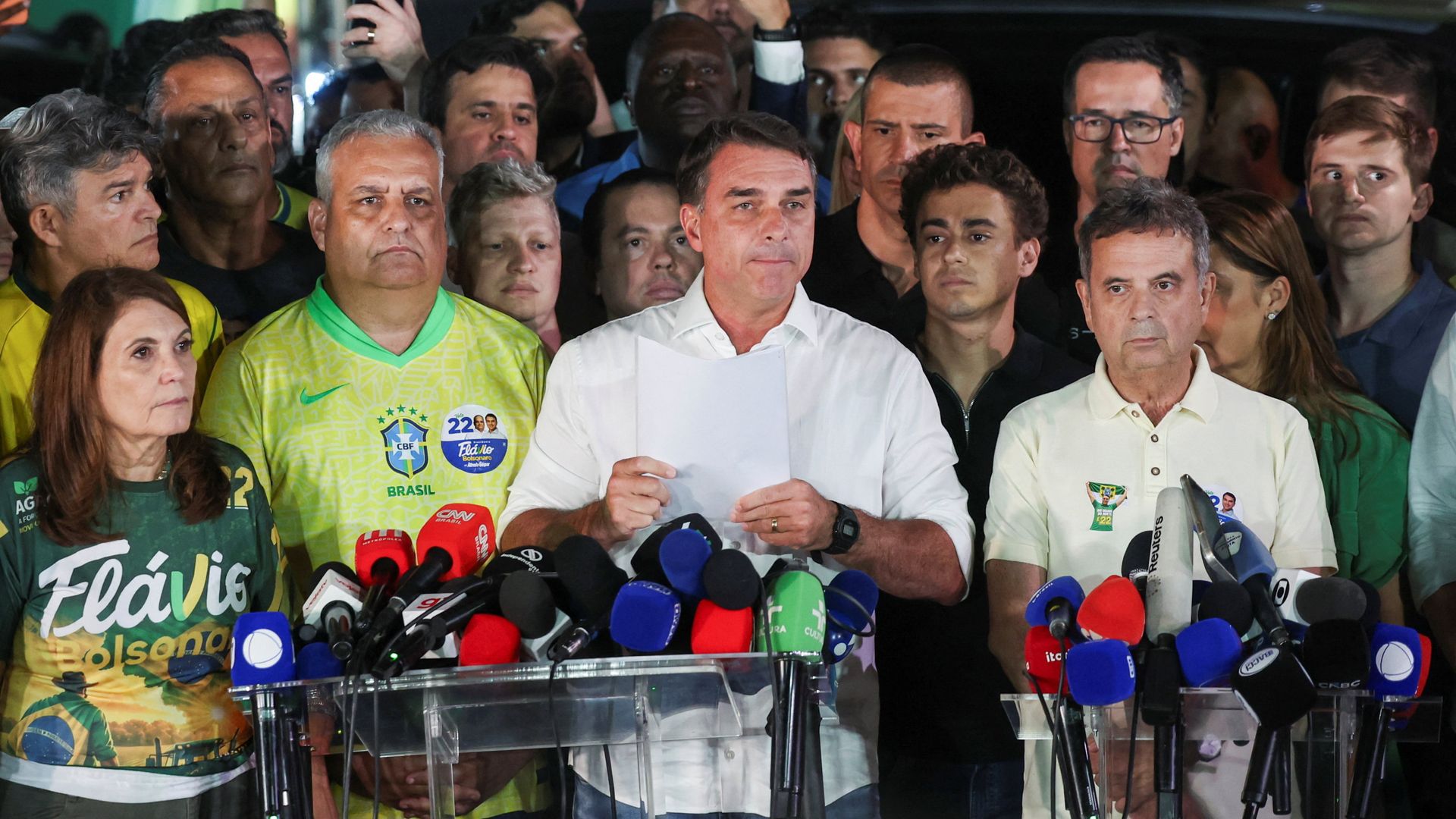
Most headlines treated the court order against Flávio Bolsonaro like an ordinary travel restriction. It wasn't. Within 48 hours of losing Brazil's October 25, 2026 presidential runoff to Luiz Inácio Lula da Silva, the defeated Brazilian presidential candidate was ordered to hand over his passports, had them canceled by Federal Police, slipped across a land border into Argentina, and touched down in Miami.
If you only read the surface-level wire reports, you missed the real story. People assume this was simply a sore loser dodging election fallout, or a straightforward political witch hunt by a rival administration. Both takes miss the actual mechanics of Brazilian judicial power, the multi-million-dollar financial probes closing in on him, and why crossing into Argentina by car was the only move he had left.
Why the Passport Handover Order Happened Hours After the Election
Flávio Bolsonaro lost the October 25 runoff with 48.2% of the vote against Lula's 51.8%, a margin of more than 4.4 million votes. By Monday morning, October 26, Supreme Federal Court Justice Alexandre de Moraes ordered the 45-year-old Rio de Janeiro senator to surrender both his Brazilian diplomatic and Italian passports within 24 hours.
Timing matters here. Candidates in Brazil enjoy strong political visibility during an active campaign, and courts tread carefully to avoid looking like they're tipping the scales before ballots are cast. Once the runoff ended and Superior Electoral Court President Kassio Nunes Marques confirmed the results, that political shield vanished overnight.
De Moraes didn't pull the travel ban out of thin air. He cited two overlapping pressures:
- Flight risk signals from inside the family. Flávio's brother, former congressman Eduardo Bolsonaro, had publicly suggested Flávio should leave Brazil if he lost. Eduardo knew what he was talking about—he was already living in the United States despite an outstanding Brazilian arrest warrant and a four-year prison sentence for judicial coercion.
- Active money-laundering investigations. Assigned to de Moraes via the Supreme Court's lottery system on October 16, the primary probe examines Flávio's financial ties to attorney Willer Tomaz and suspected money laundering routed through online betting platforms like Blaze.
Flávio filmed a video outside his father's residence claiming he had never planned to leave Brazil and would comply with the order. He didn't. When the 24-hour deadline expired on Tuesday morning without a single document turned in, Brazil's Federal Police revoked his passports and flagged immigration checkpoints nationwide.
Inside the Money-Laundering Probes Driving the Case
To understand why a sitting senator risked becoming an international fugitive rather than handing over two booklets, you have to look at the paper trail Federal Police investigators have been assembling. This isn't a vague political beef. It's a forensic accounting problem.
The Willer Tomaz and Online Betting Trail
Investigators in Rio Grande do Sul originally opened a file looking into illegal overseas money transfers tied to online gambling. That trail led them straight to attorney Willer Tomaz, who is accused of laundering more than $1 billion through an online betting scheme.
According to Federal Police findings reported by g1 and O Globo, the connection between Tomaz and Flávio Bolsonaro wasn't merely social:
- Police uncovered emails between Tomaz's secretary and a Santander bank employee indicating the two men shared an account under Alcazar Holdings, a firm owned by Tomaz.
- In the first half of 2025 alone, they took at least five international trips together—visiting South Africa, Portugal, France, and the United States—with Tomaz's company allegedly footing bills for Bolsonaro and his family.
- De Moraes's October 26 order explicitly barred Bolsonaro from contacting Tomaz, a standard anti-collusion measure when investigators suspect witnesses or co-targets might align their stories.
Both men deny sharing bank accounts or having improper financial ties. Still, once you lose the presidential race, you lose the executive leverage that might otherwise slow down a federal inquiry.
The Dark Horse Film Financing Mystery
Then there's the second investigation, which involves Dark Horse, a biographical film chronicling former President Jair Bolsonaro's political career. According to reporting by The Intercept Brasil, Flávio asked banker Daniel Vorcaro to steer 131 million reais (roughly $24 million) toward the project, with around 60 million to 61 million reais (about $11 million) actually paid out by May 2025.
Vorcaro was later arrested by Federal Police in November 2025 and again in March 2026 amid a broader corruption and financial fraud probe. When reporters first pressed Flávio on the banker's role in funding his father's biopic, he denied it—only to admit the payments months later on GloboNews, blaming a confidentiality agreement for his earlier silence.
Put those two cases side by side. Add the fact that Flávio's Senate term expires early next year, which strips away the special Supreme Court jurisdiction (foro privilegiado) that keeps sitting lawmakers out of lower trial courts. Suddenly, staying in Brasília looked a lot like walking into the same legal buzzsaw that put his father under house arrest on a 27-year coup-plot sentence.
How He Slipped Past a Nationwide Border Alert
Here is where the story turns into a logistics breakdown for Brazilian border enforcement. By Tuesday, October 27, Flávio's Brazilian and Italian passports were officially canceled in the system. Any attempt to board a commercial or private flight out of São Paulo, Rio de Janeiro, or Brasília would have triggered an immediate stop at Federal Police immigration desks.
So he didn't fly out of Brazil.
According to Argentina's National Directorate of Migration, Flávio crossed from Brazil into Argentina by land on Tuesday night alongside his wife and two daughters. Brazil shares a massive, porous land border with Argentina where Mercosur citizens routinely cross with minimal friction, and Brazilian Federal Police later admitted they had no official exit record for the senator.
Once across the border, the escape moved fast:
- In Argentina, Bolsonaro and his family boarded a private jet operated by Baires Fly—an aviation firm previously used by Argentine President Javier Milei—bound for Guayaquil, Ecuador.
- After a brief stopover in Ecuador, they caught an early Wednesday morning flight straight to South Florida.
- Just after 9:30 a.m. on October 28, cameras caught him stepping off a plane at Opa-Locka Executive Airport outside Miami and climbing into a waiting SUV.
The wildest detail? Public U.S. government records indicate he entered the United States presenting his canceled Brazilian diplomatic passport, backed by emergency visa clearance from the U.S. State Department. U.S. Customs and Border Protection inspected the family under standard immigration procedures and released them into South Florida.
The Geopolitical Fallout Between Washington, Brasília, and Miami
You can't separate this passport drama from the political alliance between the Bolsonaro family and President Donald Trump. On the very day Flávio fled, Trump told reporters he would approve of Bolsonaro coming to the United States, calling the Bolsonaro family "fine people" while casting doubt on Brazil's election and market reaction.
In Brasília, President Lula didn't hold back during his 81st birthday celebrations. "Those who have nothing to hide have nothing to fear," Lula told supporters, adding a sharp jab at the opposition dynasty's priorities—"Brazil is their second home; their first home is the United States."
Meanwhile, Flávio's abrupt exit blindsided his own party back home. Right-wing leaders in Brazil had urged him to concede gracefully and use his 48.2% vote share—plus a conservative majority in Congress—to lead a disciplined domestic opposition. Instead, from Miami, he initially published a social media letter declaring himself the "true president of Brazil" and "president-elect," before quietly editing the post to "leader of Brazil" after widespread mockery. By early November, he was speaking at a conservative conference at Mar-a-Lago, trying to maintain relevance from 4,000 miles away.
What Actually Happens Next in Extradition and Brazilian Law
If you're trying to figure out whether Flávio Bolsonaro will ever be forced back to Brazil, don't expect a dramatic extradition flight anytime soon. Legal scholars and practitioners tracking U.S.-Brazil extradition treaties point to several massive roadblocks that effectively shield him in Florida:
- No formal arrest warrant yet. Brazilian Federal Police clarified that defying a passport surrender order and breaching a travel ban don't automatically make someone a criminal fugitive subject to immediate arrest. Justice de Moraes would first need to escalate the infraction into a preventive detention order—a step that carries heavy diplomatic baggage.
- The political offense exception. The U.S.-Brazil extradition treaty explicitly bars extradition for political offenses or cases where the requested person faces politically motivated prosecution. Because Flávio frames every Supreme Court inquiry as partisan retaliation by de Moraes—and because the U.S. State Department actively facilitated his entry visas—Washington has every legal and political tool needed to reject a Brazilian extradition request.
- Dual criminality hurdles. For extradition to succeed, the alleged conduct must be a crime in both countries. Campaign finance disputes or complex Brazilian judicial coercion charges rarely map cleanly onto U.S. federal criminal statutes, giving defense lawyers years of appellate runway.
For anyone following Latin American politics or international legal disputes, keep your eyes on three concrete benchmarks over the next few months rather than social media noise:
- Watch the Federal Police indictment calendar in Brasília. If investigators file formal criminal charges over the Alcazar Holdings bank account or the Dark Horse payments before Flávio's Senate term expires early next year, the case stays at the Supreme Court; if not, it drops to a federal trial judge in Rio de Janeiro or Brasília.
- Track whether Justice de Moraes issues a preventive detention order. Until a formal arrest warrant exists in Brazil, Interpol Red Notices and U.S. extradition requests cannot even be triggered.
- Monitor Brazilian congressional leadership battles. With Flávio campaigning from Florida and Eduardo already sidelined in the U.S., rival governors and senators inside Brazil's right-wing bloc are actively carving up the movement's leadership ahead of future municipal and national cycles.
A passport handover order only works when the target respects the border fence—and when a neighboring country and a superpower aren't willing to leave the gate wide open.
Check out France 24's coverage on Flávio Bolsonaro's US visa and arrival for video footage and diplomatic context surrounding his departure from Brazil and entry into Florida.