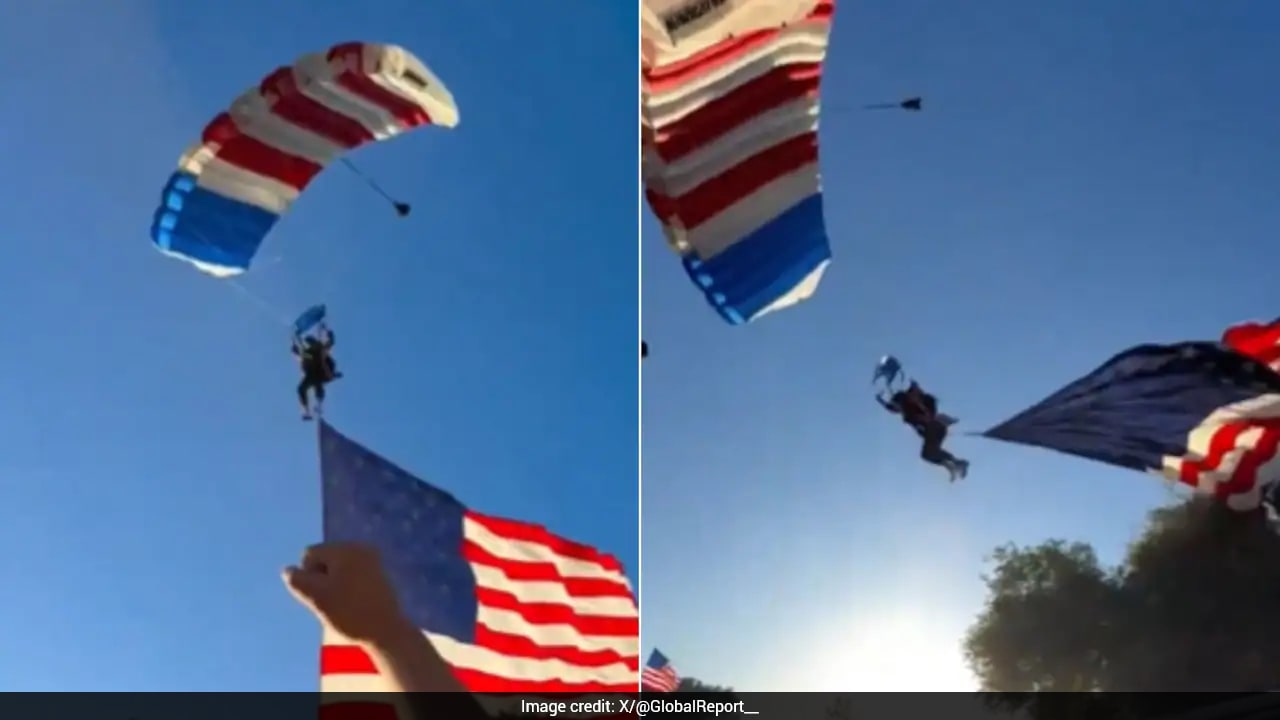
A massive American flag trailing behind a skydiver looks incredible from the ground. It catches the wind, ripples beautifully against the blue sky, and pumps up the crowd at stadiums or holiday events. But what looks like a smooth, patriotic glide is actually one of the trickiest, most exhausting stunts a professional parachutist can attempt.
The internet just got a vivid reminder of that reality.
During the 65th Folsom Pro Rodeo near Sacramento, California, a veteran skydiver named Ross Vail descended toward the arena. He was carrying a giant US flag as part of the Independence Day weekend festivities. Everything seemed fine until the final seconds of his descent. The low-hanging flag snagged a nearby tree. The sudden drag instantly jerked the canopy off course, sending Vail crashing face-first into a beer tent right next to terrified spectators.
Miraculously, Vail walked into the arena moments later to a standing ovation. He only suffered a cut lip and was back in the air the very next day.
While the viral video ended safely, it exposed the thin line between a flawless stadium landing and a disastrous accident. Most people assume the skydiver simply steers the parachute and the flag follows. That assumption is completely wrong.
The Physics of Drag and Why Big Flags Are Dangerous
Flying a massive banner changes the entire aerodynamic profile of a parachute system. It is not just extra weight. It acts like a giant anchor dragging behind the jumper.
When a skydiver jumps without a flag, they only worry about their body weight, the canopy size, and the wind. The moment you attach a 30-foot or 50-foot fabric banner, you introduce massive aerodynamic drag. This drag constantly pulls the jumper backward and downward. It changes the glide angle of the parachute, making the descent much steeper than normal.
To counteract this, jumpers use heavy lead weights at the bottom corner of the flag. Without these weights, the flag would bunch up into an unreadable knot. The weights force the flag to extend vertically and horizontally, presenting a clean image to the audience.
Think about the physical reality of that setup. You have a heavy weight hanging far below your feet, combined with hundreds of square feet of fabric catching air. It creates a pendulum effect. If the jumper makes a sudden turn, the flag swings out wildly. The pilot has to actively fight the weight of the flag to keep the canopy stable.
The real nightmare happens during the landing flare. As a skydiver approaches the ground, they pull down on the steering toggles to slow their forward and downward speed. This requires precise timing. When you add the drag of a huge flag, the canopy stalls much quicker. The margin for error shrinks to almost zero.
Trees Tents and Stadium Obstacles
Look closely at the Folsom Pro Rodeo incident. The skydiver did not misjudge his steering. The flag caught a tree.
Stadium and arena jumps are notorious among professional skydivers because of tight landing zones. A typical drop zone is a massive, wide-open field with no obstructions for hundreds of yards. A rodeo arena or football stadium is surrounded by grandstands, light poles, wires, trees, and vendor tents.
These structures do more than just block the path. They create invisible, chaotic air currents. Wind hitting the back of a grandstand or a row of trees creates mechanical turbulence. It forms rolling eddies of air that can drop a parachute ten feet in the blink of an eye.
When you fly a flag that hangs 40 feet below you, your personal clearance height changes completely. You might clear a tree by 20 feet, but your flag is dragging right through the branches. That is exactly what happened to Vail. The moment the fabric wrapped around the tree limb, it acted like someone slamming on the emergency brake on one side of the canopy.
The parachute spun instantly. With no altitude left to recover, the skydiver became a human pendulum, swinging straight down into the structural poles of a vendor tent. The tent collapsed, absorbing some of the impact energy. If he had hit the solid wooden rails of the rodeo arena or the metal grandstands instead, the outcome would have been vastly different.
The Secret Safety Mechanism You Didn't See
Every professional flag jumper utilizes a specific safety tool that rarely gets talked about. It is called a flag release system.
When a jump goes horribly wrong, the skydiver cannot afford to stay attached to a snagged banner. If the flag gets stuck in a tree at 200 feet, it will collapse the main parachute completely, resulting in a fatal fall. Because of this, the flag is connected to the jumper’s harness via a quick-release cable, often built with a three-ring release mechanism similar to the one used for cutting away a malfunctioning main canopy.
If the flag catches an obstacle at high altitude, the jumper pulls a handle, jettisons the flag, and saves their own life.
Why didn't Vail cut the flag away? Time and altitude.
The snag occurred mere feet above the ground. In skydiving, mechanical reactions take time. A human brain needs about a second to recognize an emergency, decide to pull a handle, and execute the physical motion. When you are flying at 25 miles per hour at an altitude of 15 feet, one second is the difference between being in the air and hitting the ground. Vail simply ran out of sky. He had to ride the impact out and trust his protective gear.
What It Takes to Perform a Demo Jump Safely
You cannot just grab a flag from a hardware store and jump out of a Cessna. The Federal Aviation Administration regulates these types of demonstration jumps heavily.
Jumpers performing at public events must hold an advanced license from the United States Parachute Association, usually a D-license, which requires a minimum of 500 jumps. On top of that, they need a specific PRO rating. This rating proves the skydiver can consistently land within a tiny target circle under high-stress conditions.
Training for flag jumps happens in stages.
- Stage One: The jumper starts with a small, unweighted streamer to get used to the feeling of something trailing behind them.
- Stage Two: They move up to a medium-sized flag with light weights, practicing turns and learning how the canopy reacts to the extra drag.
- Stage Three: They practice with full-sized exhibition flags in wide-open drop zones before ever attempting a public show.
Even with hundreds of practice jumps, the weather dictates everything. A gust of wind right at the moment of landing can ruin the best preparation. If the wind pushes the jumper slightly off the target line, they have to make a split-second choice: do they abort the arena landing and head for an open parking lot, or do they fight the wind and risk hitting an obstacle?
Surviving the Slam and Moving Forward
The fact that Ross Vail walked away from a face-first tent crash and jumped again the next evening tells you everything you need to know about the resilience of pro skydivers. They understand the risks, they wear the right protective gear, and they know how to take a hit.
If you are planning an outdoor public event or just attending one as a spectator, you need to understand the logistics of these aerial displays to stay safe.
For Event Organizers
- Clear the perimeter: Keep vendor tents, temporary stages, and high-profile equipment as far away from the designated landing zone as possible.
- Trim the vegetation: If the landing zone is bordered by trees, work with local arborists to trim low-hanging or protruding branches that could catch a trailing line or flag.
- Establish a hard wind limit: Set a strict maximum wind speed for the jump. If the gusts exceed 15 knots, call off the display. No crowd reaction is worth an injured performer.
For Spectators
- Stay behind the barriers: Never cross the safety ropes or fences into the landing arena, even if the skydiver looks like they are landing perfectly.
- Watch the flag, not just the jumper: If you see the flag getting close to a structure or tree, prepare to move. The skydiver will swing toward the point of the snag instantly.
- Keep paths clear: Ensure emergency access lanes around the arena remain completely open so medical personnel can move instantly if an accident occurs.
Aerial stunts will always draw crowds because they challenge the elements. But as the Folsom incident proved, gravity never takes a holiday, and even a minor asset like a trailing piece of fabric can completely change the physics of a landing in a fraction of a second. Keep your eyes on the sky, but always know where the nearest exit is.