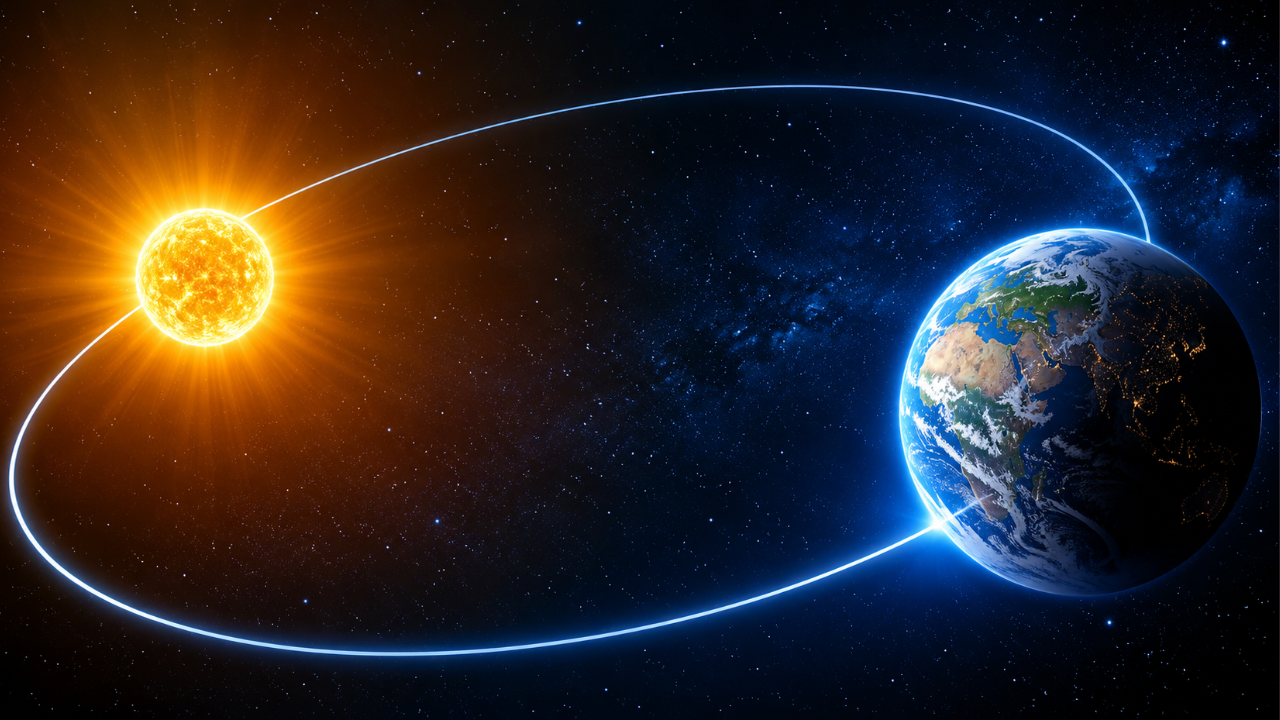
On July 6, 2026, our planet will quietly hit a major orbital milestone. At exactly 17:30 UTC, Earth will reach aphelion, the absolute furthest point from the Sun in its annual journey. At that moment, you will be roughly 94.5 million miles away from our solar system's central star. That is about 3 million miles further than we are in January.
Yet, outside your window, the asphalt is melting. Read more on a similar issue: this related article.
It feels entirely backwards. If you move away from a roaring bonfire, you get colder. If you step closer, you burn. Why does the planet defy this basic rule of thumb? The short answer is that space physics does not care about bonfire logic. The distance between Earth and the Sun does not dictate our seasons. If it did, the entire globe would freeze in July and roast in January. Instead, we have a beautifully uneven climate system driven by a planetary tilt that completely overrides our orbital distance.
[Image of Earth orbit showing aphelion and perihelion] Additional journalism by TIME explores similar perspectives on the subject.
The Big Illusion Of Our Planetary Orbit
Most school textbooks draw Earth's orbit as a long, stretched-out oval. It is a terrible visual shorthand that breaks our understanding of astronomy. In reality, Earth's orbit is almost a perfect circle.
Astronomers measure this flatness using a metric called eccentricity. A perfect circle has an eccentricity of zero. Earth’s orbital eccentricity sits at a tiny 0.0167. Because that number is so close to zero, our path around the Sun looks like a circle to the naked eye.
The 3-million-mile difference between our closest approach in January, called perihelion, and our July departure is just a drop in the cosmic bucket. It represents a variance of about 3.3 percent. While 3 million miles sounds like an impossible distance to a human driver, it is a minor wobble on an astronomical scale.
This small variation does alter the amount of solar radiation hitting the top of our atmosphere. When we are at aphelion on July 6, the planet receives about 7 percent less solar energy than it does during the January perihelion. The Sun even appears about 3 percent smaller in the sky, though your eyes cannot detect the difference without specialized solar filters. But that 7 percent drop in energy cannot compete with the raw power of Earth’s axial tilt.
The Real Reason You Are Sweating In July
The real engine behind summer heat is the 23.5-degree tilt of Earth's rotational axis. This tilt is fixed in space as we orbit the Sun. During July, the Northern Hemisphere leans directly toward the solar rays, while the Southern Hemisphere leans away.
Think about how light hits a flat surface. When the Northern Hemisphere tilts toward the Sun, solar beams hit the ground at a steep, direct angle. The energy concentrates over a tight surface area. It is intense. It stays focused on that patch of land for a long time because the tilt also lengthens our daylight hours.
Compare that to the Southern Hemisphere right now. The sunlight strikes the earth at a shallow, glancing angle. The exact same amount of solar energy spreads across a massive stretch of territory, diluting its power. That is why Buenos Aires and Sydney are experiencing winter jackets while New York and London deal with heat warnings.
The angle of the light matters infinitely more than the distance of the source. If you shine a flashlight straight down onto a table, you get a blinding, hot circle of light. Tilt that flashlight at a sharp angle, and the beam stretches into a dim, cool oval. July is simply the northern half of the planet standing directly under the flashlight.
Why Landmasses Make The Northern Summer Even Hotter
There is another piece to this puzzle that most amateur stargazers miss. The distribution of continents and oceans across our globe is completely lopsided.
The Northern Hemisphere contains the vast majority of Earth's landmasses. North America, Europe, Asia, and northern Africa dominate the top half of the globe. The Southern Hemisphere, by contrast, is overwhelmingly oceanic. It is dominated by the Pacific, Atlantic, and Indian oceans, with much less exposed land.
This matters because water and rock handle heat in entirely different ways. Land has a low heat capacity. It heats up incredibly fast when baked by direct sunlight, and it pumps that heat straight back into the lower atmosphere. Water has a massive heat capacity. It absorbs vast amounts of solar radiation without changing its temperature very much, storing the energy deep below the surface.
When the Northern Hemisphere tilts toward the Sun in July, all those massive landmasses absorb the intense, direct sunlight and heat up like an iron skillet. Even though the planet as a whole receives 7 percent less solar energy at aphelion, the northern continents run hot enough to raise the average temperature of the entire planet. Ironically, the global average temperature of Earth is actually higher in July when we are furthest from the Sun than it is in January when we are closest.
The Weird Timing Of The Actual Heat
If the summer solstice happens in late June, and aphelion hits on July 6, you might wonder why the absolute hottest days of the year usually land in late July or August.
This delay is called the lag of the seasons. It takes time for massive objects to warm up. Think about a brick oven. If you turn on the flame, the inside of the oven does not instantly hit maximum temperature. The bricks must absorb the heat energy over time before they start radiating serious warmth.
Earth operates on the same principle. The oceans, the thick atmosphere, and the deep rocky crust act as a giant thermal battery. Even after the Sun reaches its highest point in the northern sky during the June solstice, the planet keeps accumulating more heat energy during the long days than it can radiate back out into space at night. The system keeps building up energy through July. The peak temperature occurs weeks after the solstice, long after we have passed the aphelion marker.
How The Moon Messes With The Exact Date
You might notice that aphelion does not fall on the exact same calendar date or time every single year. Sometimes it is July 3, sometimes July 5, and this year it lands on July 6.
This variation happens because of the Moon.
The Earth does not orbit the Sun alone. It travels as a dual system with its lunar companion. Technically, the smooth elliptical path around the Sun is followed by the Earth-Moon barycenter, which is the common center of mass between the two bodies. Because the Moon is constantly tugging on Earth as it circles us every month, our planet loops and wobbles slightly around this center of mass.
Depending on where the Moon is in its monthly cycle when we approach the furthest point of our orbit, it can pull Earth slightly closer or push it slightly further away from the Sun. This celestial tug-of-war shifts the exact moment of maximum distance by a few days from year to year.
Tracking Solar Behavior This Month
Since you cannot feel the 107,000 kilometer-per-hour speed at which we orbit the Sun, or visually see the 3.3 percent drop in solar size, how can you engage with this orbital event?
You can track the physical impact of the solar angle yourself. Find a fixed object outside, like a fence post or a specific tree. Measure its shadow at local noon on July 6. Compare that shadow length to one taken at noon in October or December.
You will see that the July shadow is exceptionally short. This visual proof shows just how high the Sun is riding in the sky right now. That high angle is the smoking gun of summer heat. The sunbeams are piercing straight through a thinner layer of atmosphere to strike the ground with maximum intensity.
If you own a telescope equipped with a safe, certified solar filter, you can take a photograph of the Sun on July 6. Save that image. Take another photo with the exact same camera settings and telescope configuration in early January 2027 during perihelion. When you place the two images side by side, you will finally see the subtle 3 percent size change. The January Sun will look just a bit larger than the July Sun.
Do not let the summer heat catch you off guard while thinking about orbital distances. Keep your hydration levels high, understand that our atmosphere is currently storing massive amounts of energy, and enjoy the long July evenings. The planet will start its long slide back toward the Sun over the next six months, but the heat stored in our oceans and land ensures that summer weather will be sticking around for quite a while.