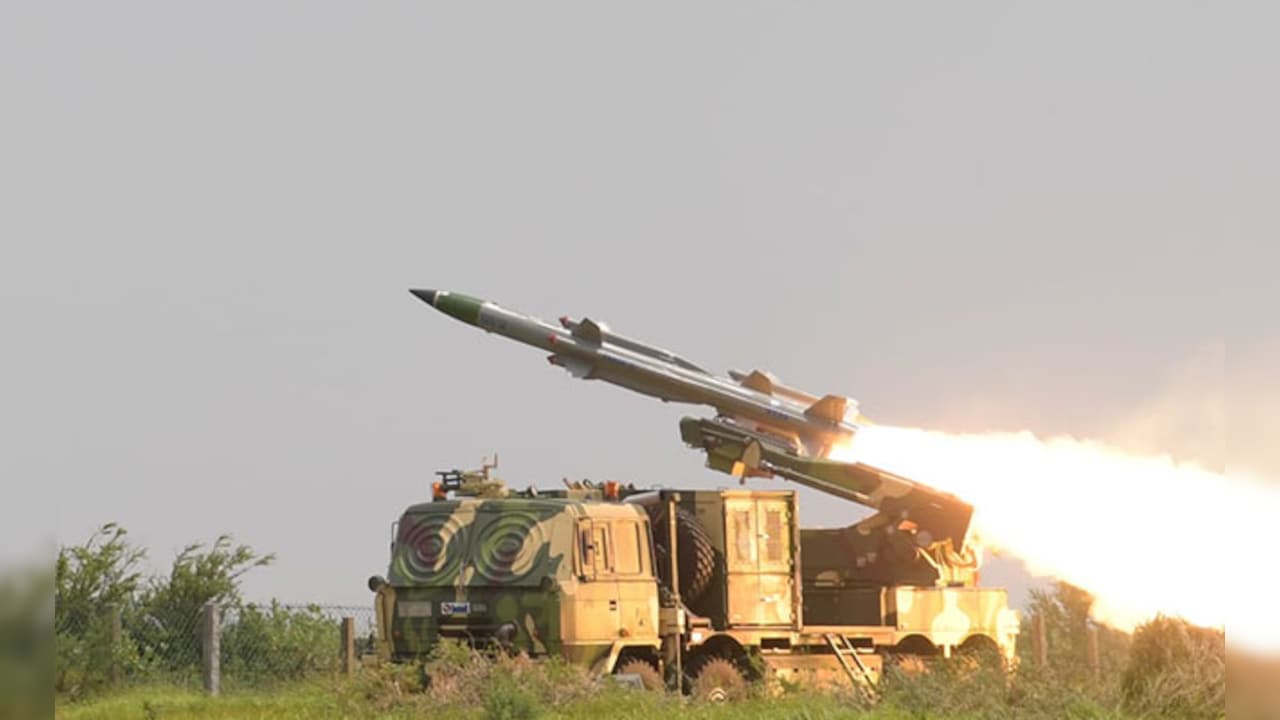
India has finally moved from being one of the world's top arms importers to a serious supplier of air defense hardware, yet exporting the Akash missile at scale still runs straight into a stubborn wall of commercial and institutional friction.
Look at the headline numbers and you'd think the champagne is already flowing. Defence exports climbed from Rs 686 crore in 2013-14 to a record Rs 38,424 crore in 2025-26 across more than 80 countries, while overall domestic defence production jumped from Rs 46,429 crore in 2014-15 to roughly Rs 1.78 lakh crore in 2025-26. On the surface, that looks like a clean lift-off.
It isn't that simple. Building a capable surface-to-air missile system is one thing. Turning it into a smooth, commercially bankable export engine for private factories and small suppliers is quite another.
The Akash Missile Export Momentum Is Real but Fragile
When India's Defence Secretary confirmed that the Akash missile had gone to Armenia first and then reached Tajikistan and Turkmenistan, it marked a genuine turning point. For years, critics wondered if indigenous air defense systems could win overseas buyers beyond polite exhibition interest. Having multiple batteries delivered to Armenia and exports reaching Central Asia proves that production has stabilized and foreign militaries are willing to buy.
Let's be honest about what Akash actually brings to a buyer's air defense grid. Developed by the Defence Research and Development Organisation (DRDO) and produced across state majors like Bharat Dynamics Limited and Bharat Electronics Limited alongside private partners, the system engages aircraft, helicopters, and drones across low-to-medium altitudes, with newer iterations like Akash Prime and Akash-NG pushing seekers, sensors, and range even further.
Winning an initial order proves technical credibility. Scaling into a repeat export franchise requires predictable delivery, spare parts, and upgrades that keep pace with modern aerial threats.
That's where the early euphoria runs into reality. Air defense isn't a one-and-done rifle sale. Buyers expect multi-year lifecycle support, training, integration with existing radars, and clear upgrade paths. A single export contract to a buyer in one region doesn't automatically unlock every market—geopolitics, competing Western or European air defense systems, and slow government-to-government negotiations still trip up deals.
Why Financing and Policy Friction Hold Back Exporters
Here's the problem that policy announcements rarely fix on their own: enthusiastic export targets don't automatically make an export deal easy to finance or execute.
Defence manufacturing is capital-heavy and unforgiving. Lead times are long, quality standards are strict, and payment milestones can stretch across years. Even when the Ministry of Defence pushes exports hard, lending institutions and financial mechanisms operate under their own rules, risk models, and procedural checks. Exporters end up caught in the middle, trying to match industrial ambition with practical working capital and export credit.
You can see this strain most sharply among smaller players. Thousands of micro, small, and medium enterprises (MSMEs) supply sub-assemblies, precision parts, electronics, and specialized engineering services. If an MSME has to tie up cash for months without clear, fast financing, it thinks twice before buying new machinery, hiring specialized engineers, or investing in its own intellectual property.
Throwing bigger credit numbers onto a slide deck won't solve that if the plumbing stays clunky. What actually moves the needle for a factory floor is faster turnaround, clearer risk-sharing rules, and alignment between export policy and day-to-day banking execution.
What Buyers and Suppliers Actually Watch Next
If you're tracking whether Akash becomes a long-term export pillar rather than a handful of standout deals, skip the press releases and watch three practical things:
- Repeat orders and sustainment: Watch whether early customers come back for follow-on batches, missiles, radar support, and modernization packages rather than treating their first purchase as a one-off.
- Supply-chain depth beyond prime contractors: Check how smoothly private partners and MSMEs scale sub-component output when domestic and export timelines overlap.
- Commercial bankability: Pay attention to how quickly exporters can access practical trade finance and credit lines without getting bogged down in red tape.
Practical Steps for Industry and Policy Watchers
If you work in defence supply chains, trade finance, or policy analysis, don't wait for another headline export figure to judge progress. Map out where capital gets stuck between contract signing and shipment, push for tighter coordination between defence export guidelines and financial institutions, and track how newer variants like Akash Prime and Akash-NG transition from trials to steady multi-customer production.
India Exports Indigenous Akash Missile System to Armenia
This video is relevant because it highlights the real-world export milestone of India's indigenous Akash air defense system to Armenia and shows the production ecosystem behind it.