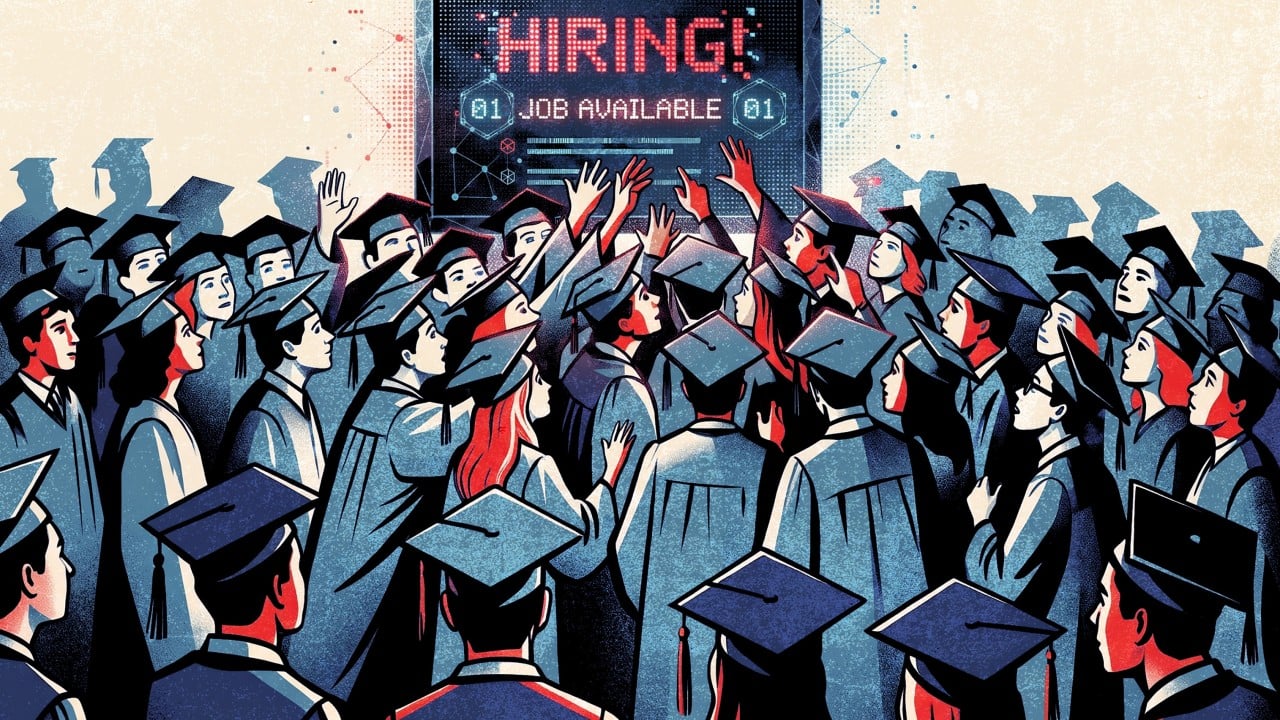
Walk onto a university campus in Bangkok, Kuala Lumpur, or Singapore right now, and you won't hear students bragging about competing job offers. You'll hear quiet panic.
Fresh graduates across the region are firing off hundreds of resumes into the void, watching entry-level postings shrink, and wondering if the degrees they just spent three or four years paying for are already obsolete. A recent South China Morning Post report captured that anxiety in stark terms, profiling young Southeast Asians—like Malaysian marketing graduate Nafeesa Azman and Singaporean animation diploma holder Joshua Nai—who watched AI tools absorb the exact junior tasks they trained to perform.
Here's what almost everyone misses about this crisis, though.
AI isn't actually wiping out Southeast Asia's graduate workforce at scale. Not yet. Something much sneakier—and honestly more dangerous—is happening instead. Companies aren't eliminating junior roles across the board; they're quietly rewriting what "entry-level" means while refusing to train people for the new standard.
The Bottom Rung Didn't Vanish It Just Got Raised Out of Reach
For decades, white-collar careers across ASEAN followed an unspoken social contract. You graduated with a degree, took a low-paying junior gig, and spent two years doing grunt work nobody senior wanted to touch. You formatted spreadsheets, drafted basic social media copy, fixed minor bugs, and summarized long industry reports.
It wasn't glamorous. It was an apprenticeship disguised as admin work.
Generative AI does that exact admin work in twelve seconds for pennies. And once managers realized a single mid-level employee with an AI subscription could outproduce three fresh hires, hiring freezes hit the exact roles designed to teach beginners the ropes.
Look at the numbers from Singapore's Ministry of Manpower. In March 2026, the city-state logged 32,800 entry-level professional, managerial, executive, and technician (PMET) vacancies. Sounds healthy, right? Dig one layer deeper, and nearly 80% of those "entry-level" listings demanded up to three years of prior work experience.
Read that again. Entry-level jobs now require three years of experience.
In Malaysia, the squeeze looks even sharper. Data from late 2026 shows routine administrative assistant roles dropping by 35%, data entry and processing work plunging 52%, and junior content writing openings contracting by 28% as multinational hubs in Kuala Lumpur and Penang automate routine workflows. Even traditional internships—long the main bridge into permanent employment—are drying up because software handles basic research and scheduling cheaper than an intern does.
So when fresh grads say they're terrified, they aren't imagining things. They're facing a broken ladder where the first rung now sits eight feet off the ground.
Why Headline Panic Overstates Mass Layoffs
If you only read viral threads on Reddit or doom-heavy headlines, you'd assume offices from Manila to Jakarta are already empty. The actual macro data tells a very different story.
In July 2026, the International Labour Organization (ILO) published a landmark study examining generative AI across ASEAN labor markets. Their headline finding surprised a lot of tech evangelists. While roughly 22.9% of ASEAN employment sits in occupations exposed to generative AI—representing nearly 80 million workers—only 3.3% falls into the highest-exposure tier. More importantly, the ILO found limited evidence of widespread job destruction so far.
In fact, employment in several AI-exposed sectors across Southeast Asia has kept growing.
Why the disconnect between macro stability and individual misery?
Because AI is attacking tasks, not whole headcounts. When a Singaporean bank or a Malaysian customer-support operation rolls out automated text and data tools, they rarely fire half the floor on Monday morning. Instead, they stop backfilling junior departures. They ask existing staff to spend less time drafting from scratch and more time auditing AI outputs, handling messy edge cases, and talking to frustrated clients.
Total headcount stays flat or edges up slightly. Meanwhile, the door slams shut on twenty-two-year-olds trying to get inside.
The Creative and Outsourcing Trap
Not every sector feels this squeeze equally. Two parts of Southeast Asia's economy are getting hit way harder than the regional averages suggest.
First, commercial creative fields. Look at what happened to Joshua Nai in Singapore, who finished a three-year polytechnic diploma in animation and game art only to walk away from gaming as studios leaned heavily on AI-generated assets. Across Southeast Asia, advertising agencies, local brands, and even public campaigns have rushed to replace junior illustrators, copywriters, and video editors with generative tools. If your portfolio consists of competent, mid-tier commercial art or generic marketing copy, you aren't competing against other graduates anymore. You're competing against a free prompt.
Second, the region's massive business process outsourcing (BPO) and back-office engine.
For twenty years, countries like the Philippines, Malaysia, and Vietnam built middle-class pipelines on global back-office work—customer support, data tagging, invoice processing, basic IT troubleshooting. In the Philippines alone, call centers and related BPO operations have employed well over 650,000 people. That entire value proposition relied on affordable, English-proficient young graduates executing repeatable cognitive tasks.
Now those exact tasks sit directly in the crosshairs of AI agents.
And here is where regional inequality turns brutal. Singapore has poured billions into continuous adult retraining through programs like SkillsFuture, giving its workforce a cushion. Indonesia has rolled out ambitious national targets to train 100,000 AI-skilled workers a year. Yet in economies where nearly 80% of workers operate in the informal sector—and where universities still grade students on rote memorization rather than messy problem-solving—graduates are walking into an automated market with 2015 skill sets.
Why Companies Are Quietly Sabotaging Their Own Future
Let's be honest about corporate short-sightedness here.
Every HR director in Bangkok, Manila, and Kuala Lumpur complains that fresh graduates lack critical thinking, commercial awareness, and independent judgment. They're right. Many Southeast Asian universities still reward textbook regurgitation over real-world execution.
I've watched hiring managers reject dozens of bright candidates because the applicants couldn't spot obvious flaws in a sample business case. Knowing how to prompt ChatGPT or Claude is no longer a differentiator—employers treat basic AI usage the same way they treat knowing how to open Microsoft Word. What companies actually pay for now is verification. Can you look at an AI-generated financial model, legal summary, or marketing plan and immediately see where it hallucinated, missed local cultural nuance, or misunderstood a customer's real pain point?
Here's the catch-22 employers refuse to admit.
How does a junior analyst learn to spot a broken financial model? By building forty models from scratch and getting red-lined by a senior manager. How does a junior marketer learn what actually converts customers in Ho Chi Minh City or Surabaya? By writing bad copy, running small tests, and watching real metrics fail.
When companies automate away all the repetitive junior work, they strip out the exact training ground that produces future senior leaders. They want five-year judgment from twenty-two-year-olds without paying for years one through four. It's a classic tragedy of the commons. Every firm wants to poach experienced talent from competitors while refusing to train entry-level staff themselves.
What Graduates in Southeast Asia Should Actually Do Now
If you're graduating in Southeast Asia over the next two years, waiting for universities or ministries to fix this won't pay your rent. You have to change how you position yourself before you ever submit an application.
Stop applying as a "generalist" who can write, research, or crunch basic numbers. Those buckets are dead. Instead, rewire your job search around four specific moves that hiring managers actually respond to:
- Build proof of judgment, not just output. Don't show a portfolio of generic articles, designs, or code snippets—everyone assumes an AI made them. Show before-and-after teardowns. Take a real local company's onboarding flow, ad campaign, or public financial report, run an AI analysis on it, and document where the AI got it wrong and how your human judgment fixed it.
- Target messy, high-context local workflows. Global AI models are fantastic at generic Western corporate English. They are still clunky with hyper-local dialects, regional regulatory quirks, physical supply chains, and relationship-heavy sales across ASEAN. Roles tied to field operations, client onboarding, local compliance, and cross-border B2B partnerships resist automation far longer than pure desk research.
- Become the workflow builder for small businesses. Multinational corporations are freezing junior hiring, but Southeast Asia runs on micro, small, and medium enterprises. In Indonesia alone, over 65 million MSMEs employ roughly 97% of the workforce, and most still run on WhatsApp messages and manual spreadsheets. Walking into a mid-sized regional logistics, retail, or healthcare firm and showing them how to automate their invoicing or customer follow-ups turns you from an expensive trainee into an immediate profit center.
- Skip the mass-application spray-and-pray. Sending 300 identical resumes through job portals puts you straight into automated applicant-tracking filters that reject anyone without three years of experience. Pick twenty growing regional companies, identify an obvious operational bottleneck they have, build a small working fix over a weekend, and email it directly to the department head.
The entry-level career ladder in Southeast Asia isn't coming back in its old form. Stop begging companies for a chance to do routine busywork that software already performs better, and start proving you can catch the expensive mistakes that software still makes.