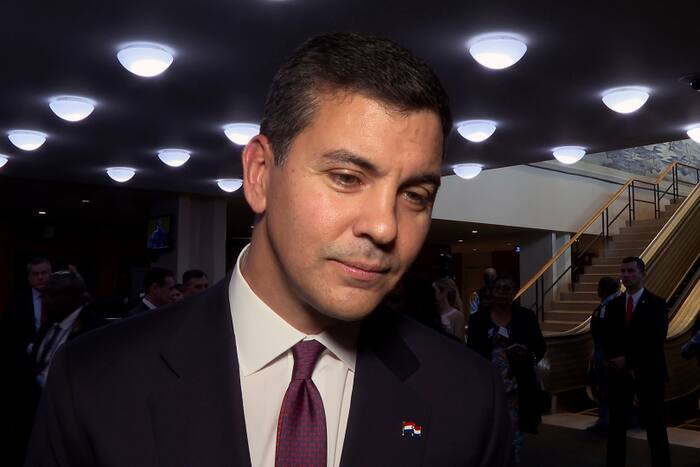
Getting arrested for a banking collapse that froze nearly three million accounts is bad enough. Getting caught working out in a custom-built private gym while awaiting trial is how you trigger a second political firestorm in ten days.
That's exactly what happened to former Paraguayan President Santiago Peña. On November 16, 2026, Guarantee Judge Osmar Legal ordered Peña transferred out of his comfortable quarters at the Presidential Escort Regiment and into the Viñas Cué military prison in Asunción. Photos released by Paraguay's Defense Ministry showed the once-untouchable leader arriving in handcuffs and a bulletproof vest—a stark visual downgrade from the air-conditioned suite he'd occupied since his impeachment.
The Detention Suite Scandal That Forced a Transfer
When Judge Legal initially ordered Peña into pretrial detention on November 7, authorities placed him at the Presidential Escort Regiment. In theory, holding a former head of state at a military base makes sense for security reasons. In practice, it quickly turned into an embarrassment for the new administration.
Local Paraguayan broadcasters, including ABC TV Paraguay and Latele, exposed what was actually happening inside the compound. Instead of a standard detention room, Peña was staying in a spacious suite outfitted with air conditioning, a large bed, a wardrobe, and a reception area. Even worse, military personnel had converted a historic meeting room inside the regiment into a private gym stocked with fitness equipment for his personal use.
Public outrage hit immediately. Thousands of ordinary Paraguayans couldn't access their life savings, yet the man accused of enabling the crisis was lifting weights in climate-controlled comfort.
New President Pedro Alliana didn't wait around to absorb the political damage. He fired the commander of the Presidential Escort Regiment. Defense Minister Óscar González confirmed that the dismissed commander had authorized the private gym installation without consulting his superiors, replacing him with Colonel Carlos Miguel Pérez Rodríguez. Judge Legal then issued an immediate transfer order to strip away any perception of VIP treatment.
What Life Looks Like Inside Viñas Cué Military Prison
Moving to Viñas Cué didn't put Peña in general population with violent offenders, because Paraguayan law still accounts for security risks facing former officials. Still, the contrast between his old quarters and his new cell is sharp.
According to Nicolás Narváez, Chief Justice of Paraguay's Supreme Military Court, the facility operates under strict uniform standards. Military authorities stressed that Peña receives no special exceptions and occupies a standard cell measuring roughly four meters by four meters.
- No private amenities. The custom gym equipment, reception rooms, and executive perks are gone.
- Strict security protocols. Judge Legal explicitly instructed prison authorities to enforce standard custody rules while safeguarding Peña's physical integrity.
- Standardized confinement. Military officials pushed back hard against media rumors of lingering favoritism, insisting he's treated like any other detainee held at the facility.
In late November, the Military Court confirmed minor procedural adjustments to his confinement terms—a routine legal step for pretrial detainees—but the message from Asunción remained clear. The era of soft-glove treatment ended the moment television cameras exposed that gym.
How the Ueno Bank Collapse Toppled Santiago Peña
To understand why a treadmill in a military barracks sparked national fury, you have to look at the sheer scale of the financial wreckage Peña left behind.
Peña, a former International Monetary Fund economist who pitched Paraguay as a low-tax, investor-friendly haven, saw his presidency implode in less than two weeks. The trigger was the November 3, 2026 intervention and insolvency declaration of Ueno Bank by Paraguay's central bank.
Launched as a digital brand in 2022, Ueno Bank grew at a pace that baffled regional economists. By June 2026, it claimed 2.9 million customers in a nation of roughly six million people—nearly half the entire population. It sponsored the national soccer team and became the poster child for Paraguay's modernization push.
Then the floor fell out. When the central bank declared Ueno insolvent, it froze accounts belonging to nearly three million retail customers alongside more than $850 million in public funds. Payrolls stalled. Small businesses couldn't pay suppliers. Families suddenly couldn't buy groceries.
Protesters flooded the streets of Asunción, clashing with police and demanding Peña's removal. On November 6—just three days after the bank went under—Paraguay's Senate voted to impeach and remove Peña for poor performance of his duties, swearing in Vice President Pedro Alliana as president.
Insider Loans, Hidden Vaults, and Criminal Charges
Most banking collapses involve bad bets or macroeconomic shocks. Prosecutors say this one involved deep conflicts of interest right at the top of the executive branch.
Peña held an ownership stake in Ueno's parent company until 2025. After taking office, he appointed Carlos Carvallo—Ueno's former chairman—to serve as president of Paraguay's central bank, the exact institution responsible for regulating Ueno. Carvallo and three former bank executives have also been arrested and charged in the investigation, though Carvallo's legal team claims he recused himself from regulatory decisions involving his old employer.
As prosecutors dug deeper, the details grew even harder for Peña's defenders to explain away:
The Mansion Raid and False Wall
On November 10, Paraguayan prosecutors raided properties linked to Peña and Carvallo. Investigators allege Peña's luxury residence was financed partly through roughly $577,000 in loans granted by Ueno while he was sitting president. During the search, agents discovered a hidden vault concealed behind a false wall.
Cross-Border Money Tracing
Paraguayan authorities aren't just looking locally. Prosecutors have formally requested financial intelligence assistance from the United States, Luxembourg, and Argentina to track funds suspected of being diverted out of Ueno before its collapse.
Criminal Allegations
Peña faces charges including criminal association and breach of trust (lesión de confianza). He has denied all wrongdoing and even petitioned Paraguay's Supreme Court to annul his Senate impeachment, arguing the removal process violated constitutional norms.
What Happens Next for Depositors and Paraguay's Legal Case
While Peña fights his detention from a four-by-four-meter cell, millions of Paraguayans are still trying to figure out when they'll see their money again.
If you're following how this crisis plays out for everyday savers and international investors, watch three concrete developments over the coming weeks:
- Deposit Guarantee Payouts. Paraguay's state deposit guarantee fund caps automatic coverage at 75 minimum monthly wages—roughly 228.3 million guaraníes (around $30,000 to $35,000 depending on exchange rates). Small retail depositors are covered up to that ceiling, while larger savers, pension funds, and institutions face a long liquidation battle to recover anything above the cap.
- Mutual Fund Redemptions. Regulators and central bank officials have rolled out staggered redemption mechanisms—such as weekly payout caps of up to 30 million guaraníes for certain Ueno mutual fund unit holders—to ease liquidity panic without draining remaining reserves overnight.
- Supreme Court and Extradition/Asset Rulings. Keep an eye on responses from Washington and Luxembourg regarding diverted funds. If foreign banking records confirm offshore transfers tied to senior officials, Peña's legal team will have almost no room left to argue this was merely a routine commercial bank failure.
For a deeper look at how the Ueno Bank scandal unfolded and led to his detention, check out Paraguayan President Ousted for Corruption Detained in 'Suite' with Gym, which breaks down the initial broadcast reports exposing his quarters.



