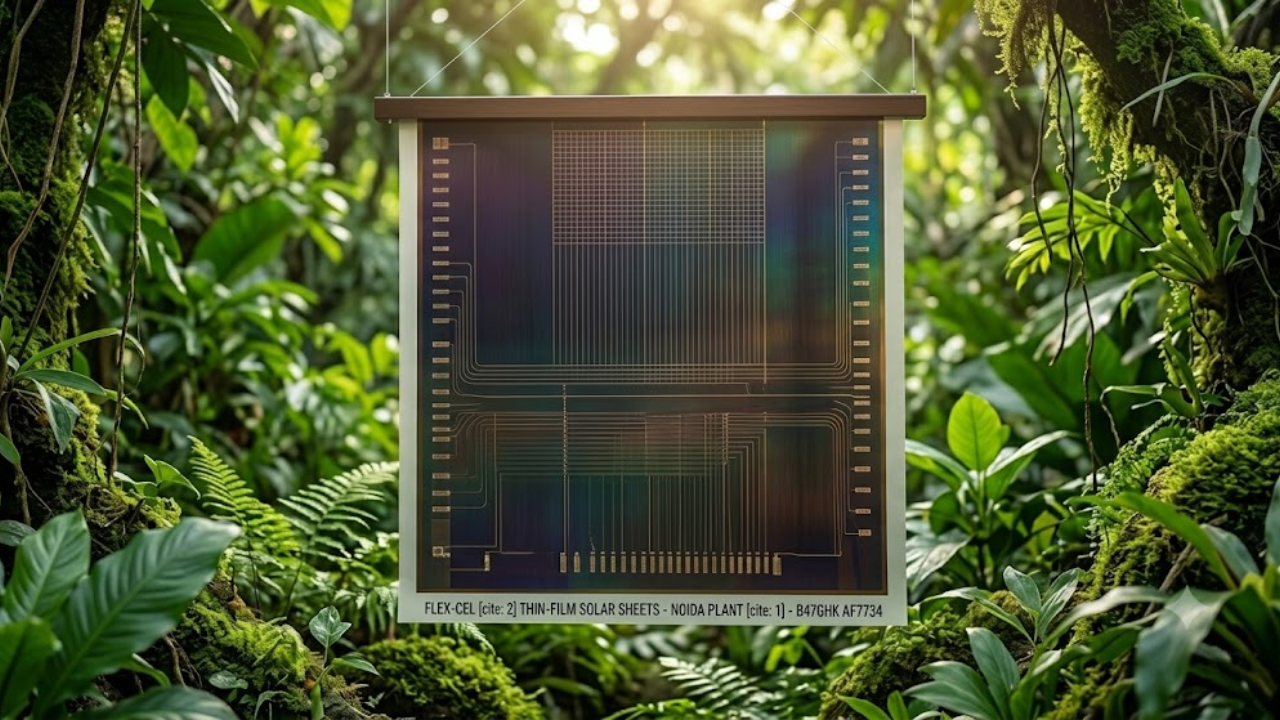
Japan is betting heavily on a novel way to generate electricity using perovskite solar cells printed on flexible surfaces, a technology often likened to printing newspapers. By coating thin plastic films with light-absorbing iodine compounds, researchers have created solar sheets that are lightweight, pliable, and capable of generating power even under weak, indoor light. Yet, while the prospect of wrapping entire city skyscrapers in power-generating paper sounds like an instant fix for the green transition, the underlying manufacturing and chemical realities present a far more difficult road to commercial viability than tech optimists admit.
The Anatomy of the Paper Solar Promise
To understand why this technology has captured the imagination of industrial planners, one has to look at the limitations of traditional silicon solar panels. Silicon is heavy. It requires rigid glass casing, heavy aluminum frames, and intensive structural support. You cannot place heavy silicon arrays on the rooftops of older, structurally delicate buildings, nor can you bend them around the curved facades of modern architectural designs.
Enter perovskites. This class of materials possesses a specific crystalline structure that excels at absorbing sunlight while remaining incredibly thin.
[Image of perovskite solar cell structure]
Instead of the energy-intensive high-temperature baking required to refine silicon, perovskites can be dissolved into liquid inks. These inks are then applied to flexible plastic substrates using roll-to-roll processing—the exact same high-speed printing method used for daily newspapers.
The physical appeal is undeniable. A square meter of these printed cells weighs a mere fraction of a standard silicon panel. They can theoretically be stuck to windows, wrapped around utility poles, or integrated into the outer fabric of backpacks. Because Japan imports virtually all of its silicon and lacks the vast open land required for massive utility-scale solar farms, the government has poured billions of yen into local perovskite development. They see it as a national security imperative to turn every urban surface into a micro-generator.
The Degradation Problem We Aren't Talking About
The enthusiasm fades quickly when you look at the chemistry. Silicon panels are boring, but they are exceptionally durable. A standard silicon array installed today will easily last twenty-five to thirty years while maintaining most of its original efficiency. Perovskites, by contrast, are notoriously unstable.
The very chemical structure that makes perovskite so efficient at capturing light also makes it highly sensitive to the environment. When exposed to moisture, oxygen, and ultraviolet light, the material begins to break down. This is not a slow, multi-decade decline. Without highly advanced protective packaging, early-generation perovskite cells can degrade in a matter of months, or even weeks.
- Moisture vulnerability: Water molecules easily penetrate the crystalline lattice, causing the active layers to decompose into their constituent parts.
- Thermal instability: The materials struggle to maintain structural integrity under the high heat generated by constant exposure to direct summer sunlight.
- Chemical leaching: Many of the most efficient perovskite formulations contain small amounts of water-soluble lead. If a cell cracks or degrades outdoors, there is a risk of toxic heavy metals washing into the local soil and water supply.
To combat this, manufacturers must seal the printed solar sheets in highly sophisticated barrier films. This requirement introduces a massive paradox. The moment you add heavy, expensive protective polymer coatings to keep moisture out, you compromise the thinness, flexibility, and low-cost profile that made the printed cells attractive in the first place.
The Manufacturing Bottleneck and Scale Illusion
Proponents of newspaper-printed solar panels point to the sheer speed of roll-to-roll printing as a guarantee of cheap, abundant energy. Printing presses can churn out miles of material in a single shift. But printing text on newsprint is vastly different from depositing nanometer-thin, defect-free layers of active semiconductor materials.
In a laboratory, scientists can carefully control the crystallization of perovskite inks on tiny, postage-stamp-sized samples. Scaling this up to a continuous roll that is several feet wide introduces massive quality control hurdles. If there is a single microscopic bubble, dust particle, or uneven patch of thickness along a hundred-meter roll, the entire batch can fail.
Furthermore, the efficiency of these cells drops significantly as the surface area increases. While small lab cells have achieved efficiency rates exceeding 25%, larger, commercially printed modules often struggle to surpass 15%. When you combine lower efficiency with a shorter operational lifespan, the lifetime cost per kilowatt-hour of printed solar begins to look far less competitive against cheap, mass-produced Chinese silicon panels.
The Silicon Monopoly and Geopolitical Friction
We must also look at the geopolitical arena. China currently controls over 80% of the global solar supply chain, particularly the refining of polysilicon and the manufacturing of silicon wafers. Japan’s push into printed perovskites is a deliberate geopolitical maneuver to bypass this monopoly. Since Japan is one of the world's leading producers of iodine—a key ingredient in perovskite chemistry—the country has a natural domestic supply chain advantage.
However, building an entirely new industrial ecosystem from scratch is an uphill battle. Silicon manufacturers are not standing still. They are constantly driving down costs and even developing "tandem" cells that layer perovskites on top of traditional silicon to boost efficiency. This leaves printed, paper-thin solar in a precarious market position. It must carve out a niche where flexibility and ultra-light weight are absolutely non-negotiable, rather than trying to compete head-to-head with utility-scale power grids.
The dream of paper-thin solar powering our world is compelling, but the road to commercial viability is blocked by fundamental materials science. Until researchers can engineer a perovskite cell that resists moisture and heat without relying on heavy, expensive encapsulation, these printed sheets will remain a specialty product for niche applications rather than the dominant force of our energy infrastructure.