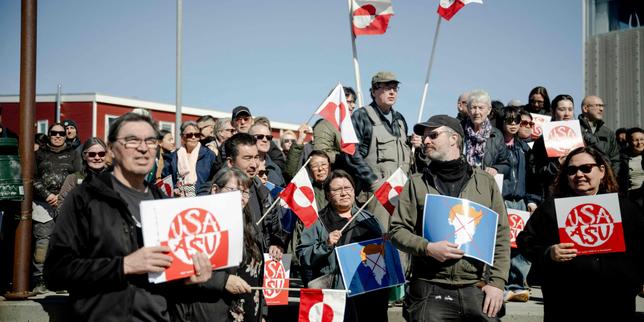
The mainstream media loves a predictable David versus Goliath narrative. When protesters gathered in Nuuk to march against the shiny new US consulate, the press rushed to print the standard script. They painted a picture of an innocent Arctic community bravely resisting the neo-imperialist tentacles of Washington. They treated Donald Trump’s infamous bid to buy Greenland as an isolated bout of madness, and the reopened American consulate as the Trojan horse executing a slow-motion corporate takeover.
It is a comforting, simplistic fairytale. It is also entirely wrong.
The lazy consensus ignores the cold, hard mechanics of Arctic sovereignty. Activists and commentators screaming about American encroachment are missing the real shift happening right under their feet. The reopening of the US consulate in Nuuk is not the beginning of American colonization. It is the only thing preventing a far more ruthless, asymmetric colonization from the East.
Greenland cannot survive in a vacuum. For Nuuk, the choice was never between absolute independence and American influence. The choice is between a transparent, treaty-bound security alignment with the West, or becoming an economic vassal state to Beijing.
The Sovereignty Illusion: Nuuk's Dangerous Myth
Let’s dismantle the foundational lie of the anti-US protests: the idea that Greenland can simply be left alone.
Greenland controls its domestic policy, but Denmark still handles its foreign affairs and defense. Nuuk dreams of full independence. It is a noble ambition, but one that is economically untethered from reality. The Greenlandic economy relies heavily on an annual block grant from Denmark, which covers roughly half of the government's budget.
To replace that money, Nuuk must exploit its vast mineral wealth, including rare earth elements, uranium, and zinc. But mining in the Arctic requires astronomical capital, highly specialized infrastructure, and massive geopolitical backing.
When the US pulled back its diplomatic presence after the Cold War, a vacuum emerged. Who rushed to fill it? Not Europe. China.
Imagine a scenario where a state-owned enterprise from a country with no respect for human rights or local autonomy bankrolls your entire national infrastructure. That is not a thought experiment; it is the exact playbook used across Sub-Saharan Africa and the South Pacific via the Belt and Road Initiative.
Before Washington woke up, Chinese state-backed companies were aggressively bidding to build three massive international airports in Greenland, including the ones in Nuuk and Ilulissat. They were positioning themselves to control the literal entry points to the island. It was only after intense pressure from Copenhagen and Washington—who saw the blatant security risk—that the Danish government stepped in with financing to block the Chinese bids.
If you are marching in Nuuk against an American diplomatic office that employs a handful of bureaucrats, you are functionally campaigning for the corporate dictatorship of the China Communications Construction Company.
The Hypocrisy of the Resource Argument
Critics claim the US consulate is just a scouting office for American mining conglomerates looking to strip Greenland of its resources. This argument is economically illiterate.
I have spent years analyzing resource extraction deals in high-risk zones. Western mining giants are paralyzed by ESG metrics, strict environmental regulations, and shareholder activism. If an American company wants to mine Neodymium or Praseodymium in Greenland, they face a decade of environmental impact assessments, litigation, and public scrutiny.
Compare that to the alternative.
+------------------------+--------------------------+----------------------------+
| Metric                 | Western Mining Outfits   | State-Backed Competitors   |
+------------------------+--------------------------+----------------------------+
| Environmental Scrutiny | High (ESG Bonded)        | Low / Non-existent         |
| Local Labor Mandates   | Strict Compliance        | Imported Labor Camps       |
| Geopolitical Strings   | Regulated by Treaties    | Debt-Trap Diplomacy        |
+------------------------+--------------------------+----------------------------+
When the Shenghe Resources Holding Co. acquired a massive stake in the Kvanefjeld rare earth project in southern Greenland, it wasn't subject to the oversight of a democratic electorate. They brought a blueprint that involved processing materials elsewhere, leaving the environmental liabilities firmly on Greenlandic soil.
The American presence does not accelerate exploitation; it creates a regulatory and geopolitical counterweight. It forces any extraction conversation to happen under the lens of Western legal standards.
Dismantling the People Also Ask Nonsense
The public discourse surrounding this issue is littered with fundamentally flawed premises. Let's correct the record on what people are actually asking about this conflict.
Can the US force Greenland to host military bases?
This question assumes the Year is 1951. Under the updated frameworks of the Thule Air Base (now Pituffik Space Base) agreements, and the broader 2003 Igaliku Declaration, nothing happens without Nuuk’s consultation. The US cannot simply seize land or expand its footprint via executive fiat. The diplomatic mission in Nuuk is designed to facilitate more direct communication with the Greenlandic government, bypassing the traditional detour through Copenhagen. It gives Nuuk a seat at the table, rather than treating them as a colony.
Why is the US suddenly interested in Greenland again?
The premise here is that American interest is a sudden whim driven by a tweet. The reality is climate change and physics. As the Arctic ice recedes, the Northern Sea Route and the Northwest Passage are becoming viable global shipping lanes.
More importantly, Russia has spent the last decade systematically militarizing the Arctic, reopening Soviet-era bases, and testing nuclear-powered cruise missiles in the region. Greenland sits squarely in the GIUK (Greenland-Iceland-United Kingdom) gap, the naval choke point crucial for North Atlantic defense. To ask why the US is interested is like asking why a homeowner is interested in a fire breaking out next door.
The Cost of the Counter-Intuitive Approach
Let’s be brutally honest about the downside of aligning with Washington.
Accepting American protection means Nuuk permanently aligns itself with the targets on America’s back. It means accepting that your waters will be patrolled by hunter-killer submarines and your airspace monitored by early-warning radar systems. It means your domestic political decisions regarding mining and infrastructure will always be viewed through the unforgiving lens of Pentagon strategy.
It is restrictive. It is frustrating. It compromises the romantic ideal of pure, unblemished sovereignty.
But the alternative is an absolute illusion. In the modern Arctic, sovereignty is an expensive luxury item. If you cannot defend your own coastline, and you cannot fund your own budget without foreign capital, you are going to be aligned with someone.
Stop Protesting the Consulate, Start Leveraging It
The protesters marching through Nuuk are using an outdated 20th-century anti-imperialist playbook to solve a 21st-century resource war. They are treating a diplomatic building as an occupying army while ignoring the quiet, financial maneuvering of authoritarian states that would gladly turn Greenland into an unmonitored open-pit mine.
The American consulate is the greatest piece of leverage Greenland has ever been handed.
Instead of demanding its closure, the Greenlandic government should be using it to demand massive investments in local education, direct American capital for green infrastructure, and ironclad guarantees for local labor on any defense projects.
Washington is terrified of losing the Arctic. They are willing to pay a premium for stability and access. Nuuk should be squeezing every single cent out of that anxiety.
Stop playing the victim in a narrative that doesn't exist. The Americans are at the door, and they brought a checkbook because they are scared of who else might walk through it. Open the door, sit down at the desk, and dictate the terms.