The Court of Appeal just handed down a ruling that should make every activist, trade unionist, and civil liberties advocate in Britain deeply uncomfortable.
On Monday morning, a five-judge panel led by Lady Chief Justice Sue Carr completely overturned a February High Court decision. They ruled that the British government’s decision to ban the direct-action group Palestine Action under terrorism legislation was entirely lawful.
By reinstating the proscription, the court didn't just target one radical group. It quietly greenlit a massive expansion of state power. For the first time in modern British history, a group primarily focused on domestic, non-violent property destruction and civil disobedience has been legally lumped into the same category as ISIS and al-Qaeda.
If you think this stops with anti-weapons protesters, you're missing the bigger picture. This ruling shifts the goalposts for what the state can label "terrorism."
What the Court of Appeal Decided
The legal battle over Palestine Action has been bouncing through the courts since last year. The group was officially proscribed under the Terrorism Act 2000 following a string of high-profile actions. Activists routinely targeted UK-based facilities owned by Elbit Systems, an Israeli defense firm, and even broke into a Royal Air Force base in June 2025 to protest British military support for Israel.
In February, three senior High Court judges pulled the emergency brake. They ruled that while Palestine Action clearly engaged in criminal damage, banning them entirely under terror laws was an unlawful and disproportionate restriction on free speech and assembly.
The Court of Appeal just threw that logic out the window.
Lady Chief Justice Carr stated that the High Court "materially understated" the latitude the Home Secretary has when making these decisions. She argued that Palestine Action isn't a transparent, public protest movement like the suffragettes. Instead, she described it as a covert organization operating with secret cells to destroy third-party property.
The panel concluded that the future risks to national security and corporate property outweighed the group's rights to freedom of expression under Article 10 and freedom of assembly under Article 11 of the European Convention on Human Rights.
The Real Numbers and the Chilling Effect
Let's look at what this looks like on the ground. The state has weaponized this ban with terrifying efficiency.
Since the proscription took effect, over 3,300 people have been arrested in connection with protests defying the ban. Think about that number. It is higher than the total number of arrests made during the peak years of the post-9/11 "War on Terror" in the UK.
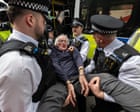
The vast majority of these arrests aren't for breaking into factories or sabotaging machinery. More than 700 people have been charged under Section 13 of the Terrorism Act simply for holding placards that read: "I oppose genocide, I support Palestine Action."
Holding a piece of cardboard is now a terror offense that can land you in prison for up to six months. If you are actually a member or financial supporter of the group, you face up to 14 years behind bars.
Even Lady Chief Justice Carr admitted the law would create a "chilling effect." She acknowledged that law-abiding citizens might feel deterred from showing up to peaceful rallies or voicing anti-Israel views out of fear that their actions could be construed as support for a banned group. But the court decided that this massive collateral damage to free speech was a price worth paying.
Moving the Goalposts on Terrorism
The biggest mistake you can make right now is thinking this is strictly about Palestine or the defense industry.
Historically, Britain's terror laws were designed to stop mass casualty violence—bombings, assassinations, and systemic campaigns of terror. Palestine Action’s tactics rely heavily on red paint, sledgehammers, and locking themselves to factory gates to disrupt assembly lines. Just last week, four of their activists were hit with massive sentences totaling over 20 years for causing £1.2 million in damage at an Elbit site, with the judge tacking on extra time specifically because of a "terrorism connection."
By validating the use of the Terrorism Act against property destruction, the state has built a beautiful tool to crush any disruptive social movement.
Think about who else uses these tactics. Climate activists block roads and paint buildings. Animal rights groups raid labs and industrial farms. Radical union groups blockade ports. Under the logic of this ruling, if a future Home Secretary decides that Just Stop Oil or Extinction Rebellion poses a significant enough threat to corporate infrastructure, they can use this exact precedent to outlaw those groups overnight.
The moment you accept that property damage equals terrorism, you give the government the right to criminalize the entire network of people surrounding a movement. Your uncle who donates £5 to a crowdfunder, the student printing leaflets, the person holding a sign at a rally—they all become terrorists in the eyes of the law.
The Legal Battle Isn't Over
Huda Ammori, the co-founder of Palestine Action who launched the original judicial review against the ban, has made it clear she isn't backing down. The group plans to appeal this decision directly to the UK Supreme Court, and if necessary, to the European Court of Human Rights in Strasbourg.
But legal battles take years. In the meantime, the ban remains fully active, and hundreds of paused criminal cases against peaceful placard-holders will now move forward through the courts.
If you want to protect the right to protest in Britain, you need to understand the mechanics of this ruling and act accordingly.
First, look very closely at the campaigns you support. If you're organizing or attending rallies, understand that displaying logos, naming, or explicitly backing Palestine Action carries genuine, immediate legal risk of arrest under the Terrorism Act. Focus your public dissent on the broader, explicitly legal issues: the arms trade, foreign policy, and the right to peaceful assembly.
Second, put direct pressure on your local MPs. The Home Secretary’s power to proscribe organizations is incredibly broad and relies on a rubber-stamp process in Parliament. Demand to know where your representatives stand on the use of anti-terror legislation against political protest groups.
The state didn't just ban an activist group on Monday. It redefined dissent. If we don't pay attention to how these laws are expanding, we won't have the right to fight back when they're inevitably turned on the rest of us.