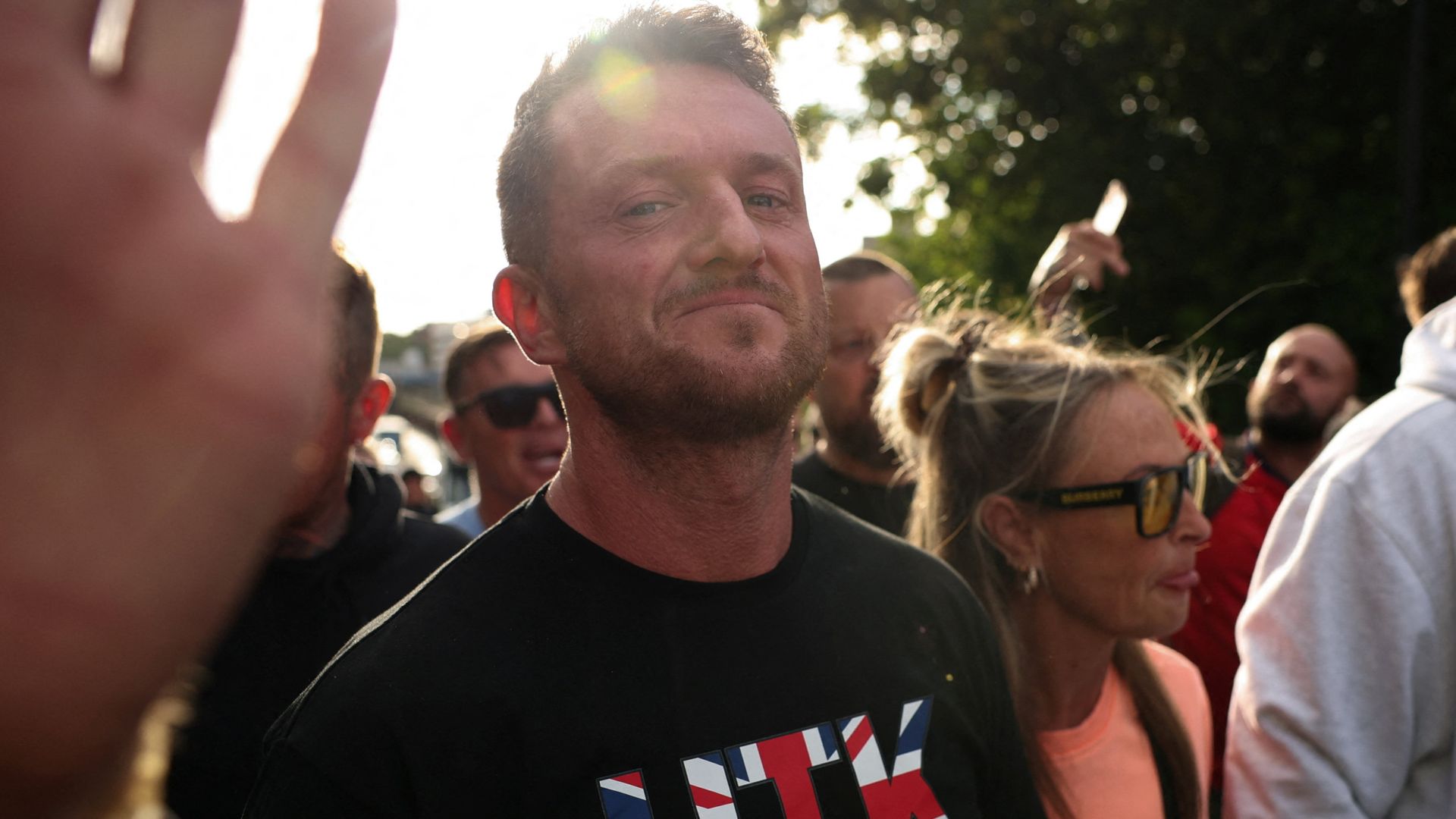
The media freak-out over the Oxford Union inviting Tommy Robinson to debate the "suspicion" of Islam is a masterclass in missing the point.
Journalists are wringing their hands over platforming, radicalization, and student safety. They treat the 193-year-old institution like a fragile glass house on the verge of shattering because a far-right instigator is stepping through the doors.
They have it completely backward. The threat to the Oxford Union isn’t that Tommy Robinson might speak. The threat is that the Union is so intellectually bankrupt, so desperate for relevance, and so divorced from its historical purpose that it needs to resort to cheap tabloid booking tactics to get anyone to look at it.
I spent years navigating the high-stakes world of elite political consulting and university lecture circuits. I’ve watched student societies transform from grueling intellectual testing grounds into lazy, content-generation engines for social media. The outcry over Robinson isn't a debate about free speech. It is a symptom of an institutional death spiral.
The Lazy Consensus on Platforming Misses the Real Scam
The dominant narrative across major news outlets follows a predictable, exhausted script. Activists demand a cancellation. The Union invokes free speech and John Stuart Mill. The police brace for protests. Everyone gets to roleplay an epic struggle for the soul of Western democracy.
It is a theatrical performance. Here is what the mainstream analysis conveniently ignores:
- The Mutual Parasitism: Tommy Robinson needs elite institutions to validate his grievance narrative. The Oxford Union needs controversial figures to validate its claim to relevance. It is a transactional marketing swap masquerading as an intellectual exercise.
- The Devaluation of Debate: A real debate requires a shared acceptance of baseline facts. When an institution invites an agitator whose brand relies on distorting those facts, it isn't "testing ideas." It is hosting a circus and calling it a symposium.
- The Safety Smoke Screen: University administrators use "student welfare" as a legal shield to avoid taking a stand on institutional quality. They frame the issue around physical safety because they are too terrified to judge intellectual merit.
When you break down the mechanics of the modern Oxford Union, you realize they are no longer in the business of rhetoric. They are in the business of outrage monetization.
Dismantling the Great Free Speech Delusion
Let’s tackle the central myth that the Union’s leadership loves to deploy: the idea that the only way to defeat bad ideas is to drag them into the light of the chamber.
"The remedy for speech that is false is more speech, not enforced silence." — Louis Brandeis, US Supreme Court Justice (Whitney v. California, 1927)
It is a beautiful sentiment. It is also completely obsolete in the digital age.
Brandeis lived in a world of information scarcity. If you wanted to counter a lie in 1927, you had to speak up because the lie occupied finite physical space in a newspaper or a town square. Today, we live in a world of information hyper-abundance.
When you bring a professional algorithm-manipulator into a traditional debating chamber, you are not engaging in "more speech." You are bringing a knife to an ecosystem fight. The chamber's rules—structured arguments, point of information, timed rebuttals—are designed for people playing the same sport. Robinson isn't playing the sport. He is filming content for his digital channels.
Imagine a scenario where a university math department invites a flat-earther to debate a geophysicist to "prove the earth is round." The department doesn't look noble; it looks ridiculous. It lowers the institutional standard of truth. By treating a baseline prejudice as a debatable proposition, the Union has already surrendered its primary asset: its prestige.
People Also Ask: The Flawed Premises of Campus Free Speech
The public discourse around campus debates is choked with bad-faith questions that lead to even worse answers. We need to dismantle these premises entirely.
Does canceling speakers protect marginalized students?
No. The premise that a speech in a private club directly inflicts systemic harm on a student body is an oversimplification pushed by administrative bureaucrats. What it actually does is insulate students from the reality of the political landscape they will inherit.
The real world is hostile, chaotic, and uncurated. Shielding students from ugly rhetoric inside a university chamber does nothing to prepare them to dismantle that rhetoric in the public square. The protectionist model turns universities into ideological cruise ships instead of training camps.
Is the Oxford Union legally obligated to host everyone?
Absolutely not. The Union is a private, independent member's club, not a public utility. It has the legal right to invite whoever it wants, which means its choices are entirely aesthetic and financial.
When the Union invites a shock-jock or an extremist, it isn't upholding a constitutional duty. It is making a programming choice. Stop treating their speaker list as a barometer of liberty; it’s a reality TV lineup.
Can bad ideas be defeated by debating them?
Only if both sides risk losing. A professional provocateur cannot lose an Oxford Union debate. If the audience votes against his motion, he tells his followers that the "elite establishment" rigged the room against him. If he wins, he claims victory over the intelligentsia.
When an opponent enters a room with a win-win scenario based entirely on their own victimization, the debate is dead before the first gavel drops.
The High Cost of Outrage Engagement
Institutions like the Oxford Union are suffering from a severe case of audience capture. They have mistaken YouTube views and Twitter impressions for cultural impact.
[Traditional Prestige Model] -> High Intellectual Quality -> Elite Reputation -> Influence
[Modern Outrage Model]      -> Controversial Booking    -> Viral Backlash    -> Web Traffic
I have watched legacy organizations take this exact shortcut. It works beautifully for about eighteen months. You book the controversial figure, the clips go viral, your subscriber count spikes, and the student officers get to feel like they are at the center of the universe.
But there is a hidden tax. Every time you chase the cheap algorithmic high of a controversial booking, you alienate the serious thinkers, the policymakers, and the genuine experts who refuse to share a stage with a circus act. Over time, your pool of speakers degrades. You stop being the place where prime ministers launch policies, and you become the place where internet grifters film their next grift.
The Union used to be a crucible where future leaders learned how to govern. Now, it is an incubator where future influencers learn how to trend.
The Playbook for Real Intellectual Dominance
If an institution actually wants to challenge the status quo rather than just exploit it for clicks, it needs a completely different operational playbook.
- Enforce Absolute Intellectual Prerequisites: Stop debating premises that have been settled for a century. Raise the barrier to entry for the chamber. If a speaker cannot sustain an argument based on peer-reviewed data or established legal frameworks, they don't get the microphone. This isn't censorship; it's editorial standard.
- Kill the Spectator Sport Format: The traditional "This House Believes" format encourages performative tribalism. Replace it with adversarial, long-form cross-examination. Don't let a speaker deliver a polished, pre-written monologue to a room of cheering or booing partisans. Put them under a spotlight with a hostile, expert interlocutor for two hours with zero audience interruption allowed. Watch how fast the bravado evaporates.
- Own the Financial Downside: Real intellectual independence costs money. If your society relies on viral clips to pay the electricity bill, you are a slave to the algorithm. Cut the administrative bloat, stop trying to scale your brand globally, and return to being a localized, high-density intellectual community.
Stop Defending the Empty Shell
The tragedy of the Tommy Robinson debate isn't that a right-wing populist is going to speak at Oxford. The tragedy is that anyone still expects the Oxford Union to matter.
The critics who protest outside the building are operating under the delusion that the Union is still the prestigious, gatekeeping institution of the 1980s. It isn’t. It is a content house with wood paneling. It is an old brand name being worn like a costume by ambitious students who want to juice their LinkedIn profiles before entering corporate law.
Stop treating the Union's decisions as a crisis of democracy. Stop giving them the free publicity they are explicitly fishing for with these invitations. If you want to defeat the grift, you don't censor it, and you don't debate it under tuxedo-clad rules. You look at the empty spectacle, you call it exactly what it is, and you turn around to build something better.


