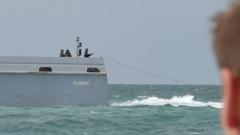
Another day, another manufactured political circus over routine military posture. The headlines scream about politicians demanding answers over a French Navy firing drill, framing a standard operational exercise as an unprovoked escalation or a reckless diplomatic blunder. The lazy consensus in the mainstream press is simple and comforting to those who prefer their geopolitics sanitized: military exercises near contested or sensitive maritime zones are provocative chest-beating that risks accidental war.
It is a completely inverted way to look at reality.
I have spent years watching defense budgets get slashed, operational readiness erode, and politicians panic the second a fleet actually operates like a fleet instead of a floating museum. When a navy stops practicing live-fire capabilities under realistic friction, it stops being a military and becomes a coast guard with delusions of grandeur. The real scandal is not that the French Navy is running high-stakes drills. The scandal is that anyone expects them to apologize for doing their jobs.
The Comforting Illusion of Bloodless Deterrence
We live in an era that desperately wants to believe deterrence is a concept managed entirely through polite communiques and economic sanctions. Bureaucrats love paper treaties because they can be drafted in air-conditioned rooms and measured in quarterly reports. Warships, on the other hand, are messy, loud, expensive, and designed for one brutal purpose: breaking things and killing people if diplomacy fails.
When critics pearl-clutch over a live-fire drill, they reveal a profound misunderstanding of how credibility works in the physical domain. Deterrence is not a static state. It is an active performance. If you do not test your weapon systems, your communications architecture, and your crews under duress, your adversaries notice.
Competitors like China and Russia do not calculate Western resolve by reading press releases or listening to parliamentary inquiries. They watch ships at sea. They measure reaction times, radar signatures, and ordnance expenditure rates. A French frigate executing a live-fire drill without asking for permission from every easily offended regional actor is a rare reminder that sovereignty requires teeth.
"A military that tailors its training schedule to avoid offending diplomatic sensibilities has already lost the operational initiative."
Dismantling the Escalation Fallacy
The core argument against these drills rests on a tired premise: that displaying military capability causes the very conflict it is meant to prevent. This security dilemma narrative sounds sophisticated in university lecture halls, but it collapses under the weight of historical precedent.
History does not show us that peace is preserved by lowering your guard to look harmless. It shows us that aggression thrives in the vacuum of perceived weakness. When the Royal Navy or the Marine Nationale scales back exercises to appease domestic critics or nervous foreign ministries, hostile actors do not reciprocate with de-escalation. They interpret it as an invitation to probe further.
Imagine a scenario where a carrier strike group or an amphibious readiness group cancels its live-fire routines because a local lawmaker worries about market volatility or diplomatic friction. Within six months, freedom of navigation operations turn into polite requests for permission. Within a year, contested zones become de facto exclusion areas dictated by whoever is willing to use actual force.
The French Navy knows this math. That is why they train how they fight, even when the political class loses its collective mind over the noise.
The Professional Reality of Fleet Operations
Let us talk about what actually happens during a modern naval firing drill, stripped of the dramatic rhetoric found in cable news segments.
Operating a modern surface combatant is not like driving a car. The sensors, combat management systems, and kinetic interceptors require constant calibration in varied sea states and electromagnetic environments. You cannot simulate the thermal signature of a live missile launch on a simulator in Toulon. You cannot train crews to manage the adrenaline spike of incoming threat vectors by reading a manual.
Here is what the critics miss about readiness metrics:
- Muscle Memory Under Load: Crew proficiency degrades astonishingly fast. Without live-fire repetitions, reaction times drift from seconds to minutes. In modern warfare, minutes mean you are on the ocean floor.
- Logistics Stress Testing: Firing live ordnance forces supply chains, armory management, and maintenance teams to execute under real pressure.
- Interoperability Friction: NATO and allied integration relies on shared operational doctrines that must be tested with live hardware, not just digital pings.
When politicians demand answers over a firing drill, they are demanding that military professionals prioritize political comfort over survival. That trade-off is unacceptable.
Why the Political Class Prefers Performative Hand-Wringing
Why do figures like desktop strategists and reactive members of parliament make such a fuss over routine exercises? Because performance outrage is cheap.
Criticizing a military drill requires zero fiscal commitment, zero strategic foresight, and zero understanding of naval architecture. It allows politicians to signal moral superiority to constituents who have never heard the deafening roar of a 76mm naval gun firing at full cyclic rate. It transforms complex geopolitical realities into a simple morality play where the military is the unruly guest crashing a peaceful dinner party.
We need to stop treating military readiness as an optional luxury that can be switched on and off depending on the current diplomatic climate. Deterrence is high-maintenance. It requires iron, fire, and the willingness to make people uncomfortable.
The French Navy did not cause a crisis by firing weapons in international waters. They simply reminded a sleeping public that the world outside our borders is still governed by power, not committee meetings.
Stop asking why the fleet is training for war. Start asking why anyone ever expected them to do anything less.


