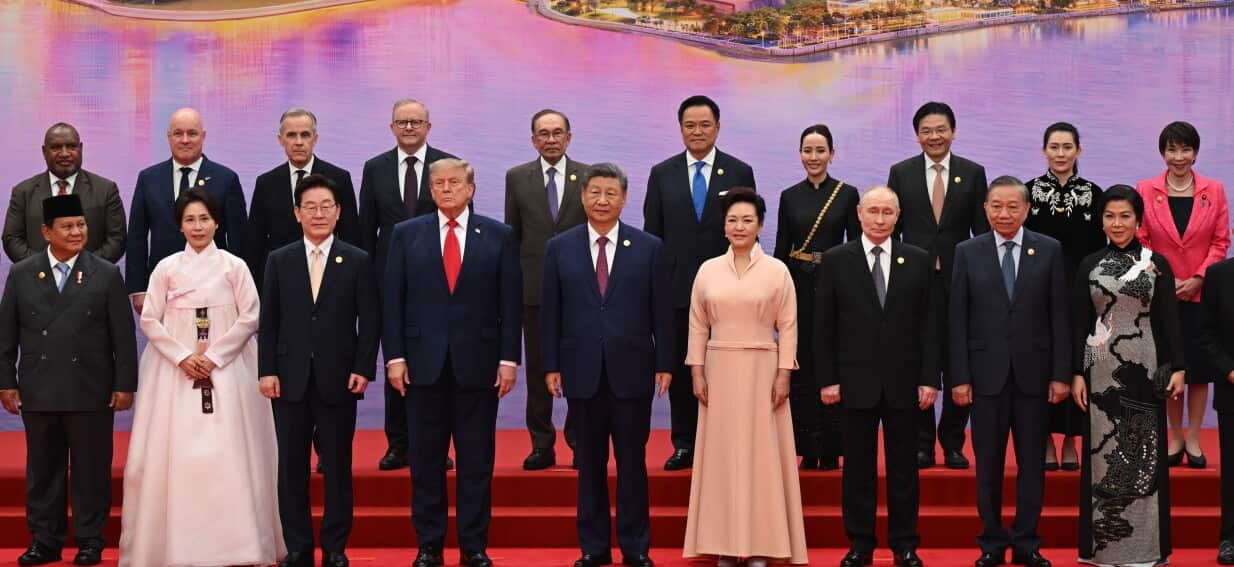
The predictable uproar over a single group photograph at the 2026 Asia-Pacific Economic Cooperation (APEC) summit in Shenzhen reveals a fundamental misunderstanding of how middle-power diplomacy actually functions. When Australian Prime Minister Anthony Albanese stood in the back row for the traditional leaders' gala portrait alongside Russian President Vladimir Putin, Chinese President Xi Jinping, and U.S. President Donald Trump, critics immediately framed the moment as a moral failure.
According to reports from The Guardian and The Independent, representatives of Australia’s Ukrainian community and political commentators urged Albanese to boycott the photo opportunity to avoid normalizing Putin's presence on the world stage. That critique rests on a seductive but flawed premise: that physical absence from a ceremonial photograph constitutes meaningful geopolitical leverage. It does not. In reality, walking off the risers in Shenzhen would have achieved zero strategic benefit for Kyiv while actively undermining Canberra's core diplomatic objectives in the Indo-Pacific.
The Optics Trap Versus Diplomatic Reality
Modern foreign policy commentary frequently confuses performative symbolism with actual power. I have watched dozens of diplomatic summits play out over the last two decades, and the pattern never changes: domestic audiences obsess over seating charts, handshakes, and group photos, while the real negotiations happen in bilateral side-rooms out of camera range.
To understand why Albanese stepped onto that stage, you have to look at the mechanics of multilateral forums. APEC—an intergovernmental forum of 21 member economies established to promote free trade across the Asia-Pacific—operates on consensus and institutional continuity, not ideological purity. Russia is a formal member of APEC. Boycotting a host-nation gala photo organized by Beijing does not isolate Moscow; it insults the host and sidelines the boycotting nation.
Consider the actual context of the November 2026 summit in Shenzhen:
- The Trilateral Dynamic: Trump, Putin, and Xi used the sidelines of the Shenzhen gathering to sign a joint four-point declaration, signaling a concert of major powers calibrating global influence.
- Regional Friction: Beijing used summit protocol aggressively to reward or punish regional players—welcoming some leaders with airport ceremonies while giving Japanese Prime Minister Sanae Takaichi a notably cool reception over her parliamentary remarks regarding Taiwan.
- Australia's Position: Canberra spent years repairing stabilized trade ties with China, its largest trading partner. Handing Beijing a gratuitous protocol snub over a routine group photo would have damaged Australian economic interests without removing a single Russian soldier from Ukrainian soil.
Answering the Wrong Question
Most coverage asks whether Albanese "normalized" Putin by standing in the same frame. That question is completely backward. Vladimir Putin was already standing next to the leaders of the world's two largest economies, Donald Trump and Xi Jinping. The presence or absence of an Australian prime minister in the back row does not alter Putin's international standing by a fraction of a millimeter.
The real question is simpler: What is the most effective way for a middle power like Australia to advance its security interests when major powers are rewriting the rules?
As The Guardian noted in its post-summit analysis, Albanese did not go to Shenzhen to flatter Moscow; he used the forum to publicly call for an end to global conflicts and insist directly that Ukraine must have a say in its own future. You cannot deliver uncomfortable messages in the room if you refuse to enter the building because you dislike the photography schedule.
Why Boycotts Fail for Middle Powers
Diplomats call it the empty chair syndrome. When a superpower walks out of a room, the room stops and takes notice. When a middle power walks out of a room, the major powers simply divide the remaining seats and keep talking.
Imagine a scenario where Albanese had boycotted the APEC leaders' photo. For twelve hours, he would have earned praise from editorial boards in Sydney and Melbourne. Meanwhile, inside the Shenzhen convention center, the United States, China, and Russia would have continued drafting declarations and shaping regional trade architecture without Australian input.
Real statecraft requires separating principled material support from empty theatrical gestures:
- Material Deterrence: Sanctions, defense aid, intelligence sharing, and economic alignment with allies impose real costs on an aggressor. Australia has committed substantial military and financial assistance to Ukraine since 2022.
- Institutional Presence: Showing up at APEC, the G20, and the East Asia Summit ensures that smaller and mid-sized nations maintain a voice against spheres-of-influence politics where large powers decide the fate of smaller neighbors.
- Bilateral Realism: Managing friction with Beijing requires disciplined protocol. Burning diplomatic capital on a photo boycott leaves zero capital left for actual trade or security disputes.
The Honest Downside of Pragmatism
Does staying in the frame carry a cost? Yes, and pretending otherwise would be dishonest. Authoritarian leaders thrive on visual propaganda. State media in Moscow routinely crops and circulates multilateral summit photos to convince domestic audiences that Russia remains an accepted, central pillar of global governance. Every democratic leader who appears on those risers inadvertently provides raw footage for Kremlin television.
Furthermore, for Ukrainian Australians whose families are enduring daily bombardment, seeing their prime minister within yards of the man responsible for that war is genuinely painful. Acknowledging that emotional reality is essential.
Yet foreign policy cannot be run on emotional optics alone. As classical realist thinkers like Hans Morgenthau argued decades ago, statesmen must judge policies by their political consequences rather than their moralistic purity. If the choice is between handing Russian state television ten seconds of B-roll footage or ceding diplomatic ground in Asia to Beijing and Moscow, any competent prime minister takes the photo and gets back to work.
How to Judge Foreign Policy Without Falling for Clickbait
Stop evaluating international diplomacy through cropped screenshots. The next time a summit photograph triggers a wave of moral outrage, apply three filters before reacting:
- Check the venue rules: Was this a bilateral endorsement, or a mandatory protocol line-up at a multilateral organization where membership is fixed?
- Follow the tangible assets: Look at weapons deliveries, sanctions enforcement, and trade agreements—not body language on a stage.
- Ask who benefits from an absence: If a democratic leader walks away from a major Asian summit, Beijing and Moscow gain an uncontested microphone.
Diplomacy is rarely photogenic. Judging a nation's foreign policy by a group portrait is like judging a surgeon's skill by the color of their scrubs. Watch the actions, track the alliances, and ignore the camera flash.
For further context on the political debate surrounding the summit, watch this broadcast segment on Albanese defends family photo with Putin at APEC, which outlines the immediate reaction from Australian lawmakers and community leaders.


