The wind in Flagstaff, Arizona, carries a specific kind of cold. It is the dry, biting chill of high altitude, the kind that makes your skin feel tight and your eyes water when you look up at the night sky. In the late 1940s, Gerard Kuiper spent a lot of nights breathing that air, staring through the eyepiece of the 82-inch telescope at the McDonald Observatory. He was hunting for ghosts in the dark.
When you spend your life looking at things that are billions of miles away, you get used to a specific type of silence. You are looking at photons that left a freezing ball of ice hours ago, travelling through a vacuum to hit a piece of glass, then a mirror, then your retina. It is the closest a human being can get to time travel. On May 1, 1949, Kuiper saw something that did not belong. A tiny speck of light, incredibly faint, moving in a bizarre, elongated loop around Neptune.
He named it Nereid. For seventy-five years, we thought we knew her story.
We thought she was a captive. A celestial hostage snatched from the frozen wastes of the Kuiper Belt during a period of ancient planetary violence. It made sense. It fit the models. But we were wrong. New data has turned that comfortable narrative on its head, and the reality is far more haunting. Nereid is not a captured stranger. She might be the last surviving child of Neptune’s original family.
The Anatomy of an Oddball
To understand why Nereid has kept astronomers awake at night for decades, you have to look at her path. Most moons are orderly. They orbit their parent planets in neat, predictable circles, sitting squarely above the planet’s equator like the brim of a hat. They are well-behaved.
Nereid is chaotic.
Her orbit is one of the most eccentric in the known solar system. Imagine a rubber band stretched almost to its breaking point. At her closest approach, she ventures within 860,000 miles of Neptune’s cloud tops. At her furthest, she swings out to a staggering 6 million miles. It takes her 360 Earth days just to complete a single trip around her parent world.
For generations, planetary scientists looked at that wildly stretched orbit and came to a logical conclusion. They deduced that Nereid must have been a passing space rock, a stray comet-like object from the outer debris field, caught in Neptune’s gravitational net long after the planet itself had formed. It was a neat explanation. It allowed us to categorize her and move on.
But science has a way of shattering neat explanations when we look closely enough.
The Great Planetary Purge
Step back for a moment to the infancy of our solar system. It was not the serene, clockwork mechanism we see today. It was a demolition derby.
Billions of years ago, the giant planets—Jupiter, Saturn, Uranus, and Neptune—were not locked in their current positions. They shifted. They migrated. As these massive gas giants plowed through fields of leftover primordial rock, their immense gravity acted like a cosmic broom, scattering billions of tons of material into the deep dark. This period of violence reshaped everything.
In the middle of this chaos, Neptune encountered Triton.
Triton is a monster of a moon. It orbits Neptune backward, a definitive sign that it was captured from the outside world. When Triton barged into the Neptunian system, its massive gravitational footprint acted like a bowling ball hitting a set of pins. It tore through Neptune’s original, native moons. Some were flung into the planet itself, vaporized in the dense atmosphere. Others were hurled out into interstellar space, destined to drift through the galaxy alone forever.
Until recently, the consensus was that Nereid was a byproduct of this later chaos, or a separate piece of cosmic debris trapped in the aftermath.
To test this, a team of researchers decided to run the clock backward. Using advanced computational models, they simulated the brutal choreography of Triton’s intrusion. They wanted to see if a native moon could survive the purge.
The results were startling. The simulations revealed that Nereid’s bizarre, stretched-out orbit is not the signature of a captured outsider. It is the scar of a survivor.
When Triton crashed the party, its gravity tugged mercilessly on Nereid. But instead of ejecting Nereid completely or destroying her, the gravitational tug-of-war kicked her into a wild, highly elongated orbit. She was pushed to the absolute brink of cosmic exile, yet she held on.
Why the Difference Matters
It is tempting to look at this and ask a simple question. Why do we care? Does it matter if a chunk of ice and rock four billion miles away is a captured stray or a traumatized native?
It matters because of what Nereid is made of.
If Nereid had been captured from the outer solar system, she would be a carbon copy of the objects found in the distant Kuiper Belt. She would tell us about the periphery. But if she is an original inhabitant of the Neptunian system, she is a time capsule. She is made of the raw material that formed Neptune itself.
By studying Nereid, we are looking at the pristine, unaltered leftovers of the birth of a giant planet. She has spent billions of years in the deep freeze, preserving the chemical signature of a time when the solar system was nothing more than a swirling disc of gas and dust.
We are realizing that our cosmic backyard is full of these traumatized witnesses.
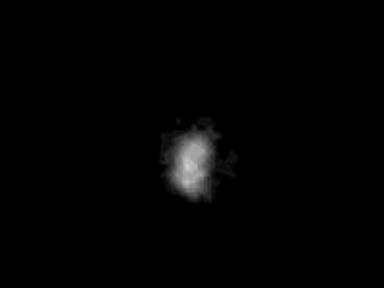
Consider the scale of what we are looking at. The Voyager 2 spacecraft screamed past Nereid in 1989, snapping a grainy, pixelated photograph from nearly three million miles away. In that image, Nereid is just a gray blob, an irregular silhouette against the blackness. We could barely see her. Yet, from that smudge of data and decades of subsequent ground-based observations, we have managed to piece together a story of survival on an epic scale.
The Solitude of the Outer Edge
There is a profound loneliness to Nereid’s existence.
For most of her year, she drifts far out in the frozen suburbs of Neptune, where the sun is nothing more than an intensely bright star, devoid of warmth. She spends months in this dark limbo, moving slowly, almost hanging motionless against the background stars. Then, as gravity pulls her back toward the planet, she picks up speed. She hurtles inward, skimming past the vibrant blue clouds of Neptune and the chaotic wake of Triton, before being flung back out into the cold dark for another year-long exile.
She has repeated this lonely loop billions of times.
Humanity has always looked at the night sky to find its own reflection. We look at Mars and wonder about life. We look at the Moon and see a stepping stone. But when we look at Nereid, we see something different. We see resilience. We see an object that was battered, displaced, and pushed to the very edge of destruction, but managed to keep its grip on its home world.
We used to think the history of our solar system was written only in the large, bright objects—the suns, the planets, the massive moons. We are learning that the true story, the nuanced, violent, breathtaking history of how we got here, is often hidden in the outcasts. It is written in the eccentric paths of the survivors that refuse to be forgotten.