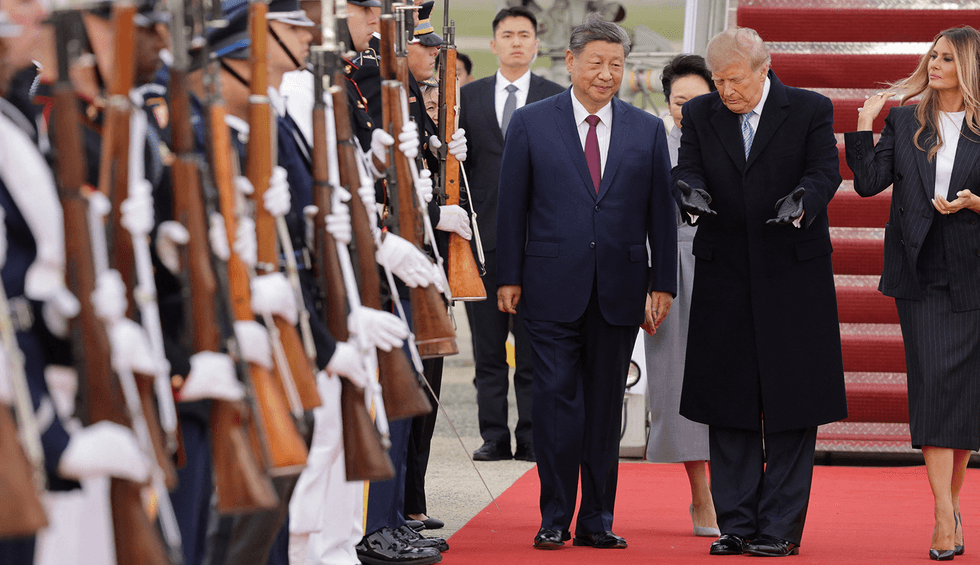
Optics rule statecraft. When a military flyover splits the sky with deafening afterburners, leaders on the reviewing stand are judged not just by their policies, but by their physiological reflexes. A viral video capturing Donald Trump flinching during a high-speed aerial pass while Chinese President Xi Jinping remained entirely stoic triggered a predictable wave of partisan mockery and cable news hand-wringing. Yet reducing a geopolitical summit to a momentary flinch misses the mechanics of how power is performed on the global stage.
The incident throws light on an ancient political theater where every twitch, gaze, and posture is scrutinized for signs of vulnerability. Xi Jinping’s immobile composure is no accident of biology. It is the product of a rigid political culture that trains its elites to suppress involuntary responses, treating physical stillness as an extension of state power. Trump’s reactive movement reflects a populist performance style that thrives on unfiltered visceral expression, treating physical spontaneity as authenticity. Understanding this clash requires looking past the superficial internet point-scoring to examine how different political systems manufacture public composure.
State visits between superpowers operate as carefully choreographed psychological warfare. Every second of footage is parsed by intelligence analysts, domestic political opponents, and foreign ministries looking for an edge. When the cameras roll, the platform becomes a ring where leaders spar without throwing a punch.
The Engineering of Stoicism in Modern Autocracy
China’s top leadership does not arrive at international summits by chance. The Chinese Communist Party operates as an ultra-selective filter, advancing individuals who master absolute emotional containment. In the corridors of Zhongnanhai, outward displays of surprise, fear, or sensory overload are liabilities.
Xi Jinping’s stillness during sudden, loud stimuli stems from decades of political conditioning. To show a startle reflex in public is to show a crack in the armor of the regime. The state apparatus relies on an aura of infallibility, and that aura begins with the physical body of the leader. A supersonic jet roaring overhead at low altitude displaces enough air to rattle a spectator's chest cavity, yet Xi’s facial muscles barely shift. This is not necessarily an absence of fear; it is the absolute mastery of public presentation.
Public relations teams in Beijing understand that an unmoving leader projects stability, predictability, and control. In contrast, Western political culture traditionally values human relatability. A leader who ducks, flinches, or laughs off a loud noise is often viewed through a domestic lens as accessible or real. But when placed next to a counterpart who looks carved from granite, the domestic populist calculus collides with global realpolitik, where symbolism carries severe weight.
The Populist Reflex and the Cost of Spontaneity
Donald Trump’s political brand was built on rejecting polished political theater. Where traditional politicians spend years learning how to mask their physical reactions behind a veneer of stoic boredom, Trump leans into his impulses. A sudden military jet breaking the sound barrier triggers a primal startle response in almost every human nervous system. Most people flinch, blink, or duck.
Trump’s physical reaction on the reviewing stand is biologically normal. The human brain’s amygdala processes sudden, loud threats faster than the rational cortex can suppress them. The evolutionary purpose of a flinch is survival.
The vulnerability lies in how political opponents weaponize that normal biology. Critics framed the moment as a sign of weakness or a lack of steadiness under pressure. This interpretation relies on a centuries-old trope that equates physical stillness with courage and physical reaction with cowardice.
The irony is thick. The same critics who decry populist leaders for being impulsive or uncalculated will simultaneously demand that these same leaders possess superhuman biological control over their autonomic nervous systems. A loud noise happens; the body reacts. The political penalty is paid not for the reaction itself, but for failing to perform the illusion of invulnerability.
Choreography of the Reviewing Stand
Every inch of a state arrival ceremony is negotiated months in advance by advance teams. Sightlines, camera angles, and the precise timing of military assets are locked down to project specific narratives.
When foreign delegations share a reviewing stand, the physical proximity forces a direct comparison of body language. Diplomats call this micro-signaling. While grand treaties are signed in conference rooms, the footage that circulates globally is often captured in these unscripted, high-sensory environments.
A military flyover is designed to overwhelm the senses. It is an intentional display of kinetic might. For a visiting head of state, watching friendly or neutral military hardware soar past is meant to awe. For a rival, it is a test of nerve.
Xi Jinping’s lack of visible reaction communicates a specific message to both domestic and international audiences: nothing startles the state. He has witnessed the rapid modernization of the People's Liberation Army firsthand, and his composure suggests familiarity and dominance over the machinery of war. Trump’s open reaction communicates a different register of engagement—one of immediate, sensory immersion in the spectacle of the moment.
The Superficiality of Global Media Analysis
The rush to judge leaders based on split-second visual clips reveals the shallow nature of modern political commentary. Cable news segments and social media threads dissect a millisecond of footage as if it were a diagnostic test of geopolitical resolve.
Policy decisions are not forged by who blinks first during a surprise noise overhead. Trade agreements, nuclear postures, and supply chain dependencies survive long after the jet fuel disperses. Yet the obsession with these visual moments persists because they offer an easy substitute for complex policy analysis.
When analysts treat a flinch as a geopolitical failure, they infantilize the electorate and reward political theater over substantive governance. A leader can flinch at a jet engine and still execute ruthless economic policy; a leader can stand entirely motionless while presiding over systemic failure.
The cameras will continue to roll at every summit, and advance teams will continue to choreograph every handshake and glance. But the next time a leader reacts instinctively to a loud noise or a sudden movement, remember that biology is difficult to legislate out of existence, even for the most powerful people on earth.