The implementation of the 'tripod' restraint technique within the Scottish Prison Service (SPS) represents a fundamental shift in the management of violent non-compliance, moving away from traditional pain-compliance models toward a biomechanical control strategy. This transition is not merely a policy update but a response to the escalating litigation risks and medical vulnerabilities associated with prone restraint. By analyzing the structural physics of the tripod position, we can define the specific mechanisms that reduce respiratory interference while maintaining the custodial requirement for absolute physical control.
The Biomechanical Failure of Traditional Restraint
Traditional restraint methods often rely on "pain compliance," where a subject is coerced into submission through the application of pressure to joint capsules or nerve centers. This model contains an inherent physiological paradox: the more a subject struggles due to pain or panic, the more force the officers apply, leading to a high probability of positional asphyxia.
The primary risk factor in these legacy systems is the compression of the thoracic cavity. When a subject is held in a prone position (face down) with weight applied to the back, the ability of the diaphragm to contract is severely limited. This creates a "oxygen debt" that, when combined with the high adrenaline state of a struggle, can lead to sudden cardiac arrest.
The tripod restraint seeks to solve this by altering the center of gravity and the points of contact between the staff and the individual. Instead of flat horizontal pressure, the technique utilizes a three-point weight distribution system that keeps the chest elevated from the floor, preserving the "respiratory excursion" (the expansion of the chest wall).
The Three Pillars of the Tripod Framework
The efficacy of the tripod system is built upon three distinct operational pillars: Structural Stability, Respiratory Preservation, and Force Graduation.
1. Structural Stability
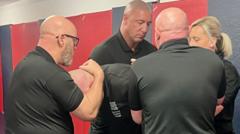
The "tripod" refers to the geometric configuration of the officers in relation to the subject. By positioning staff at specific angles—typically focusing on the pelvic girdle and the upper shoulders—the subject’s leverage is neutralized. In physics terms, the technique converts the subject's kinetic energy (struggling) into potential energy that is absorbed by the floor and the balanced stances of the officers. This prevents the subject from generating the torque necessary to roll or kick out, which usually triggers the need for more dangerous levels of force.
2. Respiratory Preservation
Unlike prone or supine (face up) positions, the tripod maneuver is designed to maintain a "void" beneath the subject's torso.
- The Sternal Void: By ensuring the sternum is not compressed against a hard surface, the technique allows for autonomic breathing to continue even during high-intensity resistance.
- Neck Safety: The protocol strictly forbids pressure on the carotid sinus or the trachea, focusing instead on the large muscle groups of the limbs and the stable bones of the hips.
3. Force Graduation
The tripod method serves as a bridge in the Use of Force continuum. It allows officers to maintain a "holding pattern" where the subject is controlled but not harmed, providing time for verbal de-escalation to take effect. If the subject ceases resistance, the transition to a standing or seated position is faster and safer than it is from a flat-prone position, where the sudden shift in blood pressure can cause fainting or "orthostatic hypotension."
Quantifying Risk Mitigation in Custodial Settings
The Scottish Prison Service's adoption of this technique follows a period of intense scrutiny regarding deaths in custody across the UK. The move is a calculated attempt to reduce "Post-Restraint Stress Disorder" and the medical emergencies that follow violent encounters. To understand the impact, one must look at the Restraint Risk Function:
$$R = (F \times T) / V$$
In this equation:
- $R$ is the total risk of a medical emergency.
- $F$ is the amount of force applied.
- $T$ is the duration of the restraint.
- $V$ is the "void" or volume of respiratory capacity maintained.
By increasing $V$ (the respiratory void), the total risk $R$ decreases, even if the duration $T$ remains constant due to the subject’s continued resistance. Legacy techniques focused almost entirely on reducing $T$ by using extreme pain to force immediate compliance; the tripod technique accepts that $T$ may be longer but balances this by maximizing $V$.
Operational Constraints and Implementation Realities
While the tripod technique is clinically superior in terms of safety, its implementation faces several logistical bottlenecks.
The first limitation is Personnel Density. The tripod requires a minimum of three trained officers to execute correctly. In many prison wings, staffing levels may not allow for this immediate ratio during a spontaneous flare-up. When only two officers are present, the geometric stability of the "tripod" collapses, and staff often revert to instinctive, less-safe techniques.
The second bottleneck is Training Decay. Biomechanical restraints are "perishable skills." Unlike simple strikes or holds, the tripod requires precise footwork and an understanding of weight distribution. Without quarterly "refresher" simulations, the technical proficiency of a custodial workforce drops significantly, leading to "technique drift" where the safe tripod slowly morphs back into a dangerous prone hold under pressure.
Finally, there is the issue of Environmental Variability. A technique perfected on a flat gymnasium mat may fail in the cramped confines of a prison cell, between a bed and a fixed toilet. The tripod requires a specific amount of floor space to allow officers to set their "base" (the distance between their feet). In confined spaces, the physics of the hold change, forcing officers to adapt the angles, which can inadvertently re-introduce pressure to the subject's torso.
The Relationship Between Mental Health and Physical Control
A significant portion of non-compliance in Scottish jails stems from acute mental health crises or "Excited Delirium Syndrome" (EDS). Subjects in this state often possess what appears to be "superhuman strength" and a high pain threshold, making traditional pain-compliance techniques entirely ineffective.
In cases of EDS, the body is already in a state of metabolic acidosis—a buildup of acid in the bloodstream. Any restraint that limits breathing exacerbates this acidosis, leading to a rapid "system crash." The tripod technique is specifically designed for these high-risk individuals. By prioritizing the "Respiratory Void," the system allows the subject to offload carbon dioxide through heavy breathing, preventing the chemical tipping point that leads to death.
Strategic Shift in Custodial Liability
The adoption of "pain-free" methods reflects a broader shift in the legal landscape of the UK. Courts are increasingly moving away from the "Reasonable Force" standard toward a "Least Restrictive Option" standard.
The strategic implications are clear:
- Litigation Shielding: By removing intentional pain from the protocol, the SPS reduces the grounds for "degrading treatment" claims under Article 3 of the European Convention on Human Rights.
- Officer Safety: While the focus is often on the prisoner, the tripod stance provides better joint protection for the officers. It reduces the likelihood of back injuries and "bitten finger" incidents common in unrefined wrestling-style restraints.
- Data Collection: Modern tripod training is usually accompanied by a requirement for "Body Worn Video" (BWV) analysis. This creates a feedback loop where footage of actual incidents is used to refine the biomechanics of the hold.
The transition to the tripod model suggests that the future of custodial management lies in the professionalization of physical intervention—treating it as a technical discipline rather than a test of strength. The success of this rollout will not be measured by the number of incidents suppressed, but by the reduction in "Code Blue" medical emergencies following those incidents.
To optimize the safety of this system, correctional facilities must move toward a "modular" cell design that accounts for the floor space required for these three-man maneuvers. Relying on a safer technique without providing the physical environment to execute it creates a "competency gap" that endangers both staff and inmates. The next logical step is the integration of biometric monitoring—such as pulse-oximeters that can be applied to a limb during a tripod hold—to provide real-time data on the subject's oxygen saturation, removing the guesswork from the Use of Force entirely.