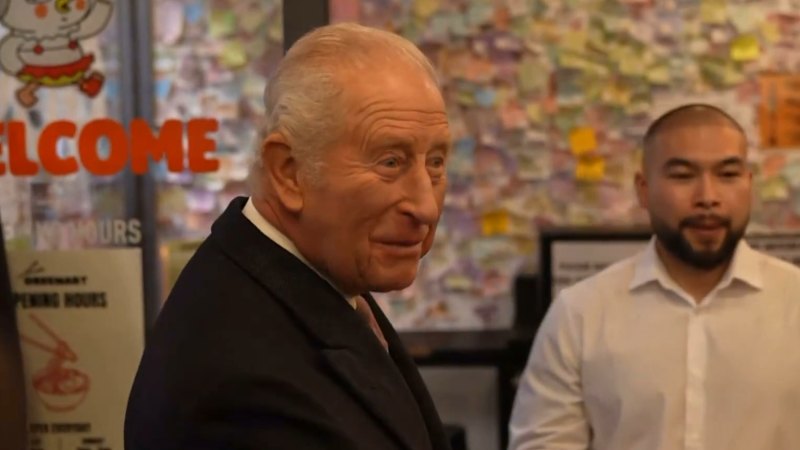
An unscripted birthday celebration for King Charles III during a public market visit appears spontaneous to the casual observer, yet it functions as a highly calibrated instrument of institutional statecraft. Standard media coverage reduces such events to human-interest anecdotes—focusing on baked goods, handshakes, and warm crowd reactions. That framing misses the structural purpose of the engagement. Modern constitutional monarchies survive not through legislative authority, but through continuous symbolic legitimacy, calculated public proximity, and disciplined reputation management. When a reigning monarch enters a commercial marketplace ahead of a milestone birthday, every variable—from security perimeters to vendor selection and press pool positioning—operates within a strict strategic framework designed to convert local goodwill into national institutional equity.
The Architecture of Engineered Spontaneity
Public relations at the head-of-state level relies on a specific paradox: the most effective public moments must look entirely unplanned while remaining operationally controlled. In institutional communications, this is the distinction between stagecraft (overtly ceremonial events like coronations or state openings of parliament) and retail engagement (localized, low-barrier interactions in everyday civic spaces). If you found value in this article, you might want to read: this related article.
A market visit represents the purest form of retail engagement. Markets are historically egalitarian spaces where economic exchange and community gathering intersect. By placing the monarch inside a local market just days before his November 14 birthday, palace communications teams achieve three distinct objectives without issuing a single policy statement:
- Spatial Equalization: Removing the physical barriers of palace gates and ceremonial carriages places the sovereign at eye level with taxpayers, neutralizing perceptions of aristocratic detachment.
- Organic Media Amplification: Local vendors and bystanders hold smartphones at close range, generating first-person, unpolished video assets that outperform official palace press releases on social platforms due to perceived authenticity.
- Earned Sentiment Transfer: When a local baker or greengrocer presents an early birthday cake or sings "Happy Birthday," the emotional warmth of a neighborhood celebration transfers directly to the institution of the Crown.
The mechanics of this interaction depend on advance reconnaissance. While a specific cake presentation or a crowd-led song may occur without formal inclusion on the minute-by-minute court circular, the conditions enabling that moment are deliberately constructed. Protection officers from the Royalty and Specialist Protection (RaSP) unit sweep the venue days in advance, vetting stallholders and establishing controlled crowd-flow corridors. Communications officers coordinate with local civic authorities to ensure press photographers occupy sightlines adjacent to the most visually dynamic stalls—typically food producers, florists, or traditional craftspeople. The "surprise" is therefore a bounded variable: the exact gesture is unscripted, but the probability of a positive, photogenic gesture occurring is engineered close to certainty. For another perspective on this development, refer to the recent update from BBC News.
The Economics of Symbolic Legitimacy
To understand why a sovereign spends finite calendar hours walking past produce stalls rather than conducting closed-door briefings, one must examine the economic theory of soft power and institutional legitimacy. Unlike elected executives, whose mandate derives from periodic ballot counts, a hereditary monarch operates on a continuous, non-electoral confidence model.
In this model, public approval functions as working capital. Every public engagement carries an opportunity cost; an hour spent at a regional market is an hour not spent on diplomatic receptions, charitable patronages, or constitutional paperwork. Palace schedulers allocate the monarch's time using an implicit return-on-attention calculation:
- High-Cost, High-Formality Events (e.g., State Banquets): Reinforce international alliances and elite continuity, but risk alienating domestic audiences experiencing cost-of-living pressures.
- Low-Cost, High-Proximity Events (e.g., Market Visits): Require minimal state expenditure while generating maximum domestic press coverage per minute invested.
During periods of inflation or economic stagnation, displays of royal opulence trigger immediate public pushback. Conversely, engaging with small-scale merchants—discussing local agriculture, artisanal food production, and regional supply chains—aligns the monarch with grassroots economic resilience. For King Charles III specifically, whose public identity over five decades has centered on organic farming, traditional craftsmanship, and sustainable food systems, a market visit is not a generic photo opportunity. It is direct brand alignment. The environment validates his long-standing policy interests without requiring him to deliver a formal speech on agricultural economics.
Micro-Interactions and the Signal-to-Noise Ratio
Standard reporting on royal walkabouts treats crowd interactions as uniform pleasantries. Operational analysis separates these micro-interactions into distinct signaling mechanisms, each targeting a different demographic segment within the domestic audience.
The Gift Exchange Protocol
When a vendor presents a monarch with an early birthday cake, pastry, or regional delicacy, a strict logistical chain activates behind the scenes. Security protocols prohibit heads of state from consuming unvetted food on-site. Immediately after the camera shutters capture the presentation and the monarch's verbal appreciation, an equerry or protection officer discreetly takes custody of the item. Despite the operational impossibility of eating the gift on the spot, the visual exchange completes its communicative cycle in under fifteen seconds: the citizen offers hospitality, and the sovereign accepts it with visible gratitude.
The Acoustic Trigger
A crowd breaking into "Happy Birthday" alters the acoustic environment of a public engagement. News editors prioritize audio-visual clips with clear emotional peaks over silent B-roll of handshakes. A recognizable song sung by ordinary citizens provides a ready-made broadcast soundbite that requires zero journalistic narration. It signals consensus affection, effectively framing the monarch not as a distant ruler, but as a familiar community figure.
The Tactile Handshake Line
The walkabout barrier—typically a waist-high metal crowd-control fence—serves a dual function. Physically, it prevents crowd crush and maintains a defensible perimeter for close-protection officers. Psychologically, it creates a porous border where physical contact occurs. Handshakes, brief eye contact, and five-second exchanges about local weather or family milestones create powerful localized loyalty. Psychologists refer to this as the mere-exposure and proximity effect: individuals who experience brief, direct personal contact with a public figure become long-term institutional advocates within their social networks, multiplying the reach of a single afternoon visit across thousands of private conversations.
Risk Variables and Operational Limitations
Treating public market visits as guaranteed public relations wins ignores significant operational vulnerabilities. Placing a head of state within arm's reach of an unscreened general public introduces acute security and reputational friction that palace planners must continuously manage.
Physical Security Exposure
Open-air markets contain high-density visual clutter, multiple entry points, and hard surfaces. Unlike controlled indoor venues with metal detectors and guest lists, a public street market allows anyone to approach the perimeter. Close-protection teams must constantly scan hands, body language, and elevated windows while remaining invisible enough not to ruin camera sightlines. Any heavy-handed intervention by security personnel—such as aggressively pushing back an enthusiastic bystander—immediately overrides the positive narrative of the visit and becomes the primary news story.
Dissent Vulnerability
High-proximity walkabouts lower the barrier for peaceful protesters. A single vocal dissenter holding a placard or shouting anti-monarchy slogans within microphone range of the press pool can hijack the audio feed of the entire broadcast. Communications teams mitigate this by routing the monarch toward dense, pre-gathered supporter clusters—often schoolchildren or local civic groups invited by the municipal council—to ensure ambient noise drowns out isolated hecklers. However, over-engineering the crowd risks exposing the artificiality of the event, which carries its own reputational penalty.
Physical Attrition
At over seventy-five years of age, while managing ongoing health treatments and a demanding constitutional workload, the physical toll of standing, walking on uneven cobblestones, and maintaining continuous facial engagement for ninety minutes is substantial. Fatigue reduces vocal projection and slows reaction times during rapid-fire conversational transitions. Schedulers must therefore cap the duration of walkabouts strictly, balancing the demand for public access against the preservation of the monarch's physical stamina.
Measuring Institutional Yield Beyond Headlines
Media outlets evaluate a royal appearance by immediate clicks, photo galleries, and superficial sentiment. Institutional strategists measure yield across longer time horizons using three structural indicators:
- Regional Press Saturation: National broadcasters cover the monarchy daily, often through a critical or analytical lens. Regional newspapers and local television stations, however, treat a royal market visit as a front-page historical event for their municipality. Securing positive front-page coverage across regional media builds a distributed buffer of goodwill outside major metropolitan centers.
- Intergenerational Visual Integration: Photographs featuring an older monarch laughing with young families, schoolchildren, and early-career market traders directly counter demographic polling showing softer support for the monarchy among citizens under thirty. Visual association with youth and everyday commerce softens the institution's generational profile.
- Continuity Reinforcement: By anchoring public appearances to recurring personal milestones—such as a November birthday—the palace establishes an annual rhythm of relatable public engagement. Over time, these recurring micro-events accumulate into a stable public persona characterized by duty, approachability, and endurance.
Strategic Execution for Institutional Communications
Organizations and public institutions seeking to replicate the reputational durability of a well-executed royal walkabout must abandon reliance on press releases and controlled studio appearances. Instead, communications leaders should deploy a disciplined Proximity-First Engagement Model:
- Select High-Friction, Authentic Venues: Place principals inside active economic ecosystems—markets, workshops, transit hubs, or community clinics—rather than sterile conference halls. The environment itself communicates operational relevance before the principal speaks a word.
- Design for Third-Party Capture: Stop optimizing events solely for official photographers. Structure sightlines, lighting, and physical barriers so everyday participants can capture clear, unobstructed vertical video on mobile devices. Unpolished peer-to-peer distribution carries vastly higher trust metrics than institutional channels.
- Prioritize Micro-Exchanges Over Speeches: Replace twenty-minute prepared remarks with thirty five-second individual interactions. Direct, unscripted dialogue with frontline workers or local merchants generates higher emotional recall and eliminates the stiffness of teleprompter delivery.
- Accept Bounded Unpredictability: Resist the urge to script every gift, question, or interaction. Establish strict physical safety parameters, vet the immediate perimeter, and then allow spontaneous human gestures to unfold naturally within that secure zone. Institutional authority is strongest when it demonstrates the confidence to remain unscripted in public.