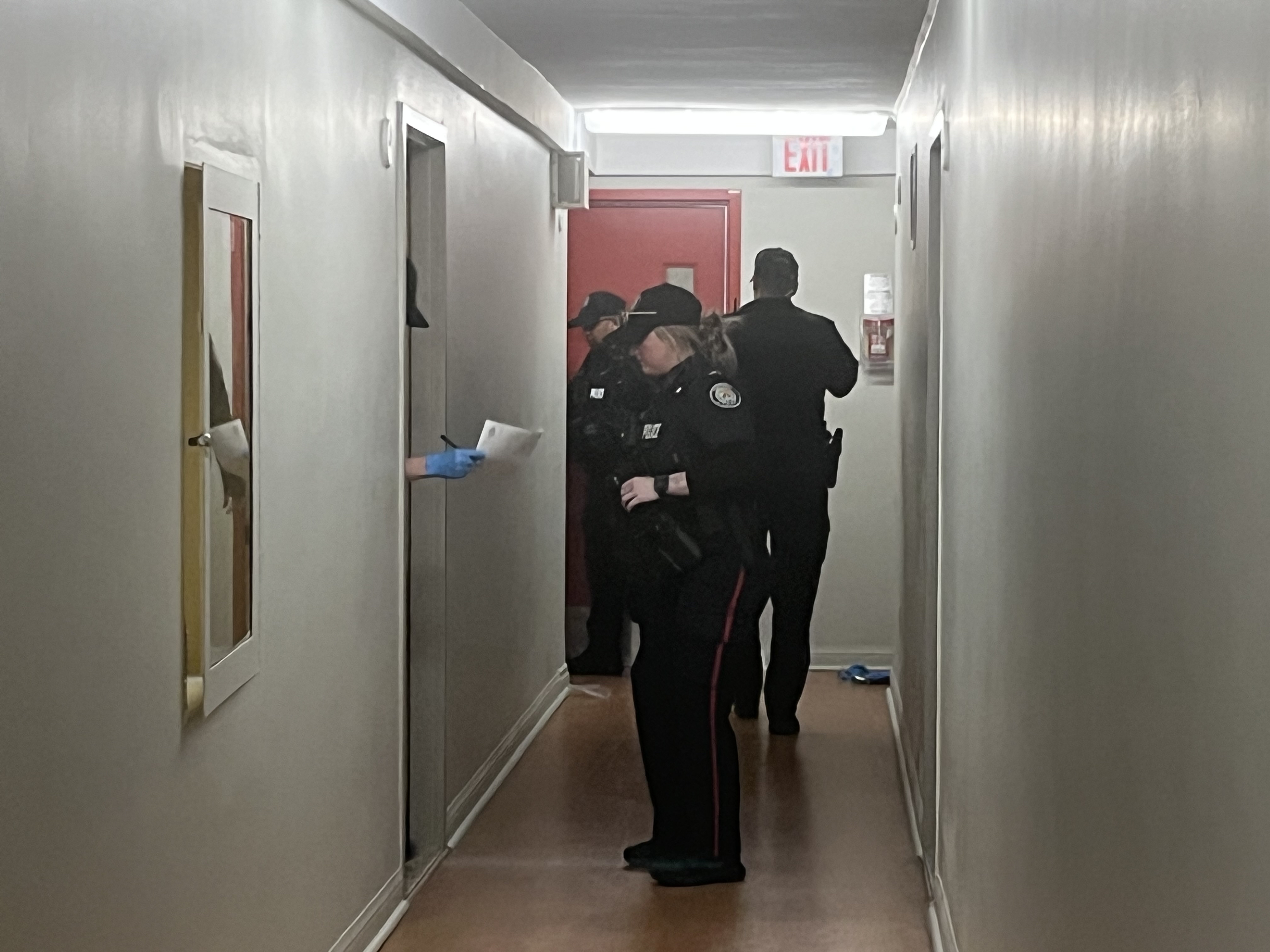
The death of a suspect during a police pursuit following a violent encounter is not a random occurrence but the culmination of a specific chain of kinetic and psychological variables. When law enforcement responds to a high-acuity event—in this instance, a multi-victim stabbing in a Toronto residential complex—the operational environment shifts from routine patrol to a high-stakes pursuit-evasion model. This transition dictates the physiological state of the actors involved and the physical limitations of the escape route. The failure to contain a suspect within the initial perimeter creates a secondary risk profile that often results in fatal outcomes, independent of the original crime’s severity.
The Triad of Tactical Escalation
The sequence of events in the Toronto apartment incident can be categorized into three distinct phases of escalation. Each phase represents a failure point where the situation moved from controlled intervention to chaotic kinetic energy.
- The High-Acuity Trigger: A report of multiple stabbing victims establishes the legal and moral necessity for immediate, aggressive police intervention. This "active threat" status removes the option for slow-roll surveillance and forces a rapid confrontational stance.
- The Perimeter Breach: The suspect’s transition from an indoor environment (the apartment) to a mobile environment (the vehicle) represents a loss of containment. Once a suspect reaches a vehicle, the potential energy of the situation increases exponentially.
- The Kinetic Resolution: The pursuit ends when the physical environment (topography, traffic, or infrastructure) or mechanical failure (collision) halts the vehicle's momentum. The suspect’s death in this case is a function of the energy transfer during a high-speed impact or a subsequent tactical engagement.
The Physics of High-Speed Pursuit Evasion
Standard reporting focuses on the "chase," but a strategic analysis focuses on the Force-Distance Relationship. In an urban environment like Toronto, a fleeing suspect operates under a significant cognitive load, attempting to navigate complex intersections while monitoring the closing distance of pursuit vehicles. This creates a "tunnel vision" effect that degrades motor skills and spatial awareness.
The probability of a fatal crash during a pursuit follows a non-linear growth curve relative to velocity. At 60 km/h, a driver retains high maneuverability; at 120 km/h in a residential or arterial zone, the reaction time required to avoid stationary objects or navigate turns exceeds human neurological capacity. When a suspect dies "fleeing police," the cause is usually the sudden conversion of kinetic energy ($E_k = \frac{1}{2}mv^2$) into structural deformation of the vehicle and the human body. Because velocity is squared in the equation, doubling the speed quadruples the impact force, making high-speed flight a high-probability suicide mission.
Human Factors and the Adrenaline Dump
The biological reality of the suspect must be accounted for in any rigorous analysis. Following a violent act such as a stabbing, the suspect is likely experiencing a massive sympathetic nervous system activation—commonly known as the adrenaline dump. This state is characterized by:
- Loss of Fine Motor Control: Manipulating a steering wheel or gear shifter becomes clunky and imprecise.
- Auditory Exclusion: The suspect may not "hear" sirens or commands, leading to a complete disconnect from reality.
- Time Dilation: The suspect’s perception of speed is warped, often leading them to believe they have more space to maneuver than actually exists.
Police officers are trained to manage this physiological spike through tactical breathing and structured radio communication. The suspect has no such training. This "competency gap" between the pursuer and the pursued is what frequently leads to a catastrophic error by the suspect.
Structural Failures in Containment Strategy
If a suspect is able to flee an apartment complex and enter a vehicle, the initial containment strategy has failed. Effective high-risk containment relies on the Inner and Outer Perimeter Model.
- The Inner Perimeter is designed to pin the suspect in the immediate vicinity of the crime (the apartment unit or floor).
- The Outer Perimeter acts as a secondary net to catch anyone slipping through the first layer.
In urban high-rises, the vertical nature of the environment makes the inner perimeter difficult to seal. Multiple exits, underground parking garages, and service tunnels provide "leakage points." The suspect in Toronto utilized one of these gaps to transition from a pedestrian-based threat to a vehicle-based threat. Once the suspect is mobile, the police face the "Pursuit Dilemma": do they chase and risk a high-speed collision, or do they back off and risk a violent offender remaining at large?
The Role of the Special Investigations Unit (SIU)
In the province of Ontario, the involvement of the Special Investigations Unit is a mandatory procedural response whenever a police interaction results in serious injury or death. The SIU’s objective is to determine if the "use of force" (even indirect force, like the act of pursuing) was legally justified under the Criminal Code.
The analytical framework for this investigation hinges on the Principle of Proportionality. Investigators will weigh the necessity of capturing a stabbing suspect against the risk posed to the public by the pursuit itself. If the suspect was driving erratically before the police engaged, the liability shifts toward the suspect. If the police tactics directly forced the suspect into a high-risk maneuver that led to the fatality, the investigation becomes more complex.
Risk Mitigation and Tactical Alternatives
The fatal outcome of this incident highlights the limitations of traditional pursuit. Modern law enforcement is increasingly moving toward technical interventions that reduce the need for high-speed chases.
- Aerial Surveillance: Using helicopters or drones to track a suspect from a distance allows ground units to fall off, reducing the suspect’s perceived need for speed.
- GPS Tagging: Deploying projectile GPS trackers (such as StarChase) allows police to track the vehicle's location without a physical tail.
- Electronic Disruption: While still in limited use, electromagnetic pulse (EMP) devices can disable a vehicle's engine management system, forcing a controlled stop.
None of these technologies were sufficient or available in time to change the outcome in this specific Toronto event. The rapid transition from "stabbing call" to "fatality" suggests a condensed timeline that precluded anything other than immediate physical pursuit.
The Social Cost of Kinetic Resolution
Every instance where a suspect dies fleeing police creates a ripple effect of secondary costs. There is the immediate loss of investigative intelligence; dead suspects cannot provide motives or name accomplices. There is the legal cost of the SIU investigation and potential civil litigation. Finally, there is the psychological impact on the victims of the initial stabbing, who are denied a formal trial and a sense of judicial closure.
The death of the suspect is not a "victory" for law enforcement; it is a messy conclusion to a failed tactical sequence. It represents the point where the justice system loses its ability to adjudicate and the laws of physics take over.
The strategic imperative for urban police forces moving forward is the hardening of apartment perimeters and the investment in non-kinetic tracking. Until the "mobile transition" can be neutralized, the statistics of pursuit-related deaths will remain a static reality of urban policing. The focus must shift from the chase to the prevention of the flight. If the suspect cannot reach the vehicle, the kinetic energy remains at zero, and the risk to the public and the suspect is localized and manageable.