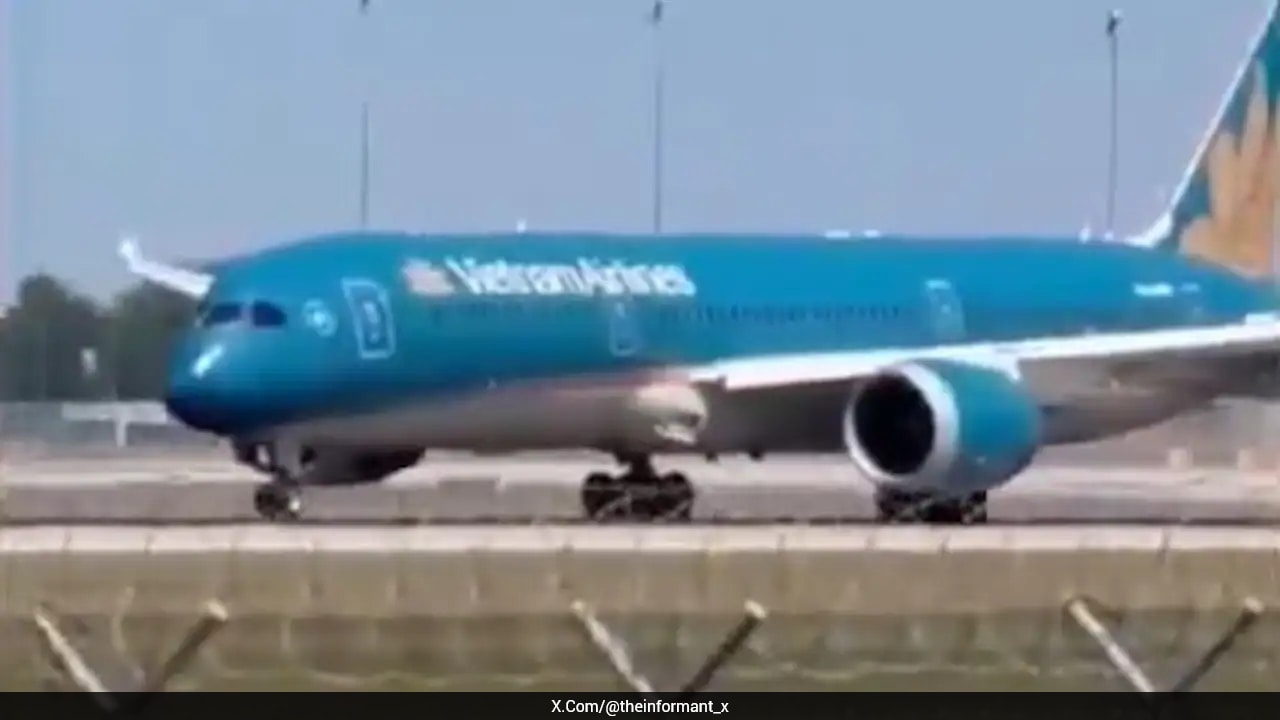
The incident involving Vietnam Airlines flight VN34 at Munich Airport serves as a stark case study in the failure of the "go/no-go" decision-making process under high-energy conditions. On August 15, 2026, a Boeing 787-9 experienced two distinct speed decelerations during its takeoff roll, leading to a precarious lift-off beyond the paved runway surface. This event demonstrates the friction between established flight deck protocols and the physical realities of kinetic energy management in heavy transport aircraft.
The Dynamics of Accelerated Inertia
At the core of the VN34 event lies a breakdown in the transition between acceleration and rotation. Standard takeoff procedures rely on the V1 speed, the threshold beyond which an aborted takeoff (RTO) is deemed higher risk than a departure. The sequence of events on runway 26L indicates that the flight crew encountered an anomalous loss of velocity approximately halfway through the takeoff roll.
Two critical periods of speed stagnation occurred before the aircraft reached V1. Once the aircraft transitioned beyond V1, the decision to abort became physically unfeasible due to the remaining runway length. At this juncture, the crew was locked into a high-speed trajectory. The pilots applied maximum thrust in a reactive effort to regain required takeoff speed, but the temporal loss during the initial roll had already exhausted the safety margin defined by the runway's length.
Kinetic Energy and Runway Geometry
The Boeing 787-9, a massive asset with significant mass, requires precise energy distribution to rotate at the optimal pitch. The investigation reveals that the aircraft did not attain lift-off until it had moved approximately 120 meters beyond the paved surface of the 4,000-meter runway. The "91 meters remaining" figure cited in reports refers to the point at which the crew attempted to initiate rotation, not the point of flight.
The consequences of this late rotation were mechanical and structural:
- Geometric Interference: The late rotation necessitated an aggressive pitch angle, leading to a tail strike against the runway surface. This contact causes severe damage to the rear fuselage, compromising the pressure vessel and outer skin integrity.
- Infrastructure Impact: The aircraft struck runway approach lights, causing structural damage to both the ground equipment and the landing gear assembly.
- Pneumatic Failure: Following the excursion, inspection confirmed that four of the eight main landing gear tires had burst. This is a direct outcome of the aircraft maneuvering over non-paved, high-friction, or uneven surfaces at high speed.
Tactical Protocol Analysis
The crew’s decision to continue the flight after the tail strike and tire burst highlights a secondary operational challenge: the management of latent damage. Upon reaching 10,000 feet, the flight deck identified tire pressure anomalies. The subsequent two-hour holding pattern, involving fuel jettisoning and low-approach visual inspections by air traffic controllers, reflects standard, disciplined execution of emergency procedures for suspected undercarriage damage.
The primary error occurred in the pre-V1 phase, where the speed anomalies were not immediately interpreted as grounds for an emergency abort. The secondary success occurred in the post-incident management, where the crew utilized standard holding, weight-reduction, and visual confirmation procedures to ensure a controlled return.
Strategic Recommendations
To mitigate the risk of repeat excursions, operators must shift from reliance on traditional V1 thresholds to a more proactive assessment of acceleration profiles.
- Acceleration Monitoring Systems: Flight management systems should incorporate real-time acceleration monitoring that alerts the crew if the current acceleration rate deviates from the planned performance curve by more than a pre-defined margin, regardless of speed status.
- Abort Decision Hardening: Training cycles should emphasize that any sustained, uncommanded drop in speed during the takeoff roll—even if occurring below V1—warrants an immediate RTO to prioritize ground safety over schedule adherence.
- Tail Strike Prevention Protocols: Implement updated flight control law protections that limit pitch authority if the aircraft has not achieved a specific ground speed, preventing structural tail strikes during desperate late-rotation attempts.
The focus must remain on the absolute integrity of the takeoff sequence. The performance penalty of an aborted takeoff is measurable and manageable, whereas the tail strike and runway excursion represent a total loss of the operational envelope.
Vietnam Airlines 787 Munich Runway Incident
This footage provides a visual record of the late rotation and subsequent structural strain on the aircraft, clarifying the physical constraints faced by the flight crew.