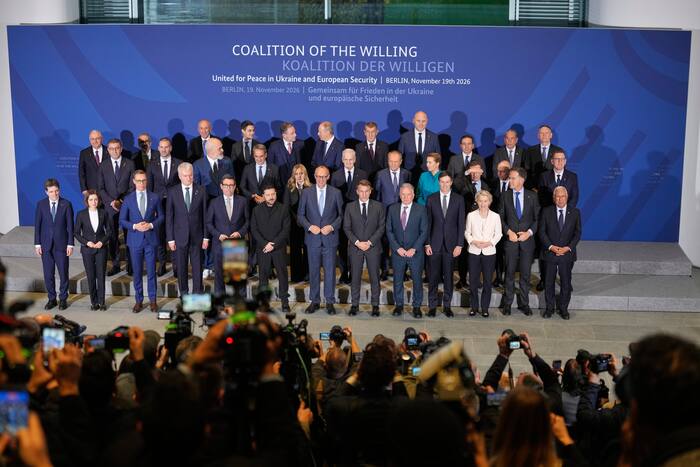
Military exercises conducted by eleven European nations on Polish territory do not represent a routine readiness check. They function as an operational stress test for a specific, high-risk strategic scenario: deploying a multinational stabilization force into a post-conflict Ukraine without invoking the collective defense mechanisms of the North Atlantic Treaty Organization. Standard reporting treats these drills as diplomatic signaling or general preparation. That framing misses the mechanical reality of coalition warfare. When eleven distinct national militaries converge to rehearse post-armistice security operations, the primary obstacle is not enemy fire, but internal friction across command structures, rules of engagement, logistics chains, and political escalation thresholds.
To understand the viability of a European-led postwar security architecture, analysts must separate political rhetoric from military mechanics. A stabilization mission in Ukraine requires transitioning from high-intensity territorial defense to armed deterrence and border monitoring along a contested demarcation line. Executing this transition with a patchwork coalition outside formal alliance command structures introduces severe operational vulnerabilities. Evaluating these drills requires dissecting the three structural pillars that dictate whether such a force can survive contact with reality: command integration, the logistics of cross-border sustainment, and the deterrence credibility gap.
The Command and Control Bottleneck
In a conventional alliance operation, unified command resolves ambiguity. When European states assemble an ad-hoc coalition of the willing—even one drawing heavily from existing European Union or NATO member militaries—they forfeit the automatic legal and operational authority of integrated alliance headquarters. Exercises in Poland specifically target the friction generated when eleven national contingents attempt to synchronize tactical movements under a composite headquarters.
The core mechanism at risk is the Observation-Orientation-Decision-Action (OODA) loop at the operational level. Every participating nation brings distinct doctrinal assumptions regarding force protection, artillery clearances, and air defense integration. In a postwar Ukrainian theater, a peacekeeping or reassurance force will not face lightly armed insurgents; it will face a peer adversary equipped with long-range precision fires, electronic warfare suites, and persistent unmanned aerial surveillance.
- National Caveats as Systemic Drag: Participating governments routinely impose classified operational restrictions on their deployed units. One contingent may be authorized to return fire against unmanned aerial vehicles breaching a buffer zone, while an adjacent unit from another nation requires ministerial approval from its home capital before engaging. Adversary intelligence units actively probe boundary lines between national sectors to exploit these exact seams.
- Communications Interoperability: Despite decades of standardization agreements, tactical radio encryption, battlefield management systems, and blue-force tracking networks frequently fail to share data seamlessly across eleven different national defense architectures. Polish training grounds serve as the laboratory to identify where digital links drop and force staffs to revert to slow, vulnerable voice relays or liaison officers.
- Rules of Engagement (ROE) Harmonization: Peace enforcement requires a precise escalation ladder. If an armored patrol encounters an unannounced incursion across a demilitarized zone, the tactical commander must know within seconds whether the response is observation, warning fire, or lethal suppression. Drills in Poland force legal advisors and operational planners from all eleven capitals to reconcile conflicting domestic laws governing the use of force abroad.
Without a single, undisputed operational commander possessing authority to redeploy units and authorize lethal force across all eleven contingents, the coalition risks paralysis during the opening hours of a ceasefire violation. The Polish exercises are designed to expose these command fractures in a controlled environment before they become fatal in theater.
The Sustainment Architecture and Polish Transit Corridors
Strategy is constrained by logistics. A multinational force operating inside Ukraine depends entirely on the throughput capacity of its rear-area staging bases, primarily located in eastern Poland. The geography of Eastern Europe dictates that Poland functions as the indispensable logistical funnel for any western military presence in Ukraine.
Sustaining eleven different national armies creates a supply chain nightmare known in military science as class-of-supply fragmentation. While NATO standardization exists on paper for basic ammunition calibers and fuel types, modern mechanized units rely on specialized spare parts, proprietary diagnostic software, and distinct maintenance protocols.
- The Maintenance Multiplier: If eleven nations deploy main battle tanks, infantry fighting vehicles, and self-propelled artillery, the logistical tail must support multiple incompatible platforms. A Leopard 2 variant operated by one nation requires different supply chains than a Challenger, Leclerc, or K2 platform operated by another. Forward repair depots in Poland and western Ukraine face rapid inventory exhaustion if forced to stock bespoke components for eleven separate tables of organization and equipment.
- Rail Gauge and Infrastructure Constraints: Moving heavy armor from Central Europe into Ukraine requires navigating the transition from European standard gauge (1,435 mm) to the Russian broad gauge (1,520 mm) used across Ukrainian rail networks. Rehearsal drills in Poland test the speed and security of transshipment hubs where heavy equipment is offloaded from Western rolling stock and transferred to Ukrainian trains or heavy equipment transporters. These hubs represent stationary, high-value targets.
- Medical Evacuation (MEDEVAC) Chains: Political support for a postwar deployment evaporates rapidly if casualties cannot be evacuated within the "golden hour." Integrating eleven national medical systems into a unified evacuation pipeline—from point-of-injury stabilization in Ukraine to Role 3 surgical hospitals in Poland—requires rigorous standardization of blood supplies, air ambulance clearances, and patient tracking protocols.
Known facts confirm that Poland has invested heavily in expanding its eastern transport infrastructure and host-nation support capabilities. However, the educated hypothesis among military logisticians is that a purely European coalition, stripped of United States strategic airlift, heavy transport, and theater-level intelligence, surveillance, and reconnaissance (ISR) assets, will hit a hard ceiling on the total troop density it can sustain forward of the Polish border. The drills reveal the exact tonnage limits of European self-reliance.
Deterrence Theory and the Escalation Paradox
The fundamental strategic purpose of a postwar European force in Ukraine is deterrence by denial and deterrence by punishment. By placing European troops on Ukrainian soil, participating governments aim to signal that renewed aggression against Ukraine equates to direct conflict with European powers. Yet this posture generates an acute strategic vulnerability: the commitment-capability mismatch.
Classical deterrence theory, as formalized by Thomas Schelling, relies on the concept of the "tripwire"—a small forward-deployed force whose primary value lies not in its ability to defeat an invasion independently, but in the certainty that its destruction will trigger an overwhelming response from the parent nations. For a European coalition operating outside NATO's Article 5 security guarantee, the tripwire mechanism is dangerously ambiguous.
If a Russian reconnaissance-in-force strikes a European battalion stationed near the Dnieper River, the automaticity of response is absent. Unlike an attack on Polish or Baltic soil, an attack on European forces operating inside a non-NATO state falls into a legal gray zone. Moscow's strategic planners understand this distinction. They can calibrate limited kinetic strikes—using long-range drones, artillery, or deniable proxy forces—to inflict casualties on a specific European contingent without crossing the threshold into full-scale conventional war with the entire continent.
- Asymmetric Political Resolve: Eleven democracies possess eleven different electoral cycles, economic sensitivities, and threat perceptions. A nation bordering Russia views a postwar mission as an existential buffer; a nation in Western or Southern Europe views it as an optional stabilization commitment. Adversary coercion targets the weakest political link in the coalition, aiming to force a unilateral withdrawal that collapses the entire mission's legitimacy.
- The Air Superiority Deficit: Modern ground forces cannot survive without control of the air and electromagnetic spectrum. European air forces possess advanced fourth- and fifth-generation fighters, yet they historically lack sufficient inventories of precision-guided standoff munitions, suppression of enemy air defenses (SEAD) platforms, and aerial refueling tankers to sustain high-intensity air operations without American enablers. Exercises in Poland must account for operating ground troops under contested skies where adversary glide bombs and loitering munitions remain a constant threat.
- Escalation Dominance: Escalation dominance belongs to the actor capable of raising the stakes of a conflict to a level the opponent is unwilling or unable to match. By deploying ground troops into Ukraine without explicit nuclear umbrella guarantees extended to that specific theater, European states risk entering a conventional confrontation where the adversary retains regional escalation dominance.
Tactical Adaptation to Post-Industrial Warfare
The character of warfare in Ukraine has rendered traditional peacekeeping doctrines obsolete. Classic United Nations or Cold War monitoring missions relied on high-visibility white vehicles, fixed observation posts, and predictable patrol routes. Deploying a force using those methods into a postwar Ukrainian environment would result in catastrophic attrition.
The exercises in Poland reflect an urgent doctrinal pivot toward dispersed, fortified deterrence. Participating units are rehearsing operations in an environment saturated by sensors and precision strike capabilities.
- Counter-Unmanned Aerial Systems (C-UAS) Integration: Every platoon-level maneuver in the Polish drills must incorporate layered counter-drone defenses. This includes electronic warfare jammers, kinetic interceptors, and strict emissions control (EMCON) to prevent adversary signals intelligence from triangulating command posts based on electromagnetic signatures.
- Subterranean and Hardened Basing: Static bases are indefensible against ballistic and cruise missiles. European engineers training alongside infantry units focus on rapid field fortification, dispersed logistics caches, and camouflaged command bunkers. The operational concept shifts from concentrated garrisons to widely distributed, mutually supporting strongpoints.
- Civil-Military Coordination in a Devastated Theater: A postwar Ukraine will contain millions of unexploded ordnances, damaged critical infrastructure, and a heavily armed, battle-hardened domestic military. European forces must establish clear territorial boundaries and deconfliction mechanisms with the Armed Forces of Ukraine (AFU) to prevent friendly-fire incidents and avoid interfering with Ukrainian sovereign defense operations.
Limitations of the Coalition Model
No military exercise can resolve a foundational political contradiction. The central limitation of the eleven-nation framework rehearsed in Poland is that tactical interoperability cannot compensate for strategic ambiguity.
First, exercises conducted in peacetime Poland benefit from permissive airspace, uncontested rear-area logistics, and reliable civilian telecommunications. In an actual Ukrainian deployment, every bridge, rail junction, and fuel depot will operate under the constant threat of sabotage, cyberattacks, and long-range kinetic strikes. Training metrics achieved in Poland will degrade rapidly under real-world friction.
Second, the reliance on rotational deployments creates chronic institutional memory loss. European militaries generally lack the force structure depth to maintain tens of thousands of troops on continuous overseas deployment without hollowing out their domestic readiness. A force that rotates every six months guarantees that just as a contingent masters the terrain, local intelligence networks, and neighboring unit protocols, it is replaced by an inexperienced formation.
Third, the exclusion of formal NATO command structures forces the coalition to build bespoke headquarters from scratch. While existing frameworks like the Joint Expeditionary Force (JEF) or EU Battlegroups provide templates, scaling them to manage a multi-brigade, high-end deterrence mission across a front spanning hundreds of kilometers stretches European staff capacity to its breaking point.
Strategic Imperatives for Operational Viability
To convert the tactical lessons of the Polish drills into a credible postwar deterrence force, European defense ministries must abandon incrementalism and execute three structural reforms before a ceasefire is signed.
First, participating nations must establish a permanent, standing operational headquarters with pre-delegated rules of engagement. Authority to engage airspace violations, counter-battery fire, and defensive maneuvers must rest with the theater commander, stripped of national parliamentary vetoes or ministerial delays. If a capital cannot accept pre-delegated lethal authority, its troops should be assigned exclusively to rear-area logistics in Poland rather than forward sectors in Ukraine.
Second, the coalition must enforce strict platform standardization by sector. Rather than mixing eleven different equipment sets across the front, planners must assign geographic sectors based on logistical commonality. Nations operating Leopard tanks and standardized 155mm artillery systems must be grouped together to consolidate maintenance depots and spare parts pipelines, drastically reducing the logistical tail required to sustain combat power.
Third, European planners must explicitly integrate Ukrainian forces into the command architecture rather than treating them as a separate entity. A European reassurance force cannot function as an independent buffer; it must operate as a hardened strategic reserve and technological enabler—providing air defense, intelligence fusion, and long-range strike coordination—anchored directly behind entrenched Ukrainian front-line formations. The credibility of European deterrence depends entirely on fusing Western technological enablers with Ukrainian combat mass.