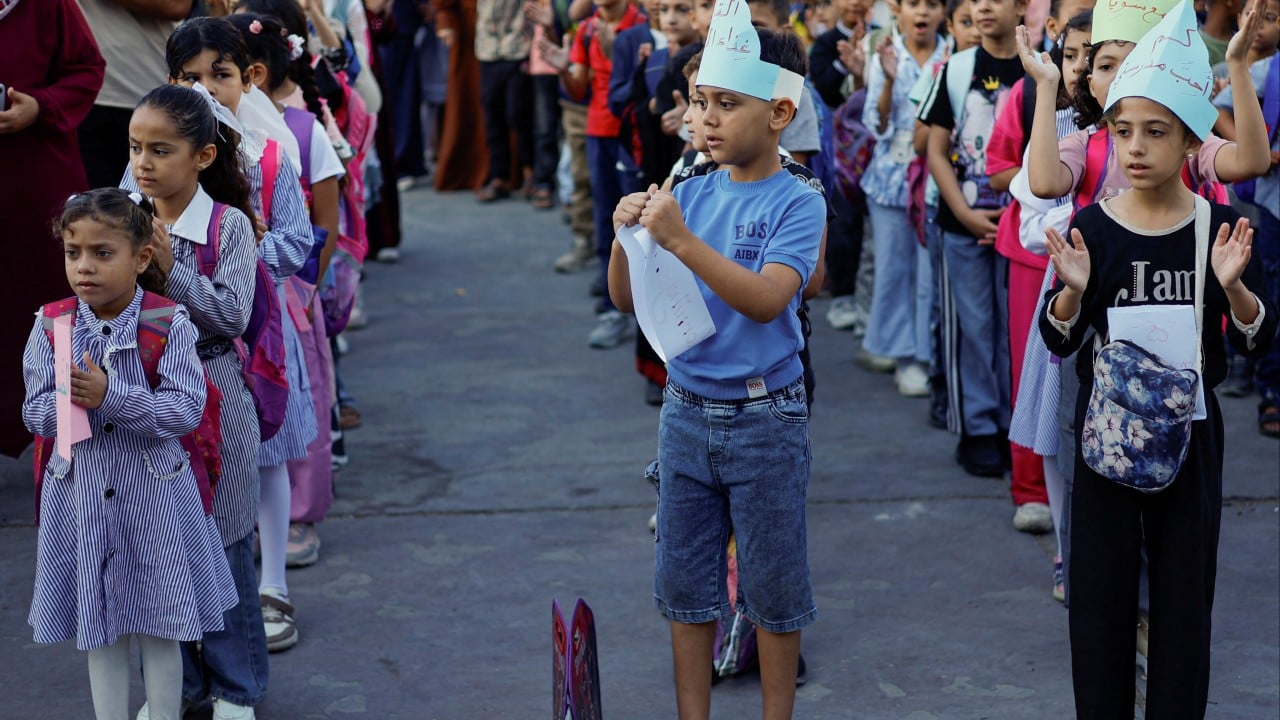
The headlines arrived wrapped in artificial sentimentality. Children returning to in-class instruction after three years of forced absence. Photographs of backpacks, chalk dust, and cautious smiles against a backdrop of pulverized concrete. International wire services cheered it as a triumph of human resilience. NGO directors released self-congratulatory statements about the restoration of normalcy and the healing power of the classroom.
It is a comfortable narrative designed to soothe the conscience of distant observers. It is also an absolute fraud.
Pretending that sticking children back into crumbling concrete boxes with broken windows and zero sanitation constitutes an education system is not humanitarianism. It is institutional gaslighting. When you resurrect a nineteenth-century schooling model inside a completely shattered ecosystem, you are not saving a generation. You are masking a systemic failure behind the aesthetic of a chalkboard.
Let us strip away the moral posturing and look at the structural reality. I have spent years analyzing conflict-zone infrastructure and post-crisis resource allocation. I have watched billions of dollars in international aid flow into symbolic projects that look magnificent in annual reports while collapsing under the weight of basic physics. The narrative that reopening schools equals recovery ignores every metric of actual human survival, cognitive development, and economic viability.
The Comforting Lie of Institutional Normalcy
The core premise of the mainstream coverage is that the primary deficit of the past three years was the absence of a physical classroom. Fix the building, hand out notebooks, and the trauma evaporates. This is magical thinking of the highest order.
A child sitting in a schoolroom with no running water, intermittent electricity, a roof compromised by blast damage, and an empty stomach is not learning. They are enduring another form of exhaustion. Educational researchers love to talk about learning loss, but they treat it as an arithmetic problem. They assume you can simply add hours back into the equation to make up for lost time.
That math falls apart when the foundation is gone. When the water coming out of the tap is brackish, when medical care is rationed, when half the extended family is missing or maimed, the classroom is not a sanctuary. It is an exercise in surrealism. Teachers are expected to deliver standardized curricula to children whose immediate environment demands acute crisis navigation skills.
We are forcing kids to memorize grammar rules while their bodies process chronic stress hormones that shut down higher-order cognitive processing. It looks good on camera. It generates donor checks. But functionally, it is an empty shell.
The Bureaucratic Addiction to Performative Reopening
Why do international agencies and local bureaucracies push so aggressively for these symbolic reopenings? The answer is institutional self-preservation.
Aid organizations operate on quantifiable outputs. They need metrics that fit neatly into quarterly spreadsheets. "Number of schools reopened" is a clean, binary statistic. It requires no nuanced qualitative evaluation. You count the doors unlocked, you photograph a child holding a pencil, and you declare victory.
Deeper structural rehabilitation—building decentralized micro-learning nodes, establishing clean energy grids for digital access, providing genuine mental health infrastructure, or creating flexible vocational pathways—is messy, difficult, and slow. It resists easy PR packaging. So the institutional machinery defaults to what is fast and visible: throwing coats of paint on unstable structures and calling it a curriculum.
This is performative bureaucracy at its most dangerous. It allows donors to wash their hands and move on to the next crisis, convinced that the education file is closed because the bells are ringing again. Meanwhile, the children inside those buildings are being underserved by a system that prioritizes institutional vanity over actual cognitive and physical safety.
The Obsolescence of the Factory Model Under Siege
Even if every school building in the region were miraculously restored to pristine condition tomorrow, the model itself is fundamentally broken for the realities of the twenty-first century, let alone a post-conflict zone.
The traditional schooling architecture—rows of desks, a single authority figure lecturing at the front, rigid grade-level segregation, and standardized testing—was designed in the industrial era to churn out compliant factory workers. It is a fragile, centralized system. When the central node gets bombed, blocked, or starved of resources, the entire apparatus collapses. That is precisely what happened, and it is what is happening again.
Rebuilding that exact same fragile monolith is an act of historical amnesia. A population facing chronic isolation and infrastructural collapse does not need more chalk-and-talk lecturing. They need antifragile, decentralized learning networks. They need digital-first infrastructure that can survive blockades, power cuts, and physical displacement.
When you anchor education to a specific geographic building, you make learning hostage to geography. Every time a checkpoint closes, a supply line breaks, or artillery falls nearby, the education stops. That is not a sustainable model for a population under siege.
The Cost of Ignoring the Psychological Baseline
Let us address the elephant in the room that every glossy press release glosses over: chronic, unrelenting trauma.
Children who have spent formative years witnessing destruction, displacement, and constant insecurity do not process information the way stable populations do. Their nervous systems are wired for threat detection. When you place a traumatized child into a rigid, authoritarian classroom environment without heavy, radical psychological support, you often trigger behavioral distress rather than intellectual growth.
Standard school discipline models view trauma responses as insubordination. Teachers who are themselves traumatized, underpaid, and overwhelmed resort to authoritarian management styles because they have no other tools. The result is an environment of mutual surveillance and stress, masquerading as an orderly institution.
True recovery requires flipping the script. Education in these environments must be therapeutic first, academic second. It must focus on cooperative problem-solving, emotional regulation, digital literacy, and practical survival skills. Forcing kids to sit quietly and copy math problems off a crumbling blackboard while their community lacks basic civil infrastructure is a cruel distraction from the skills they actually need to navigate their reality.
What Radical Educational Sovereignty Looks Like
If we stopped virtue-signaling and actually cared about the intellectual future of these children, what would we do?
First, we would decentralize immediately. Instead of funneling millions into repairing unsafe, centralized brick-and-mortar mega-schools, we would fund neighborhood-level learning pods. Small, resilient clusters of children meeting in community spaces, private homes, or shaded outdoor areas, facilitated by locally vetted mentors rather than traditional credentialed bureaucrats.
Second, we would flood the zone with technology, not textbooks. Physical books rot, get lost, or burn. Digital devices powered by decentralized solar micro-grids, pre-loaded with open-source educational content, interactive coding tools, and language platforms, provide infinitely more leverage than a set of outdated curriculum guides. A child with offline-first digital access holds a portable library that cannot be blocked by concrete walls or border closures.
Third, we would integrate practical vocational and civic engineering directly into the curriculum. When your environment requires rebuilding water filters, managing solar arrays, and programming basic automation tools, those should not be elective after-school clubs. They should be the core subjects. Make learning synonymous with rebuilding the immediate physical world.
Admitting this approach has downsides is crucial. Decentralized pods lack the oversight of centralized ministries. Digital devices require maintenance and security against confiscation. Mentors in neighborhood pods may not have formal pedagogical degrees. These are real risks. But they are manageable risks compared to the guaranteed failure of propping up a hollowed-out, dangerous institutional facade.
The Hard Truth About Systemic Failure
The return to in-person schooling in Gaza is being celebrated because the alternative is too grim for the international community to admit. Admitting that traditional schooling is dead under current conditions forces donors and governments to confront the permanence of the blockade and the total failure of political solutions.
So they choose illusion. They fund the illusion of schools because it lets them pretend that normal life is returning, even as the structural foundations of society remain broken.
Every time we praise a superficial reopening without demanding structural transformation, we become complicit in this charade. We trade long-term competence for short-term optics. We sacrifice children's actual futures for the sake of a reassuring photo op on the evening news.
Stop celebrating the reopening of ruins. Start demanding systems that cannot be crushed by the next crisis.


