The Ontario government is moving to shutter the windows on provincial transparency by bypassing public hearings for an omnibus budget bill that effectively erases the public’s right to see the Premier’s phone logs. This isn't just a technical adjustment to administrative law. It is a targeted, retroactive strike designed to kill active investigations into how decisions are made at the highest levels of power in Queen’s Park. By folding these Freedom of Information (FOI) restrictions into a massive 1,238-word motion, the government is ensuring that the very people who pay the Premier’s salary will have no say in his decision to go dark.
The "why" behind this move is unusually transparent for a government seeking secrecy. Premier Doug Ford has openly admitted that these changes are partly aimed at neutralizing a specific request from Global News for his cellphone records. This admission clarifies the stakes. We are no longer debating abstract privacy rights for public servants. We are witnessing the creation of a legislative vault to hide the digital paper trail of political deal-making.
The Retroactive Kill Switch
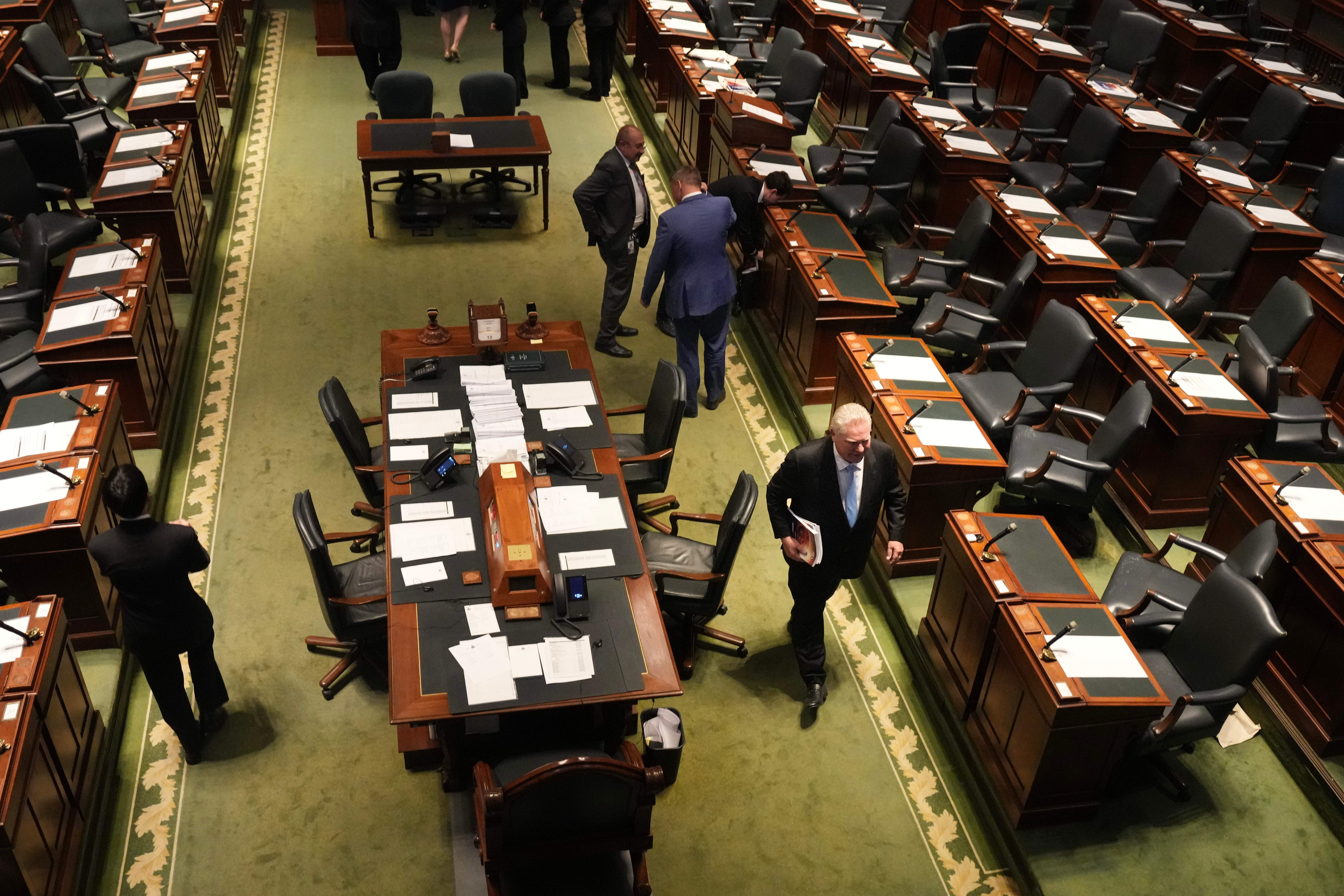
Standard legislative procedure in Ontario involves a committee stage. This is the period where a bill is poked, prodded, and criticized by legal experts, advocacy groups, and the general public. It is the democratic safety valve. By skipping this process, Government House Leader Steve Clark is removing the opportunity for the Information and Privacy Commissioner or civil liberties groups to put the government’s claims on the record.
The bill, known as Bill 97 or the Plan to Protect Ontario Act, 2026, introduces a specific exclusion. It removes the Freedom of Information and Protection of Privacy Act (FIPPA) from applying to records in the "custody or under the control" of a minister or the Premier’s office.
- The Lobbyist Connection: Currently, FOI requests are one of the few ways to verify when and where lobbyists meet with cabinet ministers. Ontario’s lobbying laws are notoriously weaker than the federal equivalent. Without phone logs or ministerial calendars, the public has zero ability to verify if a policy change was sparked by a constituent's need or a private dinner with a developer.
- The Federal Fallacy: The Premier has defended the move by claiming he is simply "aligning" Ontario with federal standards. This is a half-truth that collapses under scrutiny. While federal ministers’ offices have certain exemptions, the Supreme Court of Canada has maintained a standard of transparency that Ontario is now actively legislating against. Ontario isn't aligning; it is retreating.
- The Retroactive Clause: Perhaps the most aggressive feature of this legislation is its retroactivity. It doesn't just stop future requests. It seeks to legally incinerate requests that are already in the system.
An Omnibus Shield
The government is using a classic political maneuver: the omnibus budget bill. By burying the FOI overhaul inside a document that also addresses conservation authorities, ticket price caps, and the redevelopment of land near the Rogers Centre, they force the opposition to fight on a dozen fronts at once.
It is a strategy of exhaustion. When everything is an emergency, nothing gets the scrutiny it deserves. Government House Leader Steve Clark has previously justified fast-tracking laws by citing a "need for certainty." In this case, the only certainty being provided is that the Premier’s communications will remain a black box.
This isn't the first time this administration has pushed the boundaries of legislative speed. In the past year, they have used similar tactics to ban speed cameras and shutter supervised consumption sites. But those were policy debates. This is a debate about the rules of the game itself. If the public cannot see who the Premier is talking to, the public cannot hold the Premier accountable for what he says.
The Cost of Convenience
The government argues that these changes are necessary to relieve "operational pressure." They claim that FOI offices are overwhelmed by complex requests and "AI-driven" inquiries. There is a grain of truth here. The volume of digital data is exploding. But the solution to a backlog isn't to stop measuring the work.
The legislation shifts the basic response time from 30 calendar days to 45 business days. On its own, that might be a reasonable administrative update. But paired with the ministerial exemption, it creates a two-tier system of information. You can eventually find out how much a local agency spent on office chairs, but you will never find out who texted the Premier the night before a billion-dollar land deal was announced.
The Information Vacuum
Information and Privacy Commissioner Patricia Kosseim has been vocal about the danger here. She warned that these changes would "weaken transparency and accountability for generations." This is not an exaggeration. Once a record is removed from the scope of FIPPA, the culture of record-keeping changes. If a staffer knows a text message can never be subpoenaed by a journalist, they stop being careful. They stop using official channels. The "off-the-books" government becomes the only government.
The NDP and Liberal opposition have characterized this as an "attack on democracy." While that phrase is often used as political hyperbole, in this context, it carries weight. Democracy relies on the informed consent of the governed. If the governed are legally barred from the information required to be informed, consent is a formality, not a choice.
The bypass of public hearings is the final signal that the government is not interested in a "spirited" debate. They are interested in a fait accompli. By the time the public fully understands what has been lost, the law will be in effect, the records will be shielded, and the vault will be locked.
The immediate action step for those concerned with provincial transparency is to demand the reinstatement of the committee stage. Without public testimony from the Privacy Commissioner and constitutional experts, Bill 97 will pass as a budget measure while serving as a transparency executioner.