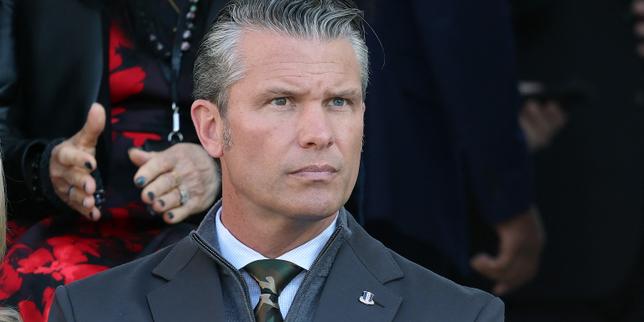
At the Tomb of the Unknown Soldier in Arlington National Cemetery, the rules do not bend for rank, celebrity, or political office. When a sentinel of the 3d U.S. Infantry Regiment, known universally as The Old Guard, reprimanded Pete Hegseth near the sacred plaza for a breach of protocol, the brief viral clip captured far more than a momentary lapse in etiquette. It exposed an enduring fault line in modern American public life: the collision between strict, apolitical military tradition and the relentless demands of contemporary political media.
A Tomb Guard's command to show respect is never personal. It is mechanical, practiced, and absolute. Whether a visitor is a tourist from Ohio, a four-star general, or a high-profile political figure and veteran like Hegseth, the sentinel's mandate remains identical. They are tasked with maintaining an unbroken, reverent silence and enforcing strict behavioral boundaries around the marble sarcophagus. Yet when such an intervention involves a prominent media personality and public figure—particularly one whose public brand is deeply intertwined with military identity and defense politics—the incident instantly transforms from a routine enforcement of cemetery regulations into a national Rorschach test.
The Unforgiving Mechanics of the Tomb Plaza
To understand why the reprimand happened, you have to understand how the Tomb of the Unknown Soldier actually operates. Most casual observers view the Changing of the Guard as a solemn tourist attraction. Inside the regiment, it is treated as a continuous, uninterrupted military mission that has run twenty-four hours a day, seven days a week, since July 2, 1937.
The sentinels are not ceremonial actors. They are active-duty infantrymen who volunteer for one of the most grueling, hyper-scrutinized assignments in the United States Army. Fewer than twenty percent of applicants pass the initial screening, and even fewer earn the Tomb of the Unknown Soldier Identification Badge, one of the rarest decorations in the military. Their daily reality is governed by mathematical precision. Twenty-one steps down the black mat. Twenty-one seconds facing east toward Washington, D.C. Twenty-one seconds facing north before turning to retrace the path.
Everything on that plaza is designed to strip away individual ego. The sentinel wears no rank insignia on their uniform so they never outrank the Unknowns—and so no visitor can pull rank on them.
When a visitor crosses a barrier, speaks loudly, records in a restricted manner, or disrupts the solemnity of the perimeter, the sentinel breaks their silent march. They turn, bring their rifle to port arms, and deliver a sharp, booming verbal challenge. "It is requested that everyone maintain a level of silence and respect," or a direct, forceful command to step back or quiet down. The voice is deliberately loud and authoritative. It is meant to startle the offender into immediate compliance without requiring physical contact.
Why Public Figures Keep Getting Caught Off Guard
Pete Hegseth is no stranger to military environments. As a former Army National Guard officer who deployed to Guantanamo Bay, Iraq, and Afghanistan, and later became a prominent conservative commentator and political figure, he understands military hierarchy better than most civilians. That background is precisely why the incident drew such intense scrutiny.
When a civilian tourist gets yelled at by a Tomb Guard—and it happens dozens of times every week—nobody writes a headline. People forget that the plaza is an active grave site, not a film set. They step over a chain to get a better angle for a smartphone photo, or they continue a conversation that echoes across the marble amphitheater.
Public figures, however, operate inside an ecosystem built on constant documentation. Whenever a prominent political figure visits a landmark, an entourage follows. There are aides, security details, photographers, and videographers trying to capture authentic moments for public consumption. In that environment, the instinct is to stage, frame, and narrate.
Arlington National Cemetery is structurally hostile to that instinct.
Under 32 CFR Part 553, the federal regulations governing Army National Military Cemeteries, political campaigning, partisan activity, and unauthorized filming or staging on cemetery grounds are strictly prohibited. Even when an event is framed as a personal visit or a tribute to fallen service members, the friction between creating media content and observing quiet reverence is almost unavoidable. Cameras click. Handlers whisper directions. People move slightly out of bounds to clear a shot. To a Tomb Guard whose peripheral vision is trained to detect the slightest anomaly on the plaza, those subtle movements register immediately as a breach of decorum.
The Myth of the Personal Rebuke
When the video of the exchange circulated online, partisan commentators immediately split into predictable camps. Critics of Hegseth framed the sentinel's sharp tone as a humiliating public scolding of a figure who frequently invokes military ethos. Supporters countered that the moment was blown out of proportion, arguing it was a minor procedural correction or an honest mistake in a crowded, high-pressure setting.
Both interpretations miss the institutional reality of The Old Guard.
A Tomb Guard does not know—and does not care—who is standing behind the stanchions. During their walk on the mat, their focus is locked forward. They do not scan the crowd for familiar faces from television or politics. When they issue a verbal correction, they are reacting to a specific spatial or acoustic violation in their sector.
Consider a hypothetical example of how this plays out on a typical afternoon at Arlington. Imagine a retired colonel visiting with his family who steps six inches past a velvet rope to point out an inscription on the marble to his grandson. The sentinel does not pause to check the man's lapel pin or acknowledge his service record. The rifle snaps to port arms, and the barked command echoes off the colonnade just as loudly as it would for a teenager chewing gum too loudly.
In the military, uniform enforcement is the entire point. The moment a sentinel begins making exceptions for VIPs, former officers, or political allies, the integrity of the guard mount collapses. The authority of the Tomb Guard rests entirely on absolute impartiality.
The Broader Collision Between Media Culture and Sacred Spaces
The deeper story here is not really about one awkward afternoon in Virginia. It is about what happens when modern attention economics collide with institutions that refuse to modernize their rules.
Over the past decade, sacred and solemn spaces across the world have struggled to adapt to the smartphone era. From Westminster Abbey to the Vietnam Veterans Memorial, custodians face a constant battle against visitors who experience historic sites primarily through a viewfinder. For politicians and media figures, the pressure is amplified exponentially. A visit to a national monument that is not captured on camera and distributed to an audience almost ceases to exist in the political sphere.
This creates a structural trap. To demonstrate patriotism, reverence, or leadership, public figures must be seen at places like Arlington. Yet the very act of bringing cameras, handlers, and production crews into a space designed for quiet reflection inherently threatens the atmosphere they are trying to honor.
Arlington National Cemetery has repeatedly tightened its media policies in response to this trend. The cemetery's public affairs office maintains strict guidelines separating genuine news coverage from personal or political content creation. Wreath-laying ceremonies at the Tomb of the Unknown Soldier are choreographed down to the second, with mandatory briefings for participants before they ever set foot on the plaza.
Even with those briefings, mistakes happen. Nerves, unfamiliarity with the exact boundaries of the plaza, or a momentary distraction by a member of a visiting party can trigger a sentinel's intervention. Once that happens, the viral mechanics of social media take over. A three-second clip stripped of its wider context becomes permanent digital folklore, replayed endlessly by political adversaries.
What Happens Behind the Scenes After a Breach
In the immediate aftermath of a public reprimand at the Tomb, the reaction inside the cemetery is remarkably understated. Unlike political press shops that scramble to issue statements and spin narratives, The Old Guard treats the moment as completely routine.
Once the sentinel completes their challenge and the visitor steps back or lowers their voice, the guard immediately returns to shoulder arms, executes a crisp facing movement, and resumes their twenty-one-step cadence. There is no lingering glare. There is no follow-up lecture once compliance is achieved. Off the plaza, in the quarters beneath the Memorial Amphitheater, the incident rarely merits more than a brief log entry if a security barrier was physically breached.
For the visitor, however, the psychological impact is intense. Being corrected in front of hundreds of silent onlookers in one of the quietest places in the country carries a unique sting. There is nowhere to hide, and arguing back is unthinkable. Even the most seasoned media figures know that pushing back against a Tomb Guard is institutional suicide. The only viable move is immediate, silent deference.
The Real Lesson for Public Figures and Visitors Alike
The enduring power of the Tomb of the Unknown Soldier lies in its refusal to compromise. Everything around Washington, D.C., shifts with the political winds. Administrations change, media cycles burn through scandals in hours, and public figures constantly reinvent their personas to fit the moment.
The black mat at Arlington does not change. The standards enforced by the soldiers of the 3d U.S. Infantry Regiment have remained virtually untouched for generations, surviving wars, social upheaval, and the rise of twenty-four-hour digital media.
When a prominent figure like Pete Hegseth gets checked by a Tomb Guard, it serves as a stark reminder of how rare true institutional neutrality has become. In an era where almost every public interaction is filtered through partisan loyalty or personal branding, the sight of a nameless, rankless soldier enforcing the exact same standard on everyone—without fear, favor, or hesitation—cuts through the noise. The rules at the Tomb do not exist to flatter the living, regardless of their resume or their platform. They exist solely to protect the quiet dignity of the dead.