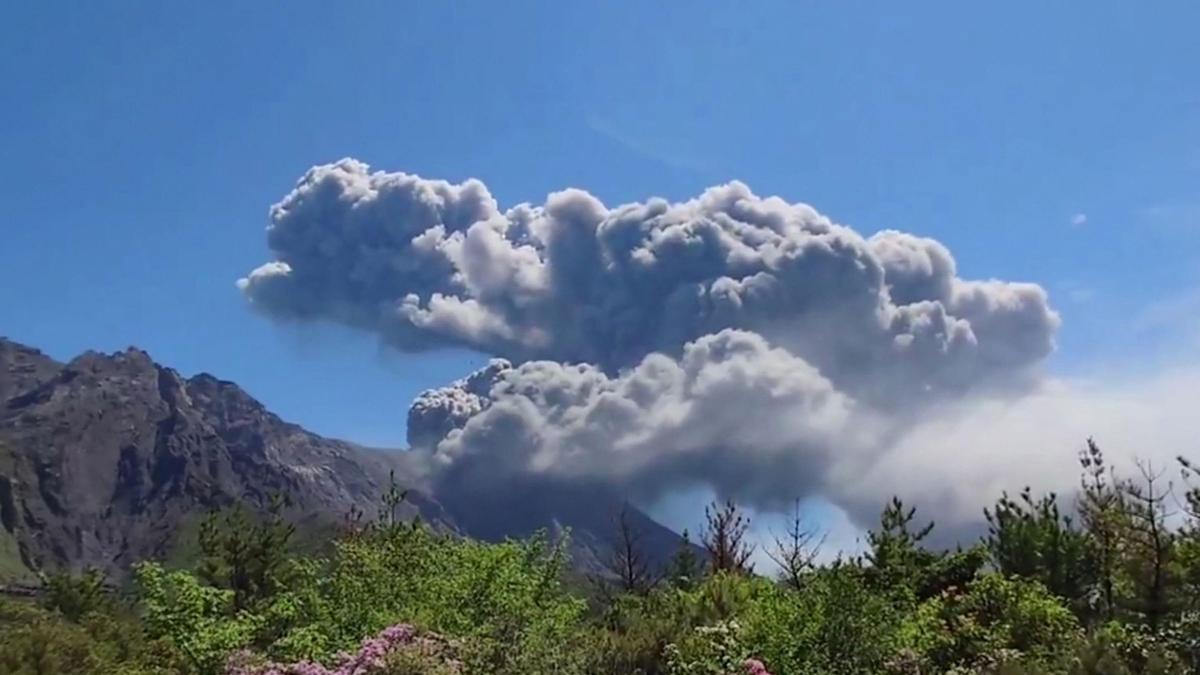
Media outlets are currently fixated on a 3.4 km ash plume rising from a Japanese volcano as if that number actually means anything. They treat every eruption like a high-jump competition. If the ash hits 3 km, it’s a headline. If it hits 10 km, it’s an apocalypse. This obsession with verticality is a lazy metric that masks the real mechanics of volcanic risk. I have spent years tracking geological data feeds and disaster response protocols; the height of a plume is often the least interesting thing happening during an eruption.
Most newsrooms look at a volcano and see a smokestack. They apply a linear logic: higher equals scarier. It’s a fundamental misunderstanding of fluid dynamics and atmospheric pressure. A 3.4 km plume is essentially a thermodynamic shrug. In the world of volcanology, height is a vanity metric. It’s the "likes" and "retweets" of geology—visible, easy to track, but frequently disconnected from the actual impact on the ground. If you liked this article, you might want to look at: this related article.
The Plume Height Fallacy
When a volcano like Sakurajima or Suwanosejima lets off steam, the height of the column depends more on local weather and atmospheric stability than the actual mass of material ejected. We call this the "plume height fallacy." A massive eruption in a high-pressure system might struggle to punch through the atmosphere, while a minor vent-clearing event in a low-pressure window looks like a world-ending event on a satellite feed.
The media focuses on the 3.4 km mark because it fits a template. But they never mention the Mass Eruption Rate (MER). If you want to know how dangerous a volcano is, stop looking at the sky and start looking at the tonnage. For another angle on this event, refer to the latest update from Associated Press.
$$MER = \frac{\pi \rho_a g H^4}{8 \alpha^2 L}$$
In this simplified model for plume height $H$, variables like entrainment coefficients $\alpha$ and atmospheric density $\rho_a$ dictate the visual outcome. Notice how much power the height $H$ has in that equation? Small changes in atmospheric conditions can wildly inflate the visual height without adding a single gram of new rock to the hazard profile. Reporters are giving you the $H$ without understanding the physics behind it.
The Real Killer is Horizontal, Not Vertical
While the public stares at ash clouds 3.4 km up, the actual threat usually moves at eye level. Pyroclastic density currents (PDCs)—those terrifying, ground-hugging avalanches of hot gas and rock—don't care about plume height. You can have a relatively low ash column that collapses under its own weight, sending a lethal surge into nearby valleys.
I’ve seen disaster agencies focus so heavily on flight path disruptions from high-altitude ash that they under-communicate the risk of lahars (volcanic mudslides) to the people living at the base. High plumes are a problem for jet engines. Ground-level surges are a problem for human lungs. One is an economic inconvenience; the other is a mass casualty event.
The "lazy consensus" dictates that we should be worried about the ash drifting toward cities. In reality, the ash fall is a cleanup headache. The real danger is the seismic instability and the potential for flank collapse. If a mountainside gives way, it doesn't matter if the ash plume was 1 km or 10 km. The geography of the region is rewritten in seconds.
Why We Ignore the Subsurface Data
Why doesn’t the media report on InSAR (Interferometric Synthetic Aperture Radar) data or GNSS (Global Navigation Satellite System) ground deformation? Because you can’t take a dramatic photo of a 2-centimeter ground swell.
- InSAR: Measures how the ground surface deforms as magma moves underneath.
- SO2 Flux: Measures the chemical "breath" of the volcano, signaling how close the magma is to the surface.
- Acoustic Monitoring: Tracks the literal sound of the earth breaking.
These are the metrics that matter. A 3.4 km plume is often just "throat clearing." It’s the volcano exhaling old material to make room. The real story is the pressure building five miles down, which isn't visible on a TikTok video.
The Economic Theater of Volcanic Alerts
There is a financial incentive to keep these "scary" numbers in the press. Aviation insurance, regional tourism boards, and government funding cycles all thrive on the drama of the "high plume."
If an eruption is labeled as "minor" or "routine" (which a 3 km plume usually is for an active Japanese peak), the funding for monitoring equipment stays flat. If it’s framed as a "massive eruption sending ash miles into the sky," the budget opens up. We are participating in a cycle of geological sensationalism that prioritizes the spectacle over the science.
The False Security of Distance
People see a plume height and calculate their safety based on how far away they are from the mountain. This is a mistake. Volcanic systems are linked to broader tectonic structures. An eruption at one peak is often a symptom of regional stress. Focusing on a single plume is like looking at one pimple and ignoring the fact that the patient has smallpox.
In Japan, the Nankai Trough and the Sagami Trough are the real players. A small eruption is a data point in a much larger, much more dangerous puzzle. By hyper-focusing on the "height of the ash," we ignore the systemic risk of the Ring of Fire. We are checking the tire pressure while the engine is on fire.
Stop Asking "How High?"
The next time you see a headline about ash reaching some arbitrary height, ask the questions the "experts" are avoiding:
- What is the composition of the ash? Is it fresh juvenile magma or just pulverized old rock?
- What is the deformation rate at the summit? Is the mountain inflating or deflating?
- Is there a change in the seismic tremor frequency? Is the "heartbeat" of the volcano speeding up?
If the answer to these is "we don't know," then the height of the plume is irrelevant noise.
We have become a society of visual observers who have forgotten how to read the underlying mechanics of the planet. We treat the Earth like a movie screen, complaining about the special effects without understanding the script.
A 3.4 km ash plume isn't a news story. It's a distraction. The mountain doesn't care about your cameras, and the physics of the eruption doesn't care about your headlines. Stop looking up and start looking at the data that actually determines who lives and who dies when the ground finally decides to open up.
The height of the plume is a symptom, not the disease.
Focus on the pressure, not the smoke.