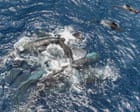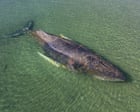
It's rare to get a win in marine conservation that doesn't end in a necropsy. Usually, when a massive fin whale wanders into the shallow, brackish waters of the Baltic Sea or gets stuck in a German bay, the story follows a grim, predictable script. Dehydration sets in. The animal’s own body weight crushes its internal organs. Eventually, it’s a recovery operation for a skeleton. But the recent saga of the young fin whale stranded off the coast of northern Germany bucked the trend in a way that’s honestly pretty miraculous.
After days of being stuck in the shallows near the Baltic port of Wismar, this twelve-meter-long juvenile finally found its way back to deep water. It wasn't just luck. It was a high-stakes waiting game played by rescuers who knew that sometimes, the best way to help a seven-ton mammal is to stop poking it.
Why Fin Whales Get Trapped in the First Place
You have to understand the geography of the Baltic to see why this was such a nightmare scenario. Fin whales are the second-largest animals on earth. They’re built for the deep, wide-open Atlantic. The Baltic Sea is basically a giant, shallow bathtub with a very narrow, confusing drain. When a young whale follows a school of herring or simply takes a wrong turn through the Skagerrak strait, it enters an environment it isn't evolved to navigate.
The water is less salty, which messes with their buoyancy. The acoustic environment is a mess because of shipping traffic. Once they hit the sandy shallows of the German coast, they're in real trouble. In this specific case, the whale was spotted near the Hook of Wustrow. It was agitated. It was splashing. It was clearly exhausted.
Most people see a stranded whale and want to immediately tow it. That’s usually a death sentence. Ropes can tear skin or break the jaw. If you pull too hard, you cause internal trauma. The German responders from the Schleswig-Holstein Agency for Coastal Defense and others took a more disciplined approach. They monitored. They kept boats back. They waited for the tide to do the heavy lifting.
The Problem With Human Intervention
We have a hero complex when it comes to wildlife. We want to see divers in the water and helicopters overhead. But for a fin whale, every human sound is a physical blow. Their hearing is incredibly sensitive. A swarm of "rescue" boats often creates an acoustic wall that prevents the whale from finding the channel back to safety.
The Role of Stress in Cetacean Strandings
When a whale stresses out, its muscle tissue begins to break down. This is called capture myopathy. It releases toxins into the bloodstream that eventually cause kidney failure. You might get the whale back into the water, but it'll die two days later because its internal chemistry is fried.
The rescuers in Germany used a "passive guidance" technique. Instead of trying to lasso the animal, they used small boats to gently nudge it away from the most dangerous shallows without causing a panic. They were essentially acting as living buoys. It’s a boring way to rescue an animal, but it’s the only way that actually respects the biology of a fin whale.
How the Tide Turned
The breakthrough happened after nearly seventy-two hours of tension. The whale had moved into a particularly shallow area of the Bay of Wismar where the water was barely deep enough to cover its dorsal fin. Volunteers and scientists were preparing for the worst. Then, the water levels shifted.
The animal seemed to regain some strength. It stopped thrashing and started making purposeful movements toward the open sea. By the time it reached the deeper channels of the Kadetrinne, one of the busiest shipping lanes in the world, the rescue shifted from "save the whale" to "get the ships out of the way."
It’s a massive logistical headache to redirect commercial shipping for a single animal. But they did it. They gave the whale a clear path. Monitoring teams eventually confirmed that the whale had passed the Fehmarn Belt, a clear sign it was headed back toward the North Sea and, eventually, the Atlantic.
What This Means for Baltic Conservation
This wasn't just a feel-good news story. It’s a data point. We’re seeing more Atlantic species entering the Baltic lately. Some researchers point to "saltwater inflows"—pulses of oxygen-rich, salty water from the North Sea—that bring prey species with them. The whales just follow the food.
The success of the Wismar rescue proves that local agencies are getting better at handling these events. They didn't overreact. They didn't turn it into a circus. They let the animal find its own rhythm.
If you're ever in a position where you spot a stranded marine mammal, don't be the person who runs up to take a selfie or tries to push it back in. You’ll likely kill it. Call the local maritime authorities. Keep your distance. Let the professionals handle the acoustics.
Support local marine biology efforts by reporting sightings through official apps or hotlines. The best thing you can do for a whale in trouble is to give it space and silence. That’s what saved this one.