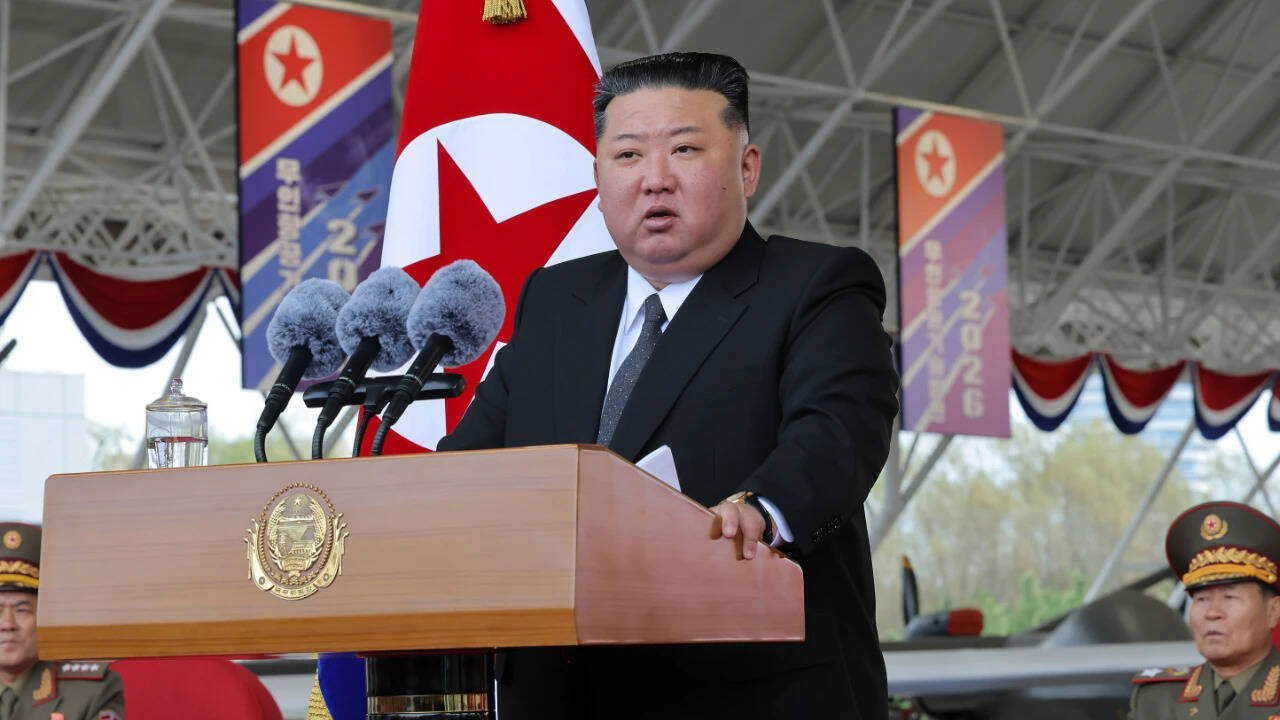
North Korea has officially rewritten its socialist constitution to designate South Korea as a "hostile state" and formally abandon the decades-old policy of peaceful reunification. Confirmed through state media reports detailing recent railway and road demolitions along the border, the Supreme People's Assembly ratified the changes at the direct order of Kim Jong Un. By codifying Seoul as a permanent foreign enemy rather than a wayward brother, Pyongyang has dismantled the ideological foundation of the Kim dynasty, transforming an unresolved civil conflict into a permanent, nuclear-backed standoff between two distinct nations.
For decades, foreign policy analysts treated Pyongyang’s reunification rhetoric as empty theater. They were wrong. That rhetoric was the glue holding the North Korean social contract together. Meanwhile, you can find related developments here: The Mechanics of U.S.-Mediated Prisoner Swaps in Abu Dhabi.
The Death of the Bloodline Myth
To understand the magnitude of this constitutional revision, you have to look at what Pyongyang just threw away. Since the Korean War armistice in 1953, the legitimacy of the Kim regime rested on a singular, sacred mission: liberating the southern half of the peninsula from American occupation and reuniting the Korean bloodline under one roof. Every privation, every famine, and every brutal political purge was justified to the North Korean public as a temporary sacrifice required to bring their southern brethren home.
Kim Jong Un just tore up that contract. To explore the full picture, we recommend the detailed report by Al Jazeera.
In January 2024, Kim stood before the Supreme People's Assembly and demanded that the constitution be purged of words like "reunification," "reconciliation," and "fellow countrymen." He ordered the physical destruction of the Arch of Reunification, a massive concrete monument erected in Pyongyang by his father, Kim Jong Il, to honor the three-point reunification charter drafted by his grandfather, Kim Il Sung. When a totalitarian ruler takes a wrecking ball to his own grandfather’s legacy, he isn't merely updating policy. He is admitting that the old ideology has become an existential threat to his survival.
The numbers tell the story of why the old myth collapsed. South Korea’s economy is roughly fifty times larger than North Korea’s. Its cultural exports—music, television, cinema, and fashion—have saturated the globe, and crucially, they have leaked across the Yalu River into North Korean living rooms via smuggled USB drives and microSD cards.
Pyongyang’s security apparatus spent the last decade fighting an internal war against South Korean pop culture, passing the notorious Reactionary Ideology and Culture Rejection Act in 2020, which prescribes the death penalty for distributing South Korean media. Yet the contradiction remained fatal. How do you execute a teenager for watching a Seoul soap opera while simultaneously teaching them in school that South Koreans are their beloved compatriots waiting to be rescued? You cannot. The cognitive dissonance was rotting the regime from the inside out. By declaring South Korea a separate, hostile foreign state, Kim Jong Un eliminated the ideological loophole. South Koreans are no longer lost cousins; they are simply enemies, no different from Americans or Japanese.
Rewriting the Rules of Nuclear Engagement
Beyond domestic ideological hygiene, this constitutional shift solves a massive legal and doctrinal problem for North Korea’s military planners.
Under the old framework, deploying nuclear weapons against South Korea was an ideological nightmare. You do not drop thermonuclear warheads on territory you claim as your own, nor do you incinerate a population you purport to be liberating. Tactical nuclear doctrine requires a clear enemy target, and for seventy years, Seoul occupied an awkward gray zone in Pyongyang’s legal architecture.
That gray zone is gone.
By defining the Republic of Korea as the "primary foe and invariable principal enemy," the revised constitution strips away any lingering moral or legal hesitation regarding the use of nuclear weapons on the peninsula. It aligns Pyongyang’s supreme law with the aggressive nuclear force policy it adopted in 2022, which explicitly authorizes preemptive nuclear strikes if the regime leadership feels threatened.
Military analysts tracking North Korean weapons testing over the past two years have watched Pyongyang pivot heavily toward short-range ballistic missiles, super-large multiple rocket launchers, and tactical nuclear delivery systems designed specifically to overwhelm South Korean air defenses. The constitutional revision is the legal paperwork catching up to the hardware already sitting in North Korean bunkers. When Kim Jong Un tells his troops that the South is a foreign adversary, he is telling them that Seoul, Busan, and Daegu are fair game for total annihilation.
Erasure on the Ground and in the Maps
The ideological purge is already manifesting in physical, irreversible ways across the Korean Peninsula.
Following the constitutional amendment, the Korean People's Army blew up the northern sections of the Gyeongui and Donghae roads and railways—the last remaining overland arteries connecting the two Koreas, built largely with South Korean taxpayer money during the naive optimism of the 2000s Sunshine Policy. State media published photographs of the explosions, framing them as an inevitable, legitimate measure to physically sever the border in accordance with the new constitution.
The erasure extends to every corner of North Korean civic life:
- State Institutions Dismantled: Agencies dedicated to inter-Korean dialogue and tourism, such as the Committee for the Peaceful Reunification of the Country and the Mount Kumgang International Tourism Administration, have been abolished entirely.
- Cartography Altered: State television broadcasts and weather maps have been cropped to delete the southern half of the peninsula, visually conditioning citizens to view the Demilitarized Zone as an international frontier rather than a temporary ceasefire line.
- Maritime Borders Contested: Kim Jong Un has explicitly rejected the Northern Limit Line, the de facto maritime boundary in the Yellow Sea drawn by the United Nations Command at the end of the Korean War, raising the immediate specter of naval clashes around South Korea’s northwestern border islands.
These are not reversible diplomatic posturing tactics. You do not blow up billion-dollar rail infrastructure and rewrite the foundational text of your state simply to extract sanctions relief at a future negotiating table.
The Geopolitical Calculation Behind the Pivot
A veteran observer of Pyongyang knows that Kim Jong Un rarely makes a move without checking the global chessboard first. This constitutional overhaul is the direct result of a shifting international order that has suddenly turned wildly in North Korea’s favor.
For thirty years, North Korea pursued reunification and diplomatic normalization with Washington because it had no other choice. The Soviet Union had collapsed, China was busy getting rich through Western trade, and Pyongyang was isolated, starving, and desperate for economic lifelines. Engaging with South Korea was a way to extract cash and concessions while keeping the United States at bay.
Today, that desperation is gone.
Russia’s invasion of Ukraine handed Kim Jong Un a geopolitical windfall he could never have engineered on his own. By shipping millions of artillery shells, ballistic missiles, and eventually combat troops to prop up Vladimir Putin’s war effort, North Korea secured a powerful patron on the United Nations Security Council. Moscow has vetoed the renewal of the UN panel of experts monitoring North Korean sanctions, effectively blinding international oversight, while funneling fuel, food, and advanced military technology back into Pyongyang.
Meanwhile, deepening strategic competition between Washington and Beijing guarantees that China will never enforce crushing economic sanctions against its buffer state on the peninsula. With Moscow providing material support and Beijing providing diplomatic cover, Kim Jong Un no longer needs South Korea’s money, and he certainly no longer needs Washington’s approval. The economic incentives that kept the reunification dream alive in Pyongyang have evaporated.
What Seoul and Washington Get Wrong About the New Reality
The prevailing wisdom in many Western policy circles is that this constitutional change is merely an admission of failure—a defensive crouch by an insecure dictator terrified of South Korean cultural influence. While that assessment captures half the truth, it dangerously underestimates the offensive utility of the move.
In Seoul, conservative and progressive administrations alike have spent decades building their entire foreign policy apparatus around the eventual unification of the peninsula. South Korea’s own constitution, in Article 3, still defines its territory as "the Korean peninsula and its adjacent islands," legally claiming the North as part of the Republic of Korea. South Korea maintains a dedicated Ministry of Unification, collects taxes earmarked for unification costs, and structures its diplomatic outreach around the premise that the division is temporary.
Pyongyang’s constitutional revision forces Seoul into an asymmetric bind. If South Korea maintains its constitutional claim over the North while Pyongyang renounces any claim over the South, North Korea can frame itself internationally as a normal sovereign state simply demanding respect for its borders, while portraying South Korea and the United States as the aggressive expansionists refusing to accept territorial reality.
Furthermore, by declaring the two Koreas to be separate, hostile states, Kim Jong Un has killed any domestic political appetite in South Korea for engagement. Progressive politicians in Seoul who advocate for sunshine policies, humanitarian aid, or inter-Korean economic projects now have zero ideological foothold in Pyongyang. There is nobody left on the other side of the DMZ whose job it is to talk to them. The phone lines are cut, the liaison office was blown up in 2020, and the roads are craters.
The Permanent Cold War
There is a grim clarity to what has just occurred on the Korean Peninsula. For seventy-one years, the world operated under the polite fiction that the Korean War was merely paused, waiting for the right diplomatic breakthrough to bring a divided family back together.
That era is over. By etching permanent division into its constitution, North Korea has formalized a new Cold War in Northeast Asia. Border skirmishes in the Yellow Sea or along the DMZ will no longer be treated as tragic misunderstandings between brothers; they will be treated as sovereign acts of war between hostile nations, backed by a growing arsenal of tactical nuclear weapons and a newly emboldened Russian alliance.
The flags of a unified Korea have been lowered for good, leaving two heavily armed states staring across a mined border with nothing left to say to each other.