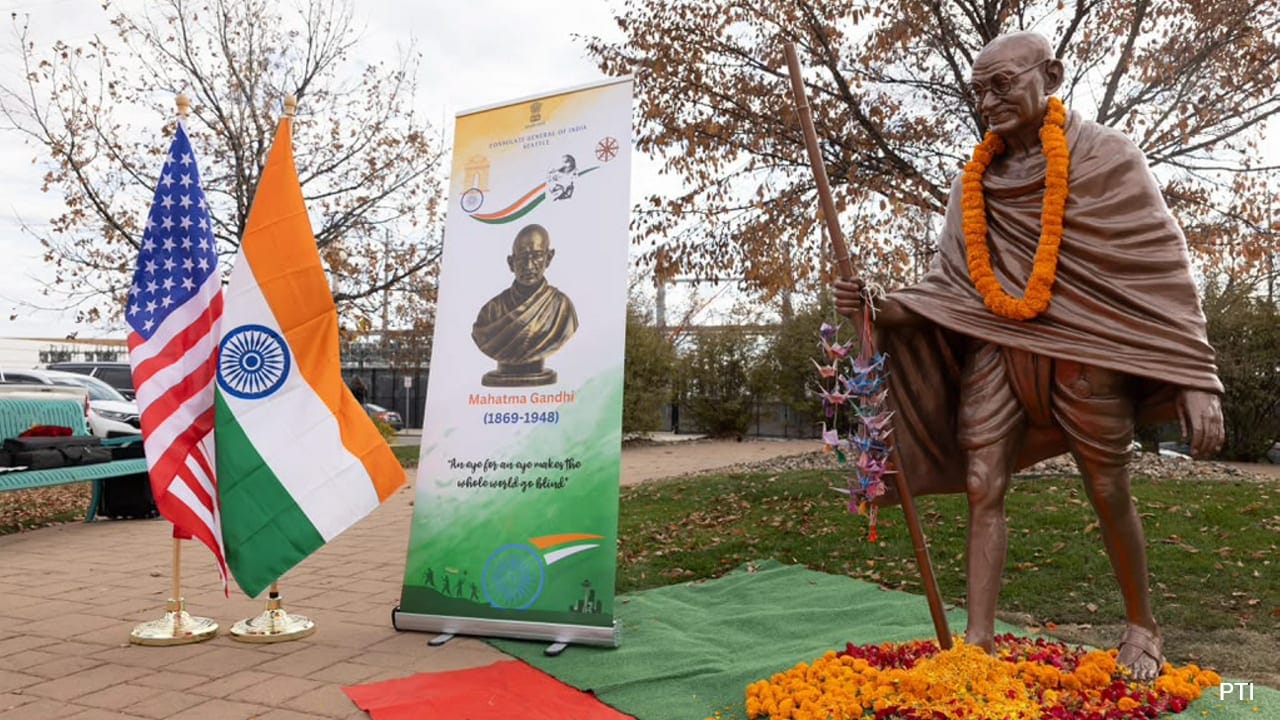
You probably wouldn't expect to find a bronze monument to an Indian independence leader standing in the middle of the American Great Plains. Yet that's exactly what happened when North Dakota installed its first-ever life-size Mahatma Gandhi statue in Fargo.
Most coastal media outlets treated the event like a quirky local footnote. They missed the bigger story entirely. When a state known more for oil fields, harsh winters, and agricultural exports dedicates prime public space to a global symbol of nonviolence, something notable is shifting in American civic culture.
What Actually Happened in Fargo
Let's get the basic facts straight first, because online rumors tend to distort local monument stories within hours. The life-size bronze statue of Mahatma Gandhi was officially dedicated in Fargo, North Dakota, marking a genuine first for the state.
Local Indian American community members worked alongside city officials and cultural organizations to bring the project to life. Unlike massive federally funded memorials in Washington, D.C., grassroots monuments like this one rely heavily on private fundraising, persistent civic advocacy, and months of municipal zoning approvals.
The statue depicts Gandhi in his familiar walking pose, staff in hand, mid-stride. That specific visual choice isn't accidental. Sculptors commissioned by the Indian Council for Cultural Relations (ICCR) and diaspora groups almost always favor the walking posture over a seated meditation pose. It represents active resistance rather than passive contemplation.
If you've ever visited Fargo's public parks or riverfront areas, you know the city takes its public art seriously, even when wind chills drop well below zero. Placing a bronze figure there sends a clear signal that the state's growing South Asian community isn't just passing through for university degrees or medical residencies. They're putting down permanent roots.
Why North Dakota Needed This Monument Right Now
People love to stereotype the Upper Midwest as monolithic. Spend ten minutes looking at actual demographic data from Fargo, Grand Forks, and Bismarck, though, and that stereotype falls apart fast.
Over the past fifteen years, North Dakota's economy drew thousands of engineers, doctors, software developers, and students from India and across South Asia. North Dakota State University (NDSU) in Fargo has hosted a thriving Indian student association for decades. Healthcare networks like Sanford Health and Essentia Health rely heavily on international physicians to keep rural clinics running.
When a community contributes that much to a region's daily survival, they eventually want their heritage reflected in the public square. Honestly, it's basic human nature. You want your kids to walk through a local park and see someone who looks like their grandparents honored alongside local pioneers.
There's also a practical diplomatic angle here that most casual observers miss. State-level cultural landmarks act as quiet magnets for international trade and academic partnerships. When Indian business delegations or university researchers visit North Dakota to discuss agricultural tech or energy grids, a dedicated Gandhi memorial serves as an immediate bridge of goodwill.
The Real History of Gandhi Statues Across America
North Dakota isn't operating in a vacuum. It joined a long, sometimes complicated tradition of Gandhi memorials scattered across the United States.
If you look at where these statues sit nationwide, a distinct pattern emerges:
- Washington, D.C. hosts the most famous one right outside the Indian Embassy on Massachusetts Avenue, dedicated in 2000 with then-Prime Minister Atal Bihari Vajpayee and President Bill Clinton present.
- New York City has had a prominent bronze Gandhi in Union Square Park since 1986, positioned deliberately near other icons of social reform.
- Atlanta placed its statue at the Martin Luther King Jr. National Historic Site, highlighting the direct ideological pipeline between Gandhi's Satyagraha movement and the American Civil Rights struggle.
- San Francisco, Houston, and Chicago all maintain major installations funded through combinations of diaspora donations and diplomatic gifts from New Delhi.
For years, the Upper Midwest remained a massive blank spot on that map. While coastal metros and major Sunbelt cities erected monuments decades ago, states like North Dakota, South Dakota, and Montana had none. Fargo's installation broke that geographic barrier.
What Most People Get Wrong About Public Monuments
Whenever a new statue goes up anywhere in America, social media immediately splits into two predictable camps. One side treats the bronze figure as an infallible saint. The other side demands its immediate removal based on modern political grievances.
Both reactions miss the point of how civic art actually works.
A monument isn't a blanket endorsement of every single opinion a historical figure held across a seventy-eight-year lifespan. Historians have documented Gandhi's flaws extensively, including his early, prejudiced writings during his years in South Africa—views he later repudiated as his political consciousness evolved. Pretending those complexities don't exist insults everyone's intelligence.
At the same time, reducing Gandhi's entire legacy to those early failings ignores why Martin Luther King Jr., Nelson Mandela, and Cesar Chavez studied his tactics like a blueprint. Gandhi proved that an unarmed population could dismantle the largest empire on earth without firing a single shot. That core strategic insight remains one of the most radical ideas in human history.
Fargo's statue works precisely because it invites conversation rather than shutting it down. Public spaces shouldn't feel like sterile corporate lobbies. They should make you stop, read a plaque, and think about how ideas travel across oceans.
The Behind-the-Scenes Reality of Installing Civic Statues
If you think getting a statue approved in a mid-sized American city is as simple as writing a check and pouring concrete, think again. Having followed municipal art installations across several states, I can tell you the red tape alone kills half of these projects before a single ounce of bronze gets cast.
First, organizers have to navigate park board politics. City councils worry endlessly about maintenance budgets, winter weather damage, and setting precedents for every other ethnic or religious group in town. If they approve a Gandhi statue this year, what happens when three other community groups show up next month demanding their own corners of the same park?
Second, there's the logistics of the sculpture itself. Many Gandhi statues in North America are cast by master sculptors in India—often following the classic styles established by artists like Ram V. Sutar or Gautam Pal—and shipped across the ocean in reinforced crates. Customs clearance, structural engineering for frost-heave foundations (crucial in North Dakota, where the ground freezes six feet deep), and liability insurance eat up tens of thousands of dollars before the unveiling ceremony even gets scheduled.
The fact that Fargo's organizers cleared every single one of those hurdles speaks volumes about their persistence. They didn't just ask for a favor from city hall; they built a coalition that made the project impossible to ignore.
How This Connects to King and American History
You can't separate Gandhi's presence in an American park from the broader story of the United States itself. The intellectual exchange between India and America goes back way further than modern immigration waves.
Henry David Thoreau wrote Civil Disobedience in 1849 while living in Massachusetts. Decades later, Gandhi read Thoreau's essay while imprisoned in South Africa and used it to sharpen his own philosophy of nonviolent resistance. Then, in the 1950s, Martin Luther King Jr. took Gandhi's methods and applied them directly to the segregated American South, even traveling to India in 1959 to walk in Gandhi's footsteps.
It's a complete circle. An American writer inspired an Indian lawyer, who in turn inspired an American preacher. Placing Gandhi's likeness in North Dakota isn't importing a foreign ideology; it's bringing an essential chapter of American civic philosophy back home.
Seeing the Bigger Picture in Fargo
If you live anywhere near the Red River Valley, go see the statue in person rather than judging it through compressed photos on your phone screen. Walk up to it, look at the details in the bronze casting, and read the inscription.
Pay attention to how the surrounding park space is used. Notice the families taking photos, the students cutting across the grass on their way to class, and the quiet contrast between the tropical cotton robes sculpted in metal and the crisp northern air around them. That contrast is the entire story of modern America in one frame.
For anyone involved in local civic groups or cultural associations hoping to bring similar landmarks to their own towns, take notes from how Fargo pulled this off. Start building relationships with your local parks department at least two years before your target date, secure private maintenance endowments upfront so taxpayers aren't footing the bill, and anchor the project in local educational partnerships so schools actually use the site after the ribbon-cutting cameras leave.


