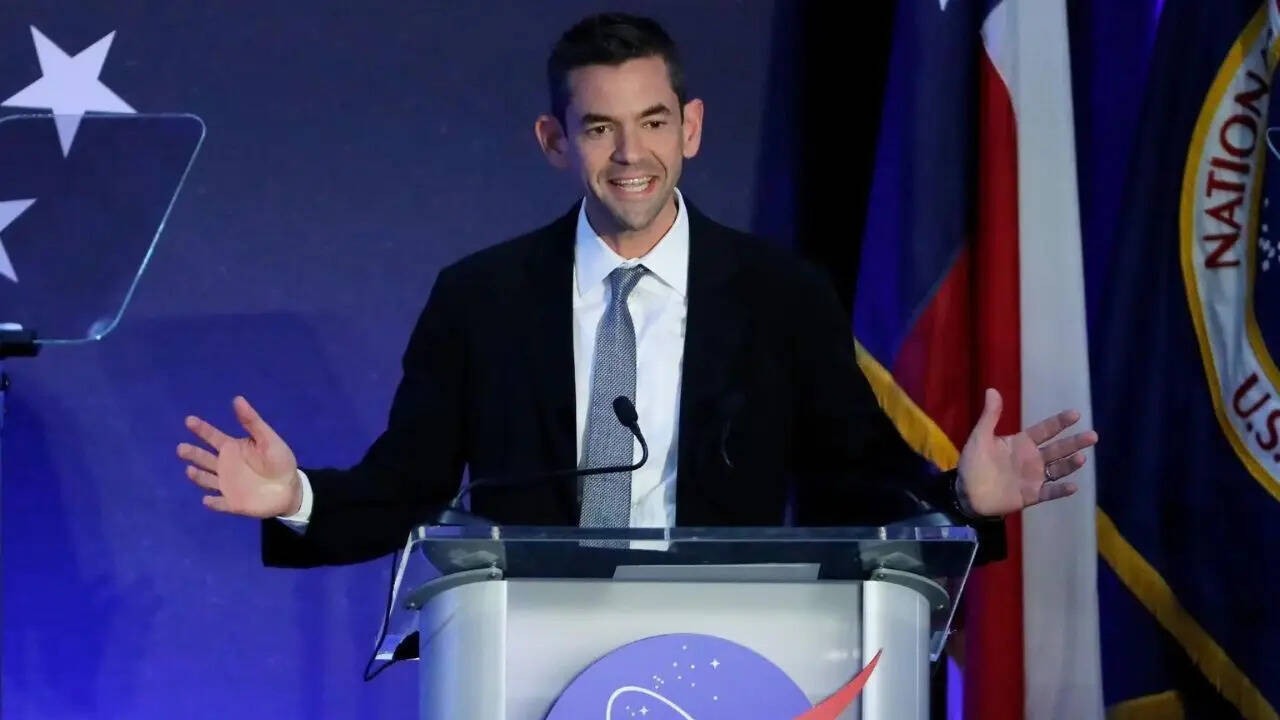
In a small, windowless room within the Dirksen Senate Office Building, the air smells faintly of floor wax and old paper. Jared Isaacman, a man who has actually looked at the curvature of the Earth from the silence of a Dragon capsule, sat before a microphone that seemed too small for the weight of the words he was about to deliver. He wasn't there to talk about budgets or solid rocket boosters. He was there to talk about an exile.
Eighteen years ago, a group of humans in a conference hall in Prague decided that a world we had known for three-quarters of a century no longer counted. They checked their boxes, looked at their math, and effectively evicted Pluto from the neighborhood. We were told it was a "dwarf." A minor player. A debris-strewn afterthought at the edge of the dark. For a more detailed analysis into similar topics, we recommend: this related article.
But as Isaacman leaned into the record of the U.S. Senate, he voiced a sentiment that has quietly simmered in the hearts of both veteran astronomers and school children who still refuse to scratch that ninth circle out of their textbooks. The definition of a planet isn't just a clinical checklist. It is a fundamental map of our place in the vacuum. By shrinking the map, we have inadvertently shrunk our ambition.
The Math of Exclusion
To understand why a NASA Administrator is spending political capital on a ball of ice 3.2 billion miles away, you have to look at the three-part rule that killed Pluto’s status in 2006. The International Astronomical Union (IAU) decreed that to be a planet, an object must orbit the Sun, be roughly spherical, and—here is the sticking point—"clear the neighborhood" around its orbit. For further details on this development, extensive reporting can also be found at USA Today.
Pluto fails the third test. It lives in the Kuiper Belt, a chaotic ring of frozen relics left over from the solar system's birth. Because Pluto shares its path with a thousand other icy ghosts, the math says it isn't dominant enough to earn the title.
But imagine applying that logic to a city. If you judge a skyscraper not by its height or its complexity, but solely by whether it has cleared all the smaller buildings away from its base, you lose the ability to describe the skyline. Isaacman’s argument to the Senate wasn't just about nostalgia; it was a challenge to the rigidity of that third rule. If Earth were placed in Pluto’s orbit, our own home wouldn't be able to "clear" that vast, debris-heavy lane. Under the current definition, Earth would be stripped of its rank too.
The distinction feels arbitrary. It feels like a technicality designed to keep the list of planets short and manageable, rather than reflective of the wild, messy reality of the cosmos.
A World with a Heartbeat
For a long time, the "dwarf" label allowed us to imagine Pluto as a dead, static rock. We pictured a gray, cratered marble floating in a permanent deep-freeze. Then, in 2015, the New Horizons probe roared past at 30,000 miles per hour, sending back images that shattered every assumption we held.
We didn't find a graveyard. We found a world with a literal heart—a massive, nitrogen-ice plain named Sputnik Planitia that pulses with geological life. We saw mountains made of water-ice that rival the Rockies, draped in red hydrocarbon snow. We saw evidence of a liquid ocean hidden beneath the crust, a dark, salty womb that suggests life might find a way even in the furthest reaches of the sun’s influence.
When you look at those photos, the word "dwarf" feels like an insult. It is a geologically active, complex world with five moons and an atmosphere that rises and falls like a breath. To Isaacman, and to the scientists who spent decades getting a camera to that lonely outpost, the label "planet" is a recognition of that complexity. It is an admission that size is the least interesting thing about a celestial body.
The Human Stakes of a Label
Why does the name matter?
Critics argue that this is a semantic distraction. They say the science remains the same whether we call it a planet, a planetoid, or a Kuiper Belt Object. But language is the primary tool of human inspiration.
Consider a ten-year-old looking through a backyard telescope. There is a profound psychological difference between telling that child they are looking at "space debris" versus telling them they are looking at a "planet." One suggests a remnant, a piece of trash left over from the real construction project. The other suggests a destination. A world. A frontier.
The "Planet" designation is a cultural flare. It signals to the public, to the taxpayers, and to the next generation of explorers that a specific place is worthy of our highest level of scrutiny and wonder. By demoting Pluto, we didn't just change a definition; we lowered the stakes of the outer solar system. We told ourselves that everything past Neptune was just the "suburbs," not worth the gas money to visit.
Isaacman’s testimony touched on this invisible cost. We are in a new era of spaceflight—a transition from government-led excursions to a multi-planetary civilization. If we want to colonize the stars, we cannot afford a narrow, exclusionary view of what constitutes a "world." We need a taxonomy that embraces the diversity of the universe, from the scorched iron of Mercury to the frozen, tectonic heart of Pluto.
The Clearing of the Neighborhood
The debate in the Senate chamber eventually circled back to the "clearing the neighborhood" clause. Isaacman proposed a shift toward a geophysical definition. Under this framework, if an object has enough gravity to crush itself into a sphere and possesses complex geology, it’s a planet. Simple. Intuitive.
Under this rule, our solar system wouldn't have eight planets. It might have dozens.
This is what scares the traditionalists. They worry that if we include Pluto, we must include Eris, Makemake, and Haumea. They fear a solar system where school children can’t memorize all the names.
But science isn't supposed to be convenient for memorization. The periodic table has 118 elements, and we don't ask chemists to declassify "Oganesson" just because it’s hard for a fourth-grader to remember. We teach the complexity because the complexity is the truth. We should be celebrating the fact that our neighborhood is more crowded and more interesting than we ever dreamed in 1930.
The View from the Edge
There is a certain loneliness in the way we talk about the edge of our system. We treat it as the "outer" limits, as if the Sun is the only thing that matters. But for someone like Isaacman, who has seen the thin blue line of our atmosphere against the absolute black, the perspective is different.
From the vantage point of a spacecraft, there are no "minor" worlds. There are only islands in the dark.
By restoring Pluto’s status, we aren't just correcting a perceived snub to a beloved ball of ice. We are correcting our own perspective. We are admitting that our first attempts to categorize the universe were flawed and that we are humble enough to change our minds when the evidence—in the form of towering ice mountains and vast, frozen plains—demands it.
The hearing ended not with a vote, but with a lingering sense of unfinished business. The microphone was turned off, the senators dispersed to their next briefings, and the wax-scented room returned to its quiet routine. But the question remains hanging in the air, as persistent as the orbit of the small, cold world it concerns.
We once sat at a table with nine chairs. We pulled one away, claiming the occupant didn't meet the height requirement, even as that occupant showed us it possessed a heart, an ocean, and a family of moons. It is time to stop looking at the math of exclusion and start looking at the reality of exploration.
Put the chair back. The ninth planet has been waiting in the cold long enough.