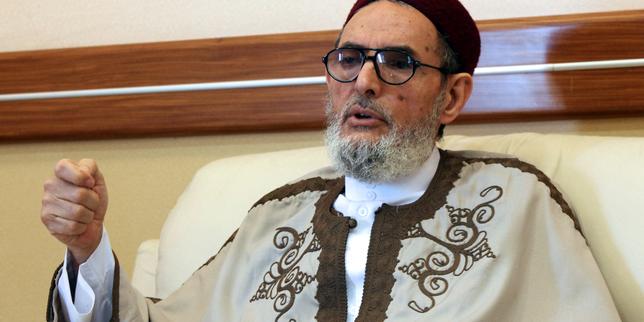
When an obscure religious ruling from North Africa suddenly threatens the supply chains and retail storefronts of a multi-billion-dollar American sportswear giant, corporate risk analysts start paying attention. The fatwa targeting Nike did not emerge from a vacuum of grassroots consumer outrage or an organic theological consensus across the Muslim world. It originated directly from the office of Sadiq al-Ghariani, the controversial Grand Mufti of Libya, a cleric whose career has long blurred the line between religious jurisprudence and militant political agitation.
To understand how an athletic footwear company became the target of a religious edict in Tripoli, you have to look past the surface-level theological complaints. Al-Ghariani is not merely a traditional scholar issuing quiet rulings on dietary laws or prayer times. Over the past decade, he has operated as a sharp political operator inside Libya’s fractured post-Gaddafi power structure, repeatedly deploying religious decrees as weapons to rally domestic factions, undermine political rivals, and project influence far beyond Libya's borders. If you liked this piece, you might want to read: this related article.
The Architecture of a Manufactured Controversy
Corporate boycotts in the Middle East and North Africa typically follow a predictable trajectory. A brand launches an ill-conceived marketing campaign, a product design inadvertently echoes sacred calligraphy, or a parent company takes a public stance on a geopolitical flashpoint. Social media amplifies the grievance, local distributors panic, and boycotts spread through WhatsApp groups and Friday sermons.
The fatwa against Nike followed a different script. Issued through Dar al-Ifta, the Libyan state religious authority headed by al-Ghariani, the ruling framed the purchase and wearing of Nike products as religiously impermissible. While the specific triggers cited by al-Ghariani’s office tapped into broader regional sensitivities regarding Western corporate complicity in Middle Eastern conflicts and alleged cultural offenses, the mechanics of the edict reveal a calculated media strategy. For another angle on this event, check out the recent update from USA Today.
Al-Ghariani operates his own satellite television network, Tanasuh TV, which broadcasts directly into Libyan homes and across the wider Arabic-speaking diaspora. A decree issued from his office is never just a written document filed away in an archive; it is immediately packaged for broadcast, clipped for social media, and amplified by allied political commentators. By targeting a globally recognizable brand like Nike, al-Ghariani guaranteed international headlines, transforming a localized political broadcast in Tripoli into a global business story.
Who Is Sadiq al-Ghariani
To grasp the weight—and the limits—of this fatwa, one has to examine the man behind the microphone. Born in 1942 in Libya, Sadiq al-Ghariani pursued traditional Islamic studies in Libya before earning a doctorate in Arabic and Islamic studies from the University of Exeter in the United Kingdom in the late 1970s. For decades, he maintained a relatively low profile as an academic and conservative scholar during Muammar Gaddafi’s regime.
Everything changed in February 2011. When the uprising against Gaddafi erupted, al-Ghariani used media appearances from exile in Britain to call on Libyans to rise up against the regime. That early backing of the revolution earned him immense political capital. In 2012, Libya's National Transitional Council appointed him Grand Mufti, placing him at the helm of the newly reconstituted Dar al-Ifta.
Since taking office, however, al-Ghariani has routinely defied attempts by successive Libyan governments to rein him in. When the Tobruk-based House of Representatives voted to dismiss him from his post in 2014, accusing him of inciting violence and fueling civil war, al-Ghariani simply refused to step down. Backed by powerful militia coalitions in western Libya and political allies in Tripoli, he continued operating Dar al-Ifta as an independent power center.
His record is defined by hardline stances that have frequently put him at odds with moderate clerics, international diplomats, and neighboring governments:
- Political interference: He has consistently issued religious rulings declaring political opponents, rival military commanders, and secular lawmakers to be enemies of Islam, effectively turning theological verdicts into partisan endorsements.
- Militia backing: During the brutal battles for Tripoli and Benghazi between 2014 and 2020, al-Ghariani repeatedly used his religious authority to urge fighters to take up arms against Khalifa Haftar’s Libyan National Army, framing a complex struggle over territory and oil revenues as a sacred duty.
- Social restrictions: Over the years, his office has issued edicts banning everything from certain banking practices and mixed-gender gatherings to women traveling abroad without a male guardian, drawing fierce pushback from Libyan civil society groups.
Weaponizing Consumer Culture for Political Relevance
Why target Nike now? The answer lies in the shifting political realities inside Libya.
For years, al-Ghariani thrived in an environment of active civil war, where his fiery sermons served as rallying cries for armed factions in western Libya. As international diplomacy has pushed Libya toward uneasy ceasefires, transitional governance deals, and negotiations over national elections, the space for overt wartime agitation has narrowed. Armed militias have increasingly rebranded themselves as formal security apparatuses, and Tripoli’s political elite has focused on securing international legitimacy and foreign investment.
In a quieter political climate, an ideological firebrand risks losing relevance. Attacking a high-profile Western consumer brand solves that problem instantly.
Cultural and consumer boycotts carry low political risk for a cleric while yielding high visibility. Unlike a fatwa calling for armed mobilization—which invites immediate condemnation from the United Nations, Western embassies, and rival Libyan factions—a ruling against an American sneaker company allows al-Ghariani to position himself as a populist defender of Islamic values and regional solidarity. It forces local merchants in Tripoli, Misrata, and Zawiya to choose between obeying the Grand Mufti’s broadcast directives or risking social backlash and harassment from hardline supporters.
The Mechanics of Local Enforcement
In stable jurisdictions, a religious edict carries purely moral weight; consumers decide for themselves whether to follow it. Libya is not a stable jurisdiction.
In cities where armed groups aligned with al-Ghariani’s ideological camp still patrol neighborhoods and oversee commercial districts, a fatwa from Dar al-Ifta functions as an informal regulatory decree. Shop owners importing athletic apparel through the ports of Tripoli or Khoms do not evaluate the ruling solely on theological merit. They evaluate it as a security and commercial risk.
If a local militia commander decides to enforce the Grand Mufti’s ruling to demonstrate ideological loyalty, a merchant displaying Nike logos in a storefront window faces the threat of confiscated inventory, forced closure, or intimidation. Consequently, the economic impact of the fatwa does not require millions of consumers to voluntarily abandon a brand. It only requires a handful of influential local gatekeepers to decide that stocking the product is more trouble than it is worth.
The Broader Pattern of Corporate Entanglement
Nike is hardly the first global corporation to find itself caught in the crossfire of Middle Eastern religious and political messaging, nor is this the first time Nike itself has faced scrutiny over religious sensibilities.
In 1997, Nike recalled tens of thousands of pairs of athletic shoes after Islamic groups pointed out that a stylized flame logo on the heel resembled the Arabic script for "Allah." In 2019, an online petition demanded the recall of the Nike Air Max 270 after critics argued the logo on the sole mirrored the same sacred word when inverted. In both instances, Nike responded through standard corporate crisis management: emphasizing that any resemblance was entirely unintentional and affirming respect for religious traditions.
What separates al-Ghariani’s fatwa from those earlier episodes is intent. The 1997 and 2019 controversies were driven by design disputes that consumers spotted on store shelves. Al-Ghariani’s intervention is top-down political theater.
By framing a global sportswear brand as an ideological adversary, the Libyan Grand Mufti taps into a well-worn playbook used by populist movements across the region. Global brands serve as convenient stand-ins for Western foreign policy. When ordinary citizens feel powerless against geopolitical events, boycotting a pair of sneakers offers a tangible, immediate way to register protest. Al-Ghariani understands this dynamic intimately and uses his pulpit to channel diffuse public frustration into targeted commercial pressure.
What Global Brands Get Wrong About Jurisdictional Risk
Multinational corporations spend millions mapping political risk in emerging markets, yet they routinely misjudge the influence of non-state and quasi-state religious figures. Corporate risk teams tend to look at formal sovereign institutions: central banks, customs ministries, trade tariffs, and official regulatory bodies.
Libya exposes the blind spot in that model. Formally, Libya’s Government of National Unity in Tripoli seeks Western commercial engagement, welcomes international brands, and wants to project an image of post-war normalcy. Informally, figures like Sadiq al-Ghariani wield parallel authority that the formal government is either unwilling or unable to confront directly.
For a brand like Nike, the direct revenue lost in the Libyan market is negligible on a global balance sheet. Libya represents a fraction of a percent of regional sales compared to powerhouse markets like Saudi Arabia, the United Arab Emirates, or Egypt. The real danger lies in contagion and gray-market disruption.
- Regional spillover: Satellite television and short-form video clips do not stop at national borders. A ruling originating in Tripoli can easily be stripped of its local political context and recirculated by activists in Tunis, Algiers, Amman, or Cairo, creating reputational headaches in far larger commercial markets.
- Distributor paralysis: Regional franchise partners and authorized distributors across North Africa operate on thin margins and rely heavily on local goodwill. Even when a fatwa lacks legal standing outside Libya, distributors often quietly pause marketing campaigns or delay seasonal inventory shipments rather than risk becoming the face of a public controversy.
- Counterfeit entrenchment: Ironically, formal boycotts rarely eliminate demand for coveted Western streetwear; they simply push it underground. When legitimate retailers pull official stock to appease local authorities, counterfeit networks step in to fill the void, flooding local bazaars with unregulated knockoffs while legitimate tax-paying merchants take the financial hit.
The Limits of the Mufti's Reach
Despite the headlines generated by the Nike edict, it would be a mistake to view Sadiq al-Ghariani as an unchallenged authority whose word is law across the Islamic world—or even across all of Libya.
Within Sunni Islam, religious authority is decentralized. A fatwa issued by Libya’s Dar al-Ifta carries zero binding authority over Muslims in Egypt, Saudi Arabia, Indonesia, or Europe. Major institutional centers of Islamic jurisprudence, such as Cairo’s Al-Azhar, operate independently and frequently view al-Ghariani’s politicized rulings with deep skepticism. Many mainstream Islamic scholars argue that weaponizing fatwas for partisan political campaigns undermines the credibility of religious jurisprudence itself.
Even inside Libya, al-Ghariani’s influence is sharply divided along geographic and generational lines. In eastern Libya, controlled by authorities aligned with the rival administration in Benghazi and Tobruk, his rulings are officially rejected and widely ignored. Among Libya’s large, overwhelmingly young urban population—many of whom are weary after more than a decade of militia rule, economic stagnation, and ideological policing—edicts banning global lifestyle brands often provoke quiet eye-rolling rather than pious compliance.
Young Libyans in Tripoli and Benghazi remain deeply connected to global sports culture, European football, and international streetwear. For many, wearing a pair of Nikes has nothing to do with endorsing Western foreign policy and everything to do with participating in global youth culture.
A Calculated Provocation With Real Collateral Damage
Sadiq al-Ghariani knows he cannot bankrupt Nike, nor can he stop young people across North Africa from admiring global athletes who wear the swoosh. That was never the objective.
The fatwa against Nike is a domestic power play disguised as a consumer advisory. It is a reminder to Tripoli’s political class that the Grand Mufti still commands an audience, still controls a media megaphone, and still possesses the ability to disrupt commercial life at will. In a country where authority is constantly contested between rival parliaments, armed factions, and unelected councils, generating an international controversy is one of the fastest ways to prove you still matter.
For multinational companies operating across volatile regions, the episode serves as a stark lesson in modern geopolitical exposure. You do not need to open a flagship store in a conflict zone to become a pawn in its internal power struggles; you just need a logo recognizable enough to make a politician's broadcast go viral.