The air inside the Dolby Theatre always smells faintly of expensive cologne, nerves, and television makeup. On this particular night, the crowd is a sea of tailored black tuxedos, glittering diamond necklaces, and the quiet, heavy intensity of people who have spent their entire lives clawing their way to the top of the sporting world. Super Bowl champions sit three rows ahead of Olympic gold medalists. Every face is a study in controlled composure. They know the cameras are watching. They know the stakes.
Then, the yellow arrived. If you liked this article, you might want to read: this related article.
It was not a subtle pastel yellow. It was a loud, unapologetic, banana-bright yellow that virtually screamed in the face of the theater’s refined lighting.
To understand why a group of grown men in bright yellow pants were standing backstage, trembling slightly but smiling wide, you have to understand the silent crisis gripping modern sports. For decades, we have been told that sports must be serious. We are taught that the only thing that matters is the scoreboard, the contract, the grind, the sacrifice. We watch athletes interview with rehearsed, robotic platitudes. We watch games stretch on for four hours under the weight of replay reviews and commercial breaks. For another angle on this event, see the recent coverage from Bleacher Report.
We forgot to have fun.
But the men waiting in the wings of the ESPYs stage did not forget. They had turned fun into a multimillion-dollar business, a sold-out national tour, and a cultural phenomenon. Now, they were about to do something no baseball team had ever done before.
They were going to sing.
The Man in the Banana Suit
Years before the bright lights of the award show, Jesse Cole stood in an empty stadium in Savannah, Georgia. The team he had bought was bleeding money. The grandstands of Grayson Stadium, built in 1926, were quiet. The paint was peeling.
Jesse had a crazy idea. What if baseball did not have to be boring? What if you stripped away the unwritten rules, the spitting, the endless adjusting of batting gloves, and the three-hour games? What if you replaced them with dancing base coaches, players on stilts, and a mascot that looked like an aggressive fruit?
People laughed. Traditionalists sneered. They said it was a circus, an insult to the sacred game of baseball.
Jesse did not care. He wore a yellow tuxedo every single day, even to the grocery store. He was a man possessed by a single, simple truth: people want to feel something. They want joy.
Consider the players he recruited. These were not top-tier MLB draft picks with seven-figure signing bonuses. They were guys who had been told they were too short, too slow, or too weird for the big leagues. They were pitchers who could throw a fastball but also do a backflip off the mound. They were players who loved the game but hated the suffocating pressure of the traditional system.
In Savannah, they found a home. They played "Banana Ball," a fast-paced, chaotic version of baseball with a two-hour time limit, no walks, and fans catching foul balls for outs. They sold out every single game. The waiting list for tickets grew to over a million people.
Yet, despite the viral videos and the packed stadiums, the sports establishment still viewed them as a novelty. A sideshow. A joke.
Until the invitation arrived.
Behind the Velvet Curtain
The ESPYs are the Oscars of the sports world. It is the night where the athletic elite gather to celebrate excellence, grit, and triumph over adversity. It is a serious night.
Backstage, the tension was thick.
Imagine standing in a hallway, wearing a bright yellow tuxedo, while Patrick Mahomes walks past you. Imagine looking down at your matching yellow cleats while the greatest athletes on earth chat quietly nearby. For the Savannah Bananas players, the imposter syndrome was real. They were entertainers, yes, but they were also ballplayers. They knew what the traditional sports world thought of them.
"Are we really doing this?" one player whispered.
"We're doing it," Jesse Cole replied, adjusting his yellow top hat. His eyes gleamed with the familiar, manic energy that had fueled his entire journey.
The plan was simple, yet incredibly risky. They were not just going to present an award. They were not going to do a quick comedy bit. They were going to perform an original, fully choreographed musical number live on national television.
It was a gamble. If they failed, they would look foolish in front of the very people they respected most. The critics who called them a gimmick would have all the ammunition they ever needed. The illusion of their magic would shatter under the harsh glare of prime-time television.
The stage manager gave the signal. Two minutes.
The players stood in a circle, their hands joined. They did not do a traditional baseball huddle. They did not talk about strategy or pitch selection. They talked about the kids in the stands who wore yellow shirts. They talked about the fans who cried when they got a ticket. They talked about why they started playing this game in the first place, back when they were eight years old in dusty public parks, before the scouts and the pressure took the magic away.
"Let's go make them smile," someone said.
Three Minutes of Beautiful Chaos
The lights in the Dolby Theatre dimmed.
The screen behind the stage flickered to life, showing a montage of the Bananas' most ridiculous moments—the dancing, the backflips, the joy. Then, the music swelled.
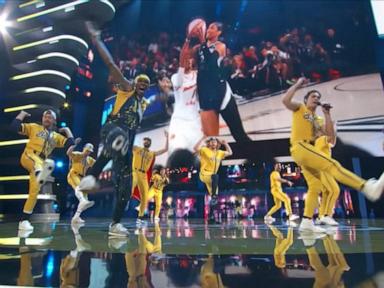
The curtain rose to reveal Jesse Cole and a line of players, dressed head-to-toe in yellow. The crowd shifted in their seats. There was a brief, palpable moment of hesitation. You could see it on the faces of the athletes in the front rows: What is about to happen?
Then, they started to sing.
The song was an anthem of defiance against the boring, the predictable, and the routine. It was a love letter to the weird. The lyrics poked gentle fun at the seriousness of the sports world, celebrating the sheer absurdity of playing baseball with a yellow ball, dancing with the umpire, and playing in front of sold-out stadiums of cheering fans who just wanted to have a good time.
They danced. They spun. They harmonized with surprising sweetness.
It was a performance stripped of all cynicism. In a world where everything is branded, analyzed, and polished to a sterile sheen, this was raw, goofy, unadulterated human connection.
Watch the faces of the audience members in the broadcast footage. At first, there are polite, slightly confused smiles. But as the song progresses, something shifts. The armor begins to crack. You see a famous quarterback throw his head back and laugh. You see an Olympic gymnast clapping along to the beat.
For three minutes, the heavy, suffocating pressure of the sports world evaporated. There was no scoreboard. There was no contract negotiation. There was only a group of guys in yellow suits, singing their hearts out, reminding everyone in that room why they fell in love with sports in the first place.
When the final note echoed through the theater, there was a split second of silence.
Then, the room erupted.
The Afterglow of the Yellow Revolution
The morning after the broadcast, the internet was flooded with clips of the performance. The cold, hard metrics of social media engagement showed millions of views within hours.
But the real victory was not in the numbers.
It was in a quiet moment that happened backstage, away from the cameras. After the performance, as the players walked back to their dressing room, sweating and laughing, they were stopped by a legendary, retired athlete. A household name. Someone who had won championships at the highest level.
He looked at the players, his eyes shining.
"I wish we had that when I was playing," he said quietly. "Keep doing what you're doing."
That is the true stakes of the Savannah Bananas' journey. It is not about selling tickets or going viral on TikTok. It is about a quiet rebellion against the idea that we must suffer to achieve greatness. It is about proving that joy is not the enemy of performance, but its ultimate fuel.
The next night, the Bananas were back on a dirt field, far away from the glamour of Los Angeles. The yellow tuxedos were dusty again. The players were sweaty, signing autographs for children until the stadium lights were turned off.
But something had changed. The world was no longer just laughing at them. The world was laughing with them, desperate to catch a spark of the magic they had carried all the way to the brightest stage in sports.