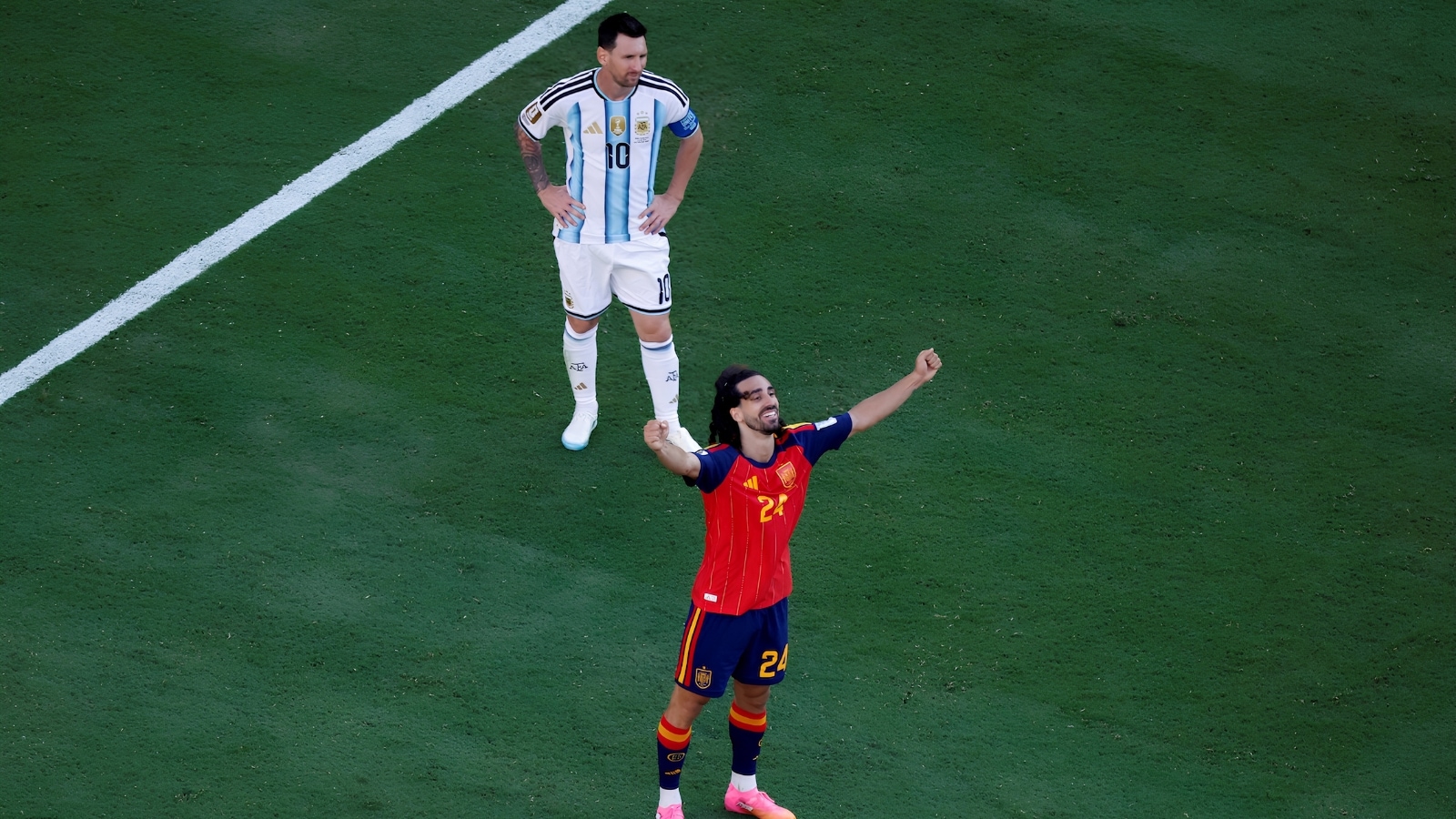
Thunder in the Desert
Thirty-eight games. That was the length of Spain’s unblemished chain—a relentless, suffocating streak of footballing perfection that felt less like a run of form and more like an unstoppable force of nature. For nearly three years, no team on earth had found a way to fracture their rhythm. They didn't just win; they disassembled opponents with cold, surgical precision.
Then they ran into a wall built of pure adrenaline and raw instinct. You might also find this similar coverage interesting: Why That $89,000 Thrift Store Wilt Chamberlain Jacket Is Actually a Warning to Vintage Collectors.
Inside the stadium, the air hummed with a tension so thick you could taste the static. On one side stood La Roja, a young, dazzling machine engineered to control every blade of grass. On the other stood Argentina, driven by something far less clinical: an ancient, unyielding desire to deliver a crown to a man whose entire life had been lived under the terrifying glare of global expectation.
Football isn't played on paper. Statistics tell us what happened, but they rarely tell us how it felt. As reported in detailed coverage by FOX Sports, the effects are worth noting.
The Hands That Refused to Yield
To understand how a game turns, you have to look past the marquee names and find the man standing alone between two white posts.
Eleven times the ball rocketed toward the Argentine net. Eleven times, Emiliano Martínez answered.
Eleven saves in a World Cup final isn't just a statistical anomaly; it is an act of psychological warfare. Imagine standing in the eye of a storm for over two hours. Every few minutes, a fresh surge of red shirts floods your space. The grass is wet, your lungs burn, and tens of thousands of voices scream from the stands. One slip of the foot, one fraction-of-a-second miscalculation, and a nation's dream evaporates.
Martínez didn't just stop shots; he erased hope. With every dive, every parry, every dramatic tip over the crossbar, you could see the visible drain on Spanish confidence. Shot number four felt routine. Shot number seven felt like bad luck for the attackers. By shot number eleven, it felt like divine intervention.
He moved with a furious, boundary-pushing energy, transforming the goalmouth into his personal fortress. It wasn't clean, and it certainly wasn't quiet. It was survival reduced to its absolute essence.
The Final Crown
While Martínez anchored the chaos in the back, Lionel Messi drifted through the midfield like a phantom, waiting for the universe to align.
Every time Messi steps onto a pitch, history leans in. The weight he carries would crush ordinary shoulders, yet he moves with a strange, deceptive lightness. At thirty-seven, he no longer sprints across the field for ninety minutes. He walks. He watches. He calculates the space between defenders like a master chess player calculating mates three moves ahead.
When the moment arrived, he didn't blast the ball with brute force. He stroked it home with a quiet, devastating calm.
That single moment rewrote the history books once more, carving out yet another record in a career already overflowing with them. But watching him celebrate, sprint toward the corner flag with tears blurring his eyes, nobody was thinking about numbers or record books. They were watching a man finally touch the sky after a lifetime of climbing.
The Unbreakable Chain Snaps
Spain did not go down easily. Their thirty-eight-game unbeaten run wasn't a fluke; it was built on a foundation of generational talent and relentless belief. Even as the clock ran down and the pressure reached a fever pitch, they threw everything forward, forcing Martínez into acrobatic, desperate maneuvers until the absolute final second.
They pushed the champions to the absolute brink of exhaustion.
When the final whistle eventually pierced the night air, the contrast was absolute. Spanish players collapsed onto the turf in disbelief, their historic streak shattered in the one game that mattered most. A few yards away, a wall of light blue and white exploded into pure, unadulterated ecstasy.
Thirty-eight games of dominance ended not by a failure of skill, but by an encounter with a team that simply refused to lose.
The trophy sat glittering under the stadium floodlights, resting quietly after one of the most violent, beautiful, and emotionally exhausting nights the sport had ever witnessed.