The mud in the Champagne region of France has a specific, ancient weight. It clings to the boots of a young lieutenant named Marc as he stares into a glowing tablet inside a command tent. He isn’t looking at a map of a single battlefield. He is looking at a continent trying to remember how to defend itself.
For decades, the sound of heavy armor moving across European soil was a ghost story, something relegated to grainy black-and-white reels or the dusty memories of grandfathers. But during Operation Orion, the silence of the French countryside was replaced by the low, guttural growl of 12,000 troops, 2,600 vehicles, and the invisible hum of electronic warfare. This wasn't a static display of power. It was a massive, multi-dimensional awakening.
The End of the Long Peace
We grew comfortable. That is the simplest truth of the post-Cold War era. We traded the grueling logistics of mass mobilization for "surgical strikes" and "asymmetric peacekeeping." We thought the days of holding vast swaths of territory against a peer adversary were over.
We were wrong.
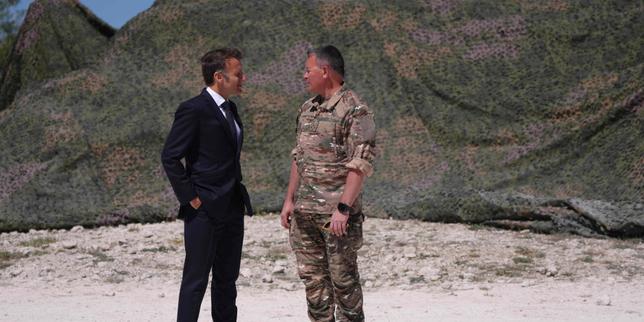
The Orion exercise represents the largest military maneuver in Western Europe in over thirty years. It wasn't just about showing off hardware; it was about testing whether the intricate, aging gears of European defense could still mesh together. When President Emmanuel Macron stood on the sidelines, he wasn't just praising a successful drill. He was acknowledging a "clear signal" sent to the rest of the world: the era of European strategic passivity has ended.
Consider the sheer scale of the operation. Orion spanned months, moving through phases of naval skirmishes in the Mediterranean to massive airborne drops in the Castres region. It simulated a "high-intensity" conflict—a polite, bureaucratic term for a total war.
The Invisible Frontline
Imagine you are Marc. You have been trained in an era of digital connectivity, where information is a commodity. Suddenly, in the middle of a simulated invasion by a fictional state named "Arnland," your screens go dark. Your GPS flickers. The sky above is filled with the invisible chatter of drones and jamming frequencies.
This is where Orion moved beyond the physical. The exercise integrated "hybrid" warfare—the kind that happens in the wires and on social media feeds. The military wasn't just fighting tanks; they were fighting misinformation campaigns and cyber-attacks designed to paralyze the civilian population before a single shot was fired.
The stakes here aren't just about who has the fastest jet. They are about the "mental resilience" of a society. If the power grid flickers and the internet dies, does the nation hold? Orion was a stress test for the very nervous system of the state. It forced different branches of the military—the Navy, the Air Force, the Space Command, and the Army—to talk to each other in a language they had almost forgotten.
The Logic of the Shield
There is a certain discomfort in talking about "war-readiness" in a modern democracy. It feels archaic, perhaps even provocative. But the logic driving the Elysee Palace is grounded in a harsh, cold reality: deterrence only works if the other side believes you can actually fight.
For years, European defense was a collection of high-tech boutiques. France had great jets. Germany had great tanks. But could they move 10,000 men across a border in forty-eight hours? Could they sustain a frontline for months without running out of basic artillery shells? Orion suggests we are finally asking the right, albeit terrifying, questions.
The exercise utilized the full spectrum of modern violence. We saw the deployment of the new "Scorpion" armored vehicles, designed for a digital battlefield where every unit is a data node. We saw paratroopers falling from the sky in numbers that hadn't been seen since the 1980s. But more importantly, we saw the logistics—the unglamorous, grueling work of moving fuel, food, and medicine at the speed of a modern conflict.
The Human Cost of Readiness
Late at night, when the engines are silenced and the simulated "enemy" has retreated for the hour, the human element remains. These are 12,000 individuals—teachers, students, fathers, and daughters—playing a game that they hope never becomes real.
There is a psychological shift happening in Europe. It’s moving from the "dividend of peace" to the "burden of protection." This transition isn't easy. It requires a massive reallocation of resources and a shift in how a civilian population views its own security. When Macron speaks of a "clear signal," he isn't just talking to Moscow or Washington. He is talking to the people of Europe, preparing them for a world that is less stable and more demanding.
The "Arnland" of the exercise might be fictional, but the vulnerability it exposed is not. The exercise forced commanders to deal with "saturated" environments where every move is watched by a satellite and every radio burst is a target. It proved that in the next war, there is no "rear." Every square inch of the continent is part of the front.
The Weight of the Signal
We often think of peace as a natural state, a default setting of the world. It’s more like a garden that requires constant, sometimes violent, weeding. Orion was a massive, expensive, and loud way of tending that garden.
As the exercise drew to a close, the mud of Champagne began to dry. The tanks were loaded back onto trains, and the digital clouds of the cyber-war were archived for analysis. But the atmosphere has changed. The "signal" has been sent. It’s a message that says Europe is no longer content to be a playground for the ambitions of others. It is a message that security is not a gift, but a muscle that must be exercised until it aches.
Marc packs his tablet and looks out over the quiet hills. The silence is back now, but it feels different. It’s no longer the silence of someone who is asleep. It’s the silence of someone who is wide awake, listening to the wind, waiting for the first sign of a storm that they are finally ready to meet.