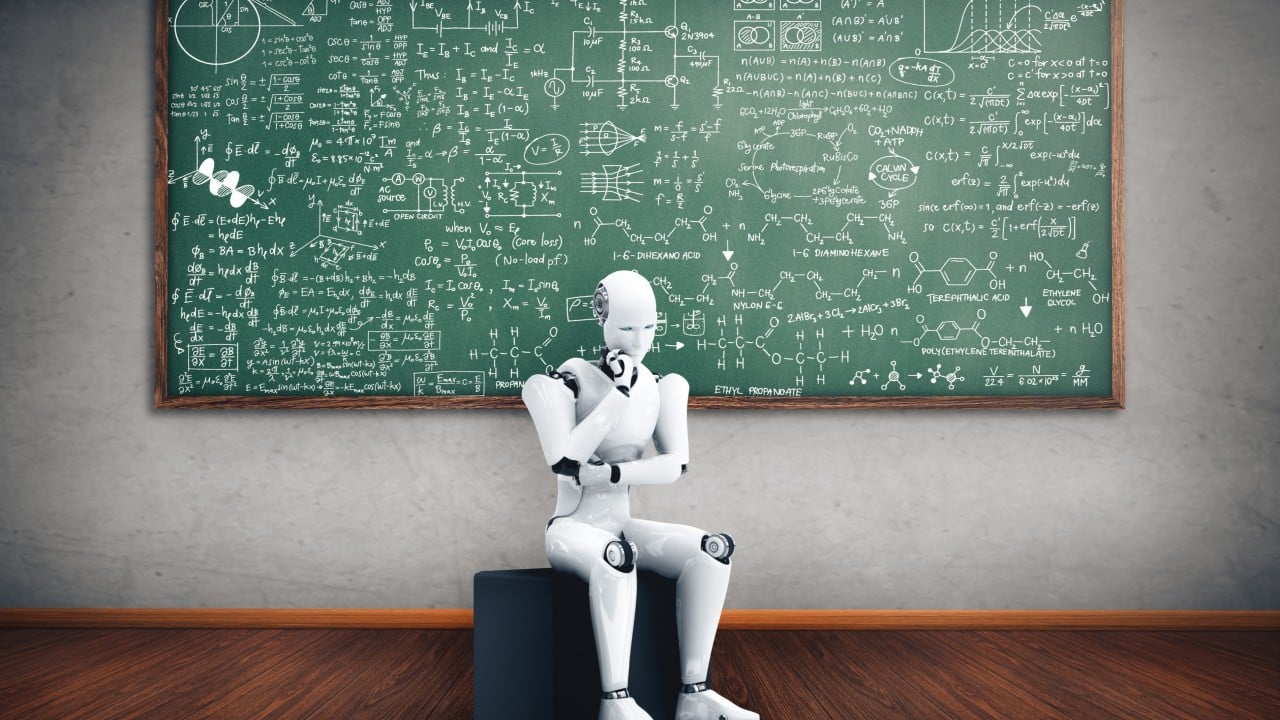
Mathematics has a specific kind of silence. It is not the peaceful quiet of an empty forest or the heavy stillness before a storm. It is a dense, suffocating quiet. It lives in the spaces between chalkboard lines, in the cramped margins of notebooks belonging to scholars who have spent forty years chasing a ghost.
For decades, certain mathematical problems have stood like monolithic stone walls at the edge of human understanding. They do not yield to brute force. They do not care about coffee-fueled all-nighters or the prestige of academic chairs. They simply wait. For another perspective, check out: this related article.
Then came the night a doctor in China sat down with a piece of artificial intelligence, and the stone wall cracked.
We have spent years treating artificial intelligence like a shiny calculator or a clever digital assistant that can draft an email or summarize a meeting. We have treated it as a tool for the surface layer of human thought. We forgot what happens when a tool designed to find patterns is pointed at the oldest puzzles in the universe. Related insight on the subject has been published by Engadget.
Consider what happens when a mind stops fighting the complexity and starts listening to the geometry.
Yufei Zhao is not your traditional chalkboard dweller. Trained in medicine, his daily life was once bound by the pulse of biology, the messy, unpredictable chemistry of the human body. Medicine teaches you to look for signals hidden beneath noise. It trains you to recognize patterns in chaos, to spot the subtle anomaly that signals a tumor or an infection long before the symptoms roar.
That background changes how you look at numbers.
When Zhao turned his attention toward a stubborn mathematical puzzle—a problem that had mocked theorists for generations—he did not approach it with the orthodox rituals of a pure mathematician. He brought ChatGPT into the room.
Critics scoffed. Purists rolled their eyes. How could a stochastic parrot, a machine trained on human chatter and internet prose, help untangle the severe, unforgiving rigor of number theory? How could an algorithm that occasionally hallucinates facts say anything meaningful about abstract proofs?
Because the critics misunderstood what ChatGPT was doing.
It was not solving the math for him. It was acting as a tireless, infinitely patient sparring partner. It was the mirror that reflected his own intuition back at him, polished and clear.
Imagine standing in a vast, dark labyrinth. You have a single match, and every time you strike it, you catch a brief, terrifying glimpse of the walls around you before the flame dies. You have to remember the turns, calculate the distance, and guess where the exit lies in total blackness.
For decades, mathematicians have been striking those matches alone.
Zhao turned on a floodlight.
By using ChatGPT to rapidly test hypotheses, to restructure propositions, and to explore tangential pathways that would take a human mind weeks to draft out on paper, he bypassed the tedious mechanical friction of research. The AI did not possess genius. But it possessed velocity. It allowed a human mind to dance at a speed previously impossible.
The breakthrough did not happen in a vacuum of silicon and electricity. It happened at the intersection of exhaustion and breakthrough. It happened because someone dared to mix two completely different worlds: the messy, biological intuition of a medical doctor and the cold, unyielding logic of machine learning.
We are terrified of this shift.
Every time a machine crosses a threshold into territory we reserved exclusively for our own soul, we panic. We worry about obsolescence. We wonder if the poets will be replaced by prompt engineers, if the thinkers will be reduced to curators of machine output.
We are asking the wrong question.
The question is not whether the machine can think. The question is what happens to human creativity when the heavy lifting of calculation is stripped away.
When the printing press arrived, scribes wept. They believed the sacred art of hand-copying texts was dead, and with it, the reverence for the written word. They were right about the dying of an old trade, but catastrophically wrong about the future of thought. The printing press did not kill books; it unleashed an explosion of literacy that built the modern world.
The partnership between Zhao and ChatGPT is our printing press moment for logic.
Think about the sheer weight of what we face. Climate change, epidemiological crises, economic instability, the unmapped frontiers of quantum mechanics. These are not problems that can be solved by a lone genius working by candlelight. They are too vast, too deeply interconnected, too fast-moving.
We need tools that match the scale of our ambition.
When the mathematical world woke up to the news that a medical doctor had used a consumer-facing AI model to crack a decades-old problem, the shockwaves were immediate. Journals scrambled to understand the methodology. Universities debated the ethics of machine-assisted proofs. Traditionalists argued about whether the achievement belonged to the man or the machine.
That argument is a distraction.
It belongs to neither. It belongs to the space between them.
It belongs to the friction of a human asking a hard question and a machine organizing the chaos of the answer. It is the story of a new kind of literacy.
We are entering an era where the most valuable skill will not be the ability to memorize formulas or execute tedious calculations. Those tasks belong to the silicon. The most valuable skill will be the courage to ask better questions. The willingness to stare into the dark labyrinth of a complex problem and invite an alien intelligence to help you map the walls.
The math did not change that night. The numbers remained the same. The laws of logic refused to bend.
What changed was us.
A doctor looked at a screen, typed a prompt, and pushed human curiosity one step further into the unknown. The quiet room did not stay quiet for long. The equations began to sing. And somewhere out there, in the vast, unmapped darkness of what we do not yet know, the next wall is waiting to fall.