The midnight air over the Black Sea usually tastes of salt and diesel. For the workers at the Ust-Luga oil terminal, that scent is as familiar as their own breath. They move in rhythm with the machinery, small shadows against the colossal geometry of steel tanks that hold Russia’s economic lifeblood. To them, the war in Ukraine was a distant rumble, a sequence of headlines consumed on glowing phone screens during cigarette breaks.
Then came the buzzing.
It did not sound like a weapon of modern high-tech warfare. It sounded like a lawnmower. A persistent, metallic drone, vibrating through the cold mist. Within minutes, that fragile illusion of distance shattered. A flash of blinding white punctured the dark, followed by a shockwave that rattled the teeth in the workers' skulls.
The sky did not just light up. It ignited.
The New Geometry of Warfare
For decades, military power was measured in tonnage. Steel hulls, heavy armor, and the sheer crushing weight of industrialized logistics decided conflicts. If you wanted to cripple an enemy’s energy supply, you needed a squadron of heavy bombers or a barrage of million-dollar cruise missiles.
Not anymore.
Consider a hypothetical engineer named Dmitry, standing on the perimeter of that burning facility. In his world, security meant concrete barriers and anti-aircraft batteries designed to catch high-altitude threats. He represents a generation of defense analysts currently watching the manual on modern warfare burn in real-time. What bypassed millions of dollars of radar equipment was a machine built from carbon fiber and off-the-shelf electronics, powered by a commercial engine, and carrying a payload no larger than a backpack.
This is the asymmetry redefining global geopolitics. A drone costing less than a used sedan can travel hundreds of miles, navigate using civilian GPS coordinates, and strike with surgical precision.
The target was not chosen at random. The Ust-Luga terminal is a vital artery, pumping refined oil and gas to the global market, turning fossil fuels into the hard currency that funds a war machine. When Ukraine strikes here, they are not just fighting for territory. They are squeezing the economic windpipe of a superpower.
When the Horizon Bleeds
The logistics of an oil fire are terrifying. When a drone strikes a storage tank, the impact is only the prologue. The true enemy is the physics of crude oil.
Imagine a container holding millions of gallons of pressurized hydrocarbons. When the shell breaches, the liquid vaporizes instantly, mixing with oxygen to create a fuel-air bomb. The resulting inferno burns at temperatures exceeding 1,000 degrees Celsius. Steel structures don't just melt; they lose their structural integrity and collapse like wet cardboard, spilling burning rivers into neighboring containment zones.
From miles away, witnesses saw the horizon turn a sickening shade of orange. It looked like an artificial dawn rising over the Baltic coast.
For the firefighters rushing toward the blaze, the task is closer to myth than modern engineering. You do not extinguish an oil terminal fire with water. Water sinks beneath the oil, boils instantly, and causes an explosion known as a "boil-over," spraying blinding sheets of fire in every direction. Instead, they use foam, smothering the chemical reaction, cutting off the oxygen, and praying the adjacent tanks can be cooled enough to prevent a chain reaction.
But while the emergency crews fought the flames, a different kind of panic began to ripple through the financial centers of the world.
The Ripple in the Screen
Thousands of miles away from the smoke, in glass towers in London, New York, and Singapore, commodities traders watched numbers flicker on their monitors.
Oil is the ultimate global equalizer. A disruption in a Baltic port is felt at a gas station in Ohio within days. The global energy supply chain is an incredibly intricate clockwork mechanism, tuned to perfection to maximize profit. It possesses zero resilience against chaos.
When news of the Ust-Luga strike broke, algorithms and human traders scrambled simultaneously. Shipping insurance rates skyrocketed. Tankers already at sea received frantic orders to redirect, idling in deep water while executives calculated the risk of entering a zone where the sky could suddenly rain fire.
This is the invisible front line. The true impact of the drone warfare strategy is not measured in body counts or scorched earth. It is measured in cents per gallon, in the rising cost of maritime insurance, and in the quiet realization that no infrastructure, no matter how deep inside a nation's borders, is truly safe anymore.
The Ghost in the Machine
How does a nation defend against an enemy that is practically invisible?
Traditional air defense systems are designed to detect large, fast-moving metal objects—jets, ballistic missiles, helicopters. They are calibrated to ignore small birds. A modern long-range drone flies low, hugs the terrain, and possesses a radar cross-section no larger than a mallard. To an automated defense grid, it looks like noise.
The psychological toll on those tasked with defense is immense. Imagine staring into a radar screen for twelve hours straight, knowing that the difference between a glitch and a catastrophe is a tiny dot moving at eighty miles per hour. It is a war of attrition waged against human attention spans.
Ukraine has leaned into this reality out of sheer necessity. Lacking a conventional navy and facing an adversary with overwhelming conventional artillery, they turned to the garage. They turned to software developers, hobbyists, and university laboratories. They built an armada out of plywood, fiberglass, and code.
The strike at Ust-Luga proves that this makeshift doctrine has matured into a terrifyingly effective strategic weapon. It is no longer about harassment; it is about systemic deconstruction.
The Cold Reality Left Behind
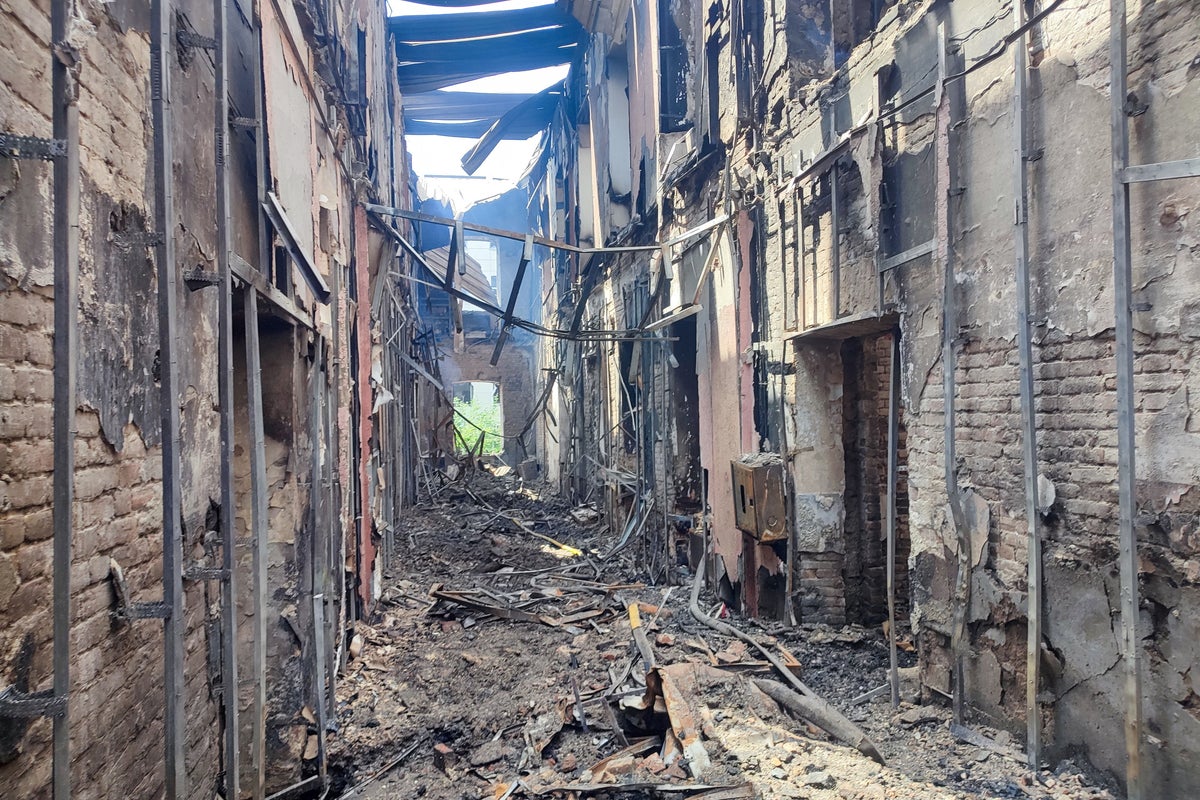
As the sun finally rose over the Baltic, it revealed a landscape of blackened skeleton structures and thick, greasy soot coating the snow. The fire was eventually contained, but the damage was already done.
The true cost is never just the price of the destroyed fuel or the cost of replacing a steel tank. The true cost is the sudden, jarring loss of certainty. Every worker at that terminal now looks at the sky differently. Every executive looks at their operational risk models and sees a gaping hole where security used to be.
The war has drifted away from the trenches of the Donbas and found its way to the quiet ports of the north. It has transformed from a clash of armies into a war against infrastructure, a quiet, buzzing campaign fought in the dark, where the stakes are nothing less than the heat in our homes and the fuel in our engines.
The sirens eventually fell silent at Ust-Luga, replaced by the hiss of cooling foam and the crackle of distorted metal. But the silence offered no comfort. It felt temporary. Everyone on the ground knew that somewhere, hundreds of miles away in a hidden workshop, another engine was being cranked to life.