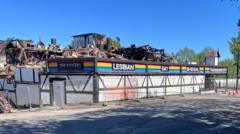
The smell of a fire never really leaves a room. It lingers in the insulation, hides behind the baseboards, and settles into the fibers of the carpet like a stubborn ghost. For the regulars of Pink Punters, that scent wasn't just the smell of charred timber and melted plastic. It was the scent of a sanctuary under siege.
Bletchley is a place of quiet brick and predictable rhythms. But within the walls of Pink Punters, those rhythms shifted into something louder, brighter, and infinitely more vital. It wasn't just a nightclub. For the LGBTQ+ community in Milton Keynes, it was the living room of a family that many had to build for themselves from scratch. When the alarms began to scream in the early hours of that Tuesday morning, the fear wasn't just about property damage. It was about the possibility that the one place where you could truly breathe had been targeted for erasure.
The facts, as the police first presented them, were cold enough to freeze the blood. Firefighters were called to the scene. Smoke billowed into the night air. A 19-year-old man was arrested on suspicion of arson. For forty-eight hours, the community held its breath, waiting for the other shoe to drop, waiting to hear if this was a message sent in gasoline and flame.
Then, the narrative shifted.
The Anatomy of an Accident
Investigating a fire is like reading a book that is actively turning to ash while you turn the pages. Forensic teams have to sift through the debris to find the "point of origin"—the exact spot where the first spark met the first combustible material. They look for "pour patterns," the tell-tale V-shaped marks that liquid accelerants leave behind. They look for intent.
In the case of Pink Punters, the search for intent led to a surprising dead end.
Thames Valley Police eventually released the teenager. The handcuffs were removed, and the suspicion of arson was scrubbed from his record. The official verdict? The blaze was "accidental." It wasn't a hate crime. It wasn't a calculated strike by a shadowy antagonist. It was a failure of physics, a mechanical betrayal, or a momentary lapse of oversight. It was just a fire.
But "accidental" is a hollow word when you’re standing in front of a blackened doorway. It suggests a lack of agency that feels almost more frightening than a villain. If there is a villain, you can fight them. You can demand justice. You can rally the troops. When the culprit is a faulty wire or a stray ember, there is no one to shout at. There is only the mess.
The Invisible Stakes of a Safe Space
To understand why a kitchen fire in a Bletchley club matters, you have to understand the geography of loneliness. For a young person coming out in a suburban town, the world can feel like a series of closed doors. Pink Punters was the door that was always unlocked.
Consider a hypothetical regular—let’s call him Leo. Leo spent years modulating his voice and checking his posture before walking into his local pub. He learned to be a ghost in his own life. The first time he walked into Pink Punters, the air felt different. It was the only place where the "act" could stop.
When a place like that catches fire, the damage isn't measured in pounds and pence. It’s measured in the sudden, sharp return of that old isolation. Even if the fire was an accident, the trauma of seeing the smoke is real. The community didn't just see a building burning; they saw the fragility of their own safety.
The club’s management acted with the kind of weary resilience that defines the queer experience. They didn't mourn the walls; they started planning the rebuild. They knew that the longer the doors stayed closed, the longer their family stayed scattered.
The Weight of Suspicion
The release of the suspect is a narrative pivot that deserves its own scrutiny. For two days, a young man’s name was whispered in connection with a heinous act. In the digital age, an arrest is often treated as a conviction in the court of public opinion. The rush to find a "who" often bypasses the "how."
The police have a difficult tightrope to walk. In the immediate aftermath of a fire at a high-profile minority venue, the pressure to act is immense. They have to show the community that they are taking the threat of hate crime seriously. But the release of the suspect without charge serves as a sobering reminder of the presumption of innocence—and the complexity of fire science.
Fire doesn't care about politics. It doesn't care about identity. It follows the path of least resistance and the laws of thermodynamics. In this instance, the law of the land caught up with the laws of nature, concluding that no crime had been committed.
Beyond the Yellow Tape
The yellow police tape has been cleared away now. The forensic vans have rolled back to their depots. What remains is a community that has been shaken awake.
The "accidental" nature of the fire doesn't lessen the work ahead. It actually complicates it. A hate crime creates a clear external enemy, which can unify a group in defiance. An accident creates an internal checklist. It’s about fire suppressors, electrical audits, and the mundane, unglamorous work of maintenance. It is the boring side of survival.
But there is a quiet beauty in that survival. The club owners didn't let the "accidental" label slow them down. They saw the outpouring of support—the messages from people who had met their partners on that dance floor, the people who had found their best friends in the smoking area, the people who had finally felt seen under those neon lights.
The fire was a reminder that these spaces are not permanent fixtures of the landscape. They are fragile ecosystems that require constant care, protection, and patronage. They exist because people decide they need to exist.
The neon might have flickered. The smoke might have clouded the vision of a community for a few days. But as the cleanup begins, the smell of smoke is being replaced by the scent of fresh paint and floor wax.
Life returns, not because the fire was "just an accident," but because the people who built Pink Punters know that a sanctuary is more than just four walls and a roof. It is the collective will of a group of people who refuse to be pushed back into the shadows, even when the lights go out.
The dance floor is empty for now, the silence heavy where there used to be bass. But the foundation is still there, cooled by the same water that saved it, waiting for the music to start again.


