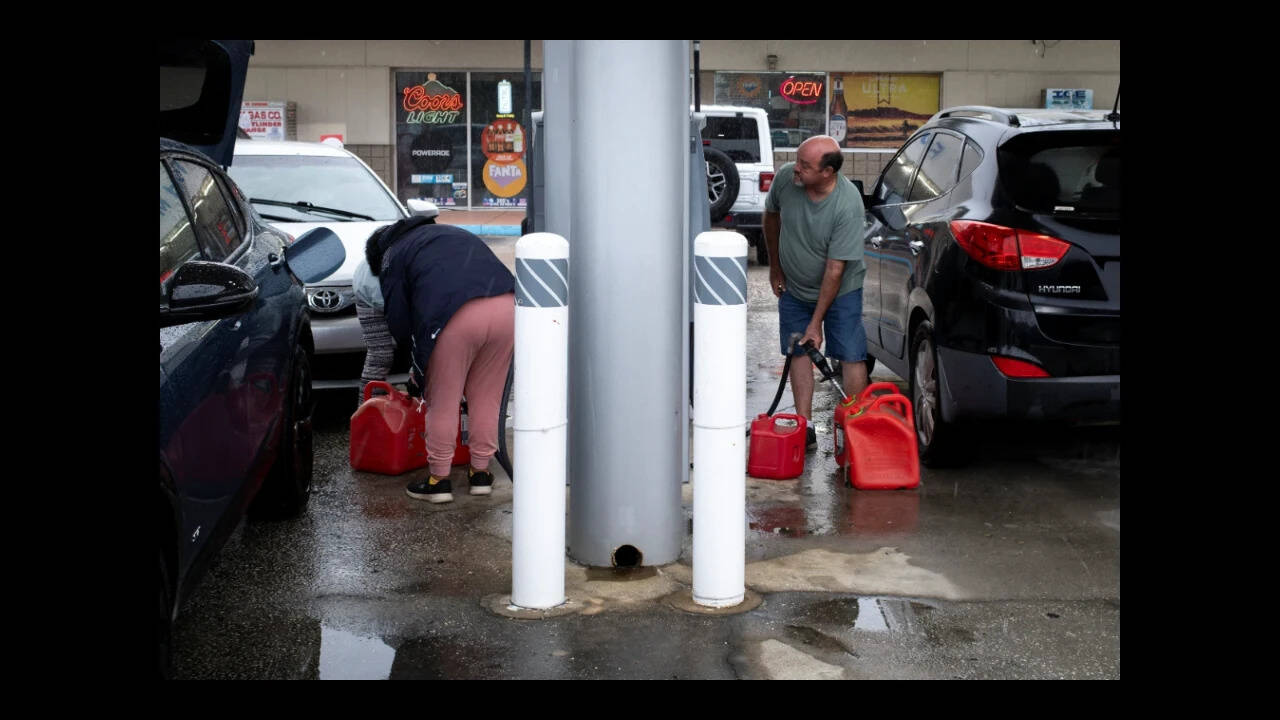
The humidity in South Florida before a storm does not merely sit on your skin. It presses down like a hot, damp palm held flat against your mouth. You learn to read the air long before the radar maps turn angry on the television screen. You smell the ozone. You watch the royal palms snap their heavy green fronds backward, fighting an invisible tide.
When Hurricane Isaias gathered its breath and swept ashore as a Category 2 tempest, it brought more than wind-sheared billboards and flying lawn chairs. It brought an abrupt, absolute silence to six hundred thousand homes.
Think about what happens when a modern life stops receiving current.
It starts with the refrigerator hum dying—that steady, white-noise heartbeat of the kitchen that you only notice when it vanishes. Then the Wi-Fi router blinks out, its tiny green eyes winking off one by one, cutting the umbilical cord to the wider world. Outside, the streetlights flicker, throw one last bruised yellow beam onto the asphalt, and surrender.
Darkness. Total, heavy, breathing darkness.
We build our lives on a grid of invisible arteries. We treat electricity like oxygen—something so constant, so fundamentally guaranteed, that we forget it is an engineering miracle holding back the dark. When Isaias slammed into the coast, those arteries severed.
Consider a hypothetical household in Palm Beach County during that exact hour. Maya sits at her kitchen table. The power failed twenty minutes ago. In front of her, a single white pillar candle casts long, shivering shadows across a Formica counter. She has lived through this before. Every Floridians attic holds the muscle memory of past storms: the taped windows, the rubber-maid tubs of canned tuna, the extra AAA batteries rolling around the junk drawer.
Yet each time, the first hour feels like a physical blow.
Her phone screen is her only compass. She scrolls through local updates, watching the casualty counter of the grid tick upward. Six hundred thousand people. That is not just a statistic spat out by a utility company press release. That is six hundred thousand living rooms plunged into uncertainty. That is insulin sitting in warming refrigerators. That is elderly neighbors on third-floor apartments with disabled elevators, listening to the wind howl against their concrete balconies while the air conditioning wheezes and dies.
The wind has a voice. People who have never weathered a hurricane think it sounds like a train. It does not. It sounds like a giant tearing canvas—miles of thick, heavy duck cloth ripping across the sky, accompanied by the percussion of flying gravel hammering against glass.
Maya watches a coconut branch strike her living room window with a wet, heavy thud. She flinches. Not because the glass broke—it held, reinforced by heavy security film—but because of the sheer violence of the impact. Nature does not negotiate. It does not care about your schedule, your deadlines, or your fragile copper wires strung up on wooden utility poles.
Behind every storm warning lies a terrifying logistical puzzle.
When winds sustain themselves at nearly one hundred miles per hour, utility trucks cannot roll. Linemen—men and women in high-visibility yellow jackets who are often the true unsung heroes of these disasters—must sit in staging lots miles away, watching the radar, waiting for the ceiling to lift. They cannot climb a bucket truck when the wind can peel the fiberglass bucket right off its hydraulic arm like an eggshell.
This creates a vacuum of agency. You are trapped. You are waiting.
For the next forty-eight hours, the rhythm of life shrinks to the radius of a flashlight beam. Outside, the storm passes, leaving behind flooded intersections, downed oaks choking residential streets, and a humid stillness that feels like stepping into a steam room. The temperature inside houses begins to climb immediately. Without central air, drywall acts as a thermal sponge, trapping the day's heat and radiating it back inward.
People step outside onto their porches. Neighbors who have lived twenty feet apart for a decade without exchanging more than a stiff wave suddenly emerge into the wreckage. Someone fires up a gas-powered generator, its noisy, puttering roar cutting through the neighborhood quiet. Someone else drags a Weber grill out to the driveway to salvage thawing ribeyes before they spoil.
Communities reform in real time, born out of shared vulnerability.
We talk about storms in terms of categories, wind speeds, and damage estimates in billions of dollars. We reduce human suffering to columns in insurance spreadsheets. But the true story of Isaias—and every storm that lashes our vulnerable coastlines—is found in the microscopic moments between the gusts. It is the sound of a battery-powered radio playing static-heavy classic rock. It is the cold sweat on the back of a parent's neck as they check on a sleeping infant in a room that is rapidly turning into an oven. It is the strange, communal solidarity of neighbors sharing bags of ice under a flickering amber sky.
The grid eventually hums back to life. The transformers blow their blue-white sparks across the night sky like erratic fireworks, and suddenly, overhead fans start spinning again, television screens flicker on, and the modern world resumes its frantic, hyper-connected pace.
Maya flicks her kitchen switch. The overhead bulb floods the room with harsh, familiar light.
She blinks against it. The candle on the table is already a puddle of cooling wax, its thin wisp of smoke curling up toward the ceiling and vanishing into the conditioned air. Outside, a car drives down the newly cleared street, its tires hissing against the still-damp pavement.
The lights are back on. But the quiet memory of the dark remains.


