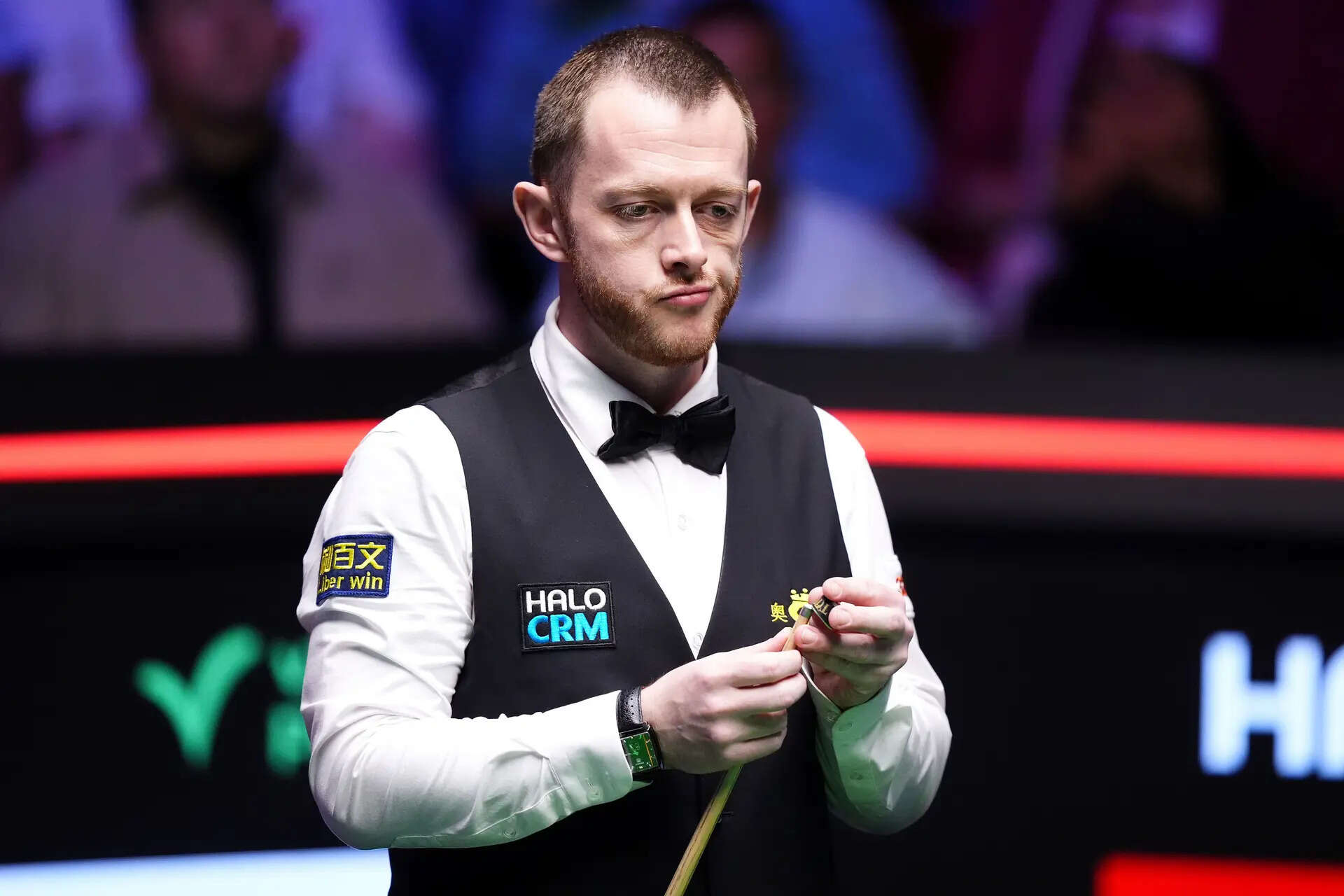
The Crucible Theatre in Sheffield is a claustrophobic pressure cooker. It is a place where the air feels heavy with the ghosts of decades past, and the silence is so absolute you can hear the internal mechanics of a player’s nervous system. Down on the floor, under the brutal heat of the television lights, Kyren Wilson and David Gilbert were locked in the kind of psychological warfare that defines the World Snooker Championship semi-finals. Every breath was calculated. Every safety shot was a chess move designed to suffocate.
Then, the world outside simply stopped. If you found value in this piece, you should look at: this related article.
For the millions of fans watching at home on the BBC, the tension didn’t break—it evaporated. One moment, the screen held the sharp, focused emerald of the table; the next, it was gone. A power outage at the broadcaster's broadcast center didn't just flicker. It severed the connection between the arena and the audience at the exact moment the drama reached its peak.
Imagine, for a second, the perspective of a lifelong fan. Let’s call him Arthur. He has watched every World Championship since the seventies. He knows the cadence of the commentator's whisper. He understands that a semi-final at the Crucible isn't just a game; it is a marathon of the soul. Arthur is sitting on the edge of his worn armchair, tea cooling on the side table, watching Wilson navigate a treacherous break. For another look on this story, refer to the latest update from The Athletic.
Suddenly, the green baize is replaced by a deer.
Not a metaphorical deer. A literal, high-definition deer from a nature documentary.
The Mechanics of Frustration
The BBC later issued a formal apology for the technical glitch, explaining that a major power failure had knocked out their ability to broadcast the live feed. But an apology is a cold comfort when the rhythm of a masterpiece is interrupted. In the control rooms, technicians were likely living through a nightmare of flashing red lights and dead servers. In the living rooms of the United Kingdom and beyond, that silence was replaced by a bewildered, collective shout at the television screen.
Broadcasting live sports is a feat of engineering that we take for granted until the wires cross. It requires a synchronized dance of satellite uplinks, fiber optic cables, and redundant power systems. When the grid fails, the illusion of proximity vanishes. We are reminded that we aren't actually in Sheffield; we are just staring at a glow-box that can be switched off by a faulty circuit breaker or a surge.
The irony was not lost on the audience. While the players continued to sweat under the lights in South Yorkshire, unaware that their battle had become invisible, the national broadcaster was forced to pivot to "filler" content. This wasn’t a planned intermission. It was a digital collapse.
Why We Care About the Silence
Snooker is a sport built on the absence of noise. Unlike the roar of a football stadium or the screech of Formula 1 tires, snooker relies on the tension of the "nothing." It is the gap between the cue ball hitting the object ball and the sound of the leather pocket swallowing it. That specific, rhythmic quiet is what hooks the viewer.
When the power cut, that silence was replaced by a different, hollow kind of quiet. The switch to a nature program felt like a surrealist joke. One minute, you are calculating the angles of a double-bank shot; the next, you are learning about the migratory patterns of birds. The whiplash was physical.
It highlights a growing fragility in our relationship with live media. We live in an era of instant gratification and 5G connectivity, yet we are still at the mercy of physical infrastructure. A transformer blows, a cable is snipped, and the shared cultural moment—the "did you see that?" moment—is snatched away.
Consider the players. Wilson and Gilbert were playing for more than just a trophy. They were playing for a place in history, for life-changing prize money, and for the validation of decades of grueling practice in lonely snooker halls. They were performing in a vacuum, their greatest professional moments happening in a dark room that no one could see.
The Invisible Stakes
There is a psychological contract between a broadcaster and its audience. We give them our time and our emotional investment, and they promise to be the window through which we witness greatness. When that window slams shut, the contract is broken.
The BBC’s apology mentioned the "unforeseen" nature of the outage. In the world of high-stakes technology, the unforeseen is the only thing you should truly expect. But for the fan, the technical "why" doesn't matter. What matters is the stolen climax. It’s the book with the last ten pages ripped out. It’s the symphony that cuts to a dial tone during the final crescendo.
The snooker community is a resilient one. They are used to late nights and slow-burning dramas. But this was a bridge too far for many. Social media lit up with a mix of fury and dark British humor. Some joked that the deer in the nature doc had a better safety game than Gilbert. Others were genuinely wounded, feeling that a sport often sidelined by mainstream media had been let down at its most vital hour.
The Human Cost of a Blown Fuse
We often talk about technology in terms of "robustness" or "capacity." We should talk about it in terms of heart. The people working behind the scenes at the BBC didn't want this to happen. There were likely engineers in tears, frantically trying to reroute signals while the weight of millions of disappointed viewers pressed down on them.
But the real story isn't the wires. It’s the man in the armchair. It’s the kid staying up past their bedtime to see a hero make a 147. It’s the communal experience of a nation holding its breath together.
When the power eventually returned and the green table flickered back into existence, the momentum had shifted. The world had moved on, even if only by twenty minutes. The players were still there, the chalk dust was still hanging in the air, and the balls were in the same positions. Yet, something had been lost. The spell was broken.
You can fix a power grid. You can reboot a server. You can write a press release that says "we're sorry for the interruption." What you cannot do is recapture the exact moment when a game of snooker transcends sport and becomes something closer to art. That moment requires a witness. And for one strange, frustrating evening in Sheffield, the witnesses were left in the dark, watching a deer graze in a field while a masterpiece was finished in secret.
The table stayed green, but the lights had already gone out in the hearts of the faithful.