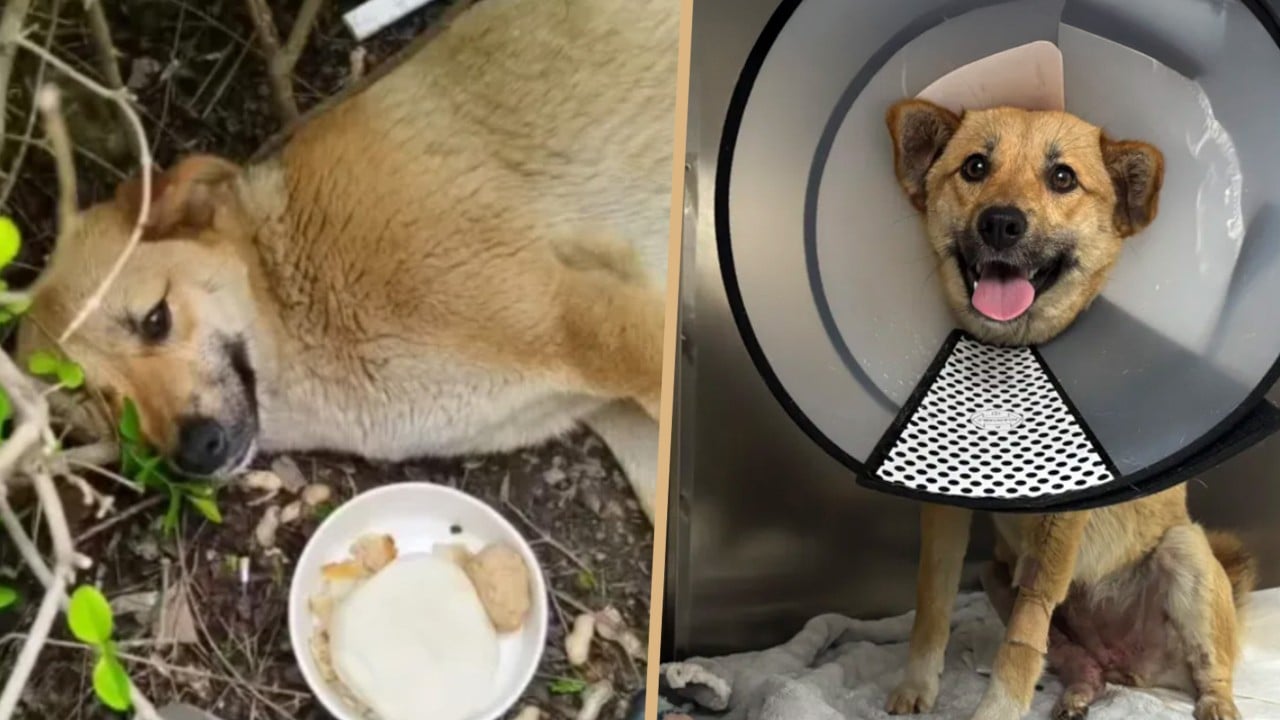
The intersection of North Jiefang Road is a place where the air smells of exhaust and burnt rubber, a chaotic theater where thousands of steel boxes scream past each other every hour. In the middle of this urban roar, there was a dog. He didn't have a name, not yet. He was just a scrap of yellow fur, a shadow darting between tires, living on the margins of a city that rarely looks down.
Then came the sound of a heavy impact. The screech of brakes. The sickening thud of metal meeting bone.
The car didn't stop. It rarely does in the middle of a midnight rush. The dog was left crumpled on the asphalt, a broken thing in a world that moves too fast to care. His breathing was shallow, his back legs useless, and the red stain on the gray pavement was spreading. Most people saw a nuisance. Most saw a carcass-in-waiting. But the taxi drivers of this city see everything. They are the night-watchmen of the concrete, the ones who notice the things the rest of us ignore while we're dreaming or doom-scrolling.
The First Light on the Road
Lao Wang was the first to pull over. His taxi, a battered teal sedan, hummed idly as he stepped out into the humid air. He didn't see a stray. He saw a fighter. The dog was trying to drag itself toward the curb with its front paws, whimpering a sound so thin it barely pierced the traffic.
Wang didn't have a medical kit. He didn't have a plan. What he had was a radio.
He keyed the mic. His voice crackled through the speakers of dozens of other cabs circling the district. He told them about the yellow dog. He told them it was dying. He told them it shouldn't have to die alone.
Silence usually follows such calls. Drivers have quotas. They have families to feed. Every minute spent idling is money bleeding out of a thin wallet. But that night, the frequency didn't stay quiet. One by one, the acknowledgments came in. Short. Terse. Determined.
"I’m five minutes out."
"I've got a blanket in the trunk."
"Tell him to hold on."
Within twenty minutes, the intersection was glowing with the amber strobes of over a dozen taxis. They formed a protective ring around the fallen animal, a barricade of chrome and glass against the indifferent tide of the city.
A Bill Paid in Small Change
The animal hospital was cold, brightly lit, and expensive. When the first group of drivers carried the dog inside, the prognosis was grim. Internal hemorrhaging. Multiple fractures. A surgery that would cost more than a month’s wages for a cabbie working twelve-hour shifts.
This is where the story usually ends. This is the part where "reality" sets in and the hard-hearted logic of the world dictates that a stray isn't worth the investment.
But the radio net was still buzzing.
Word spread through the shift changes and the roadside tea stalls. Fifty-six drivers. That was the final count. Men and women who spend their lives being shouted at by hurried commuters or ignored by the wealthy. They began to arrive at the clinic. They didn't come with corporate sponsorships or oversized checks. They came with crumpled bills tucked into their pockets and handfuls of coins gathered from their center consoles.
They pooled their resources. One driver contributed 100 yuan. Another, who had a particularly slow night, gave 20. It was a grassroots uprising of empathy. They weren't just paying for a surgery; they were protesting the idea that life is disposable.
The dog, now named "Big Yellow" by the nurses, went under the knife. While the surgeons worked, the drivers went back to the streets. They drove through the rain and the sunrise, their tires humming a different tune now. They were stakeholders in a life.
The Long Road to Standing Up
Recovery isn't a cinematic montage. It is a slow, grueling process of pain and incremental gains. Big Yellow spent weeks in a cage, his body held together by pins and plates funded by the collective sweat of fifty-six strangers.
The drivers didn't just drop the money and vanish. They became a rotating shift of guardians. They brought snacks. They checked the charts. They asked the vets for updates with the same intensity they’d use to check the price of petrol.
Consider the psychology of the "bystander effect." We are taught that the more people who witness a tragedy, the less likely any one person is to help. We assume someone else will take the burden. But in this corner of the world, the opposite happened. The crowd didn't dilute the responsibility; it amplified it. Each driver felt the weight of the other fifty-five.
There is a specific kind of beauty in a man with calloused hands and a tired back kneeling on a linoleum floor to encourage a dog to take one shaky step. When Big Yellow finally stood on all four legs, the news traveled through the taxi ranks like wildfire. It was a victory for the little guy. It was proof that the city hadn't completely hardened into stone.
The Hero of the Rank
Today, Big Yellow doesn't look like a victim. He looks like a king. He has become a fixture at the local taxi hub, a living mascot for the men who saved him. He is well-fed, his coat is thick, and he greets the incoming cabs with a wag that seems to vibrate his entire body.
He is a local hero, but not because he pulled a child from a fire or sniffed out a bomb. He is a hero because he survived the worst of us and brought out the best of us.
The drivers who saved him didn't gain anything material. They are still driving long hours. They still face the same traffic. But there is a shift in the atmosphere at the tea stalls. When they look at Big Yellow, they see a reflection of their own humanity. They see a reminder that even in a world that values speed and efficiency above all else, there is still room to stop. There is still room to care.
We often think of heroism as a grand, singular act. We wait for the "right" moment to be brave or kind. But the story of the fifty-six cabbies suggests that heroism is actually a logistics problem. It’s about being the one to pull over. It’s about being the one to pick up the radio. It’s about realizing that while you might not be able to change the world, you can certainly change the world for one broken dog on a Tuesday night.
The scars on Big Yellow’s hips are fading, hidden beneath new fur. But the bond forged in that intersection remains. The city continues to roar, the lights continue to flash, and the cars continue to speed toward their destinations. Yet, tucked away near the taxi stand, a yellow dog sleeps in the shade of a teal sedan, safe in the knowledge that he is no longer a shadow.
He is someone’s. He belongs to fifty-six people who refused to keep driving.
The asphalt is still hard, and the traffic is still loud, but for a few minutes every day, the world feels a little softer when Big Yellow leans his head against a driver’s knee.