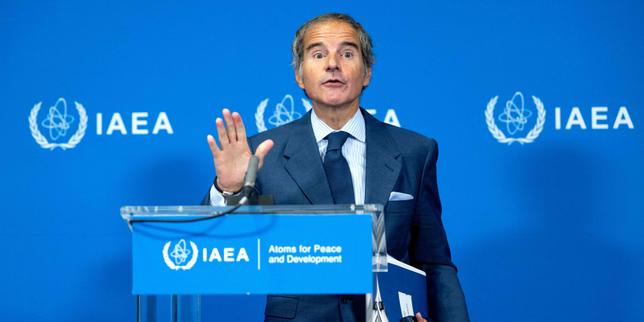
The diplomatic standoff between Tehran and Western powers just shifted into a much more aggressive gear. The International Atomic Energy Agency (IAEA) voted to send Iran's atomic dossier back to the United Nations Security Council. If you've been following nuclear non-proliferation news, you know this is the first time in two decades that such a drastic escalation has hit this specific milestone.
People often think these institutional votes are just symbolic wrist-slaps. They aren't. When the IAEA board in Vienna formally signals non-compliance, it strips away whatever diplomatic breathing room was left. Let's break down why this matters right now and what it means for global security. In related news, take a look at: Why Trump Claims the Iran War Will Stop Right After the Midterms.
The Stockpile Problem Driving the Crisis
At the heart of this referral is a massive accumulation of enriched material that has alarmed international inspectors for months. Before regional military friction and strikes impacted sites earlier in the year, the IAEA calculated that Iran held roughly 440 kilograms of uranium enriched up to 60 percent purity.
To put that in plain terms, 60 percent is technically close to weapons-grade material, which sits around 90 percent. While Iranian officials insist their nuclear trajectory remains entirely peaceful, intelligence assessments and watchdog agencies point out a sobering reality. That volume of near-weapons-grade stockpile gives Tehran potential raw material for multiple nuclear devices if leadership ever chooses to cross that threshold. The Guardian has also covered this critical subject in great detail.
The IAEA's chief, Rafael Grossi, has repeatedly warned that inspectors cannot verify the complete integrity or current status of this entire inventory. That lack of verification is precisely why Western nations—specifically the United States, the United Kingdom, France, and Germany—pushed hard for the official UN referral.
Geopolitical Fault Lines at the Security Council
Taking this dispute to the UN Security Council sounds like a straightforward enforcement mechanism, but international politics rarely works cleanly. While Western capitals view the move as essential for accountability, traditional allies of Tehran like China and Russia view it through an entirely different lens.
Expect heavy friction or potential veto roadblocks from Moscow and Beijing. Both nations have historically shielded Iran from severe multilateral sanctions, arguing that diplomatic channels under past frameworks like the Joint Comprehensive Plan of Action should be revived rather than weaponized.
However, pushing the dossier to the UN floor changes the political calculus. It forces every member state on the Security Council to go on record regarding non-compliance. It also opens the door for a potential snapback of historical UN sanctions that were lifted or expired under previous agreements, creating severe financial and trade pressures for an already strained Iranian economy.
What Happens Next on the Ground
We are looking at a period of intense economic and diplomatic jockeying. Tehran has routinely responded to Western pressure by restricting IAEA access or scaling up its centrifuge capacities further. If the Security Council moves past debate and attempts to pass punitive measures, expect regional tensions in the Middle East to spike immediately.
The real question isn't just whether the UN can pass a resolution. It's whether any international body still has the leverage to roll back an enrichment program that has advanced this far over the last decade. Watch how European capitals and Washington coordinate their next economic moves, because the window for negotiated containment is closing fast.