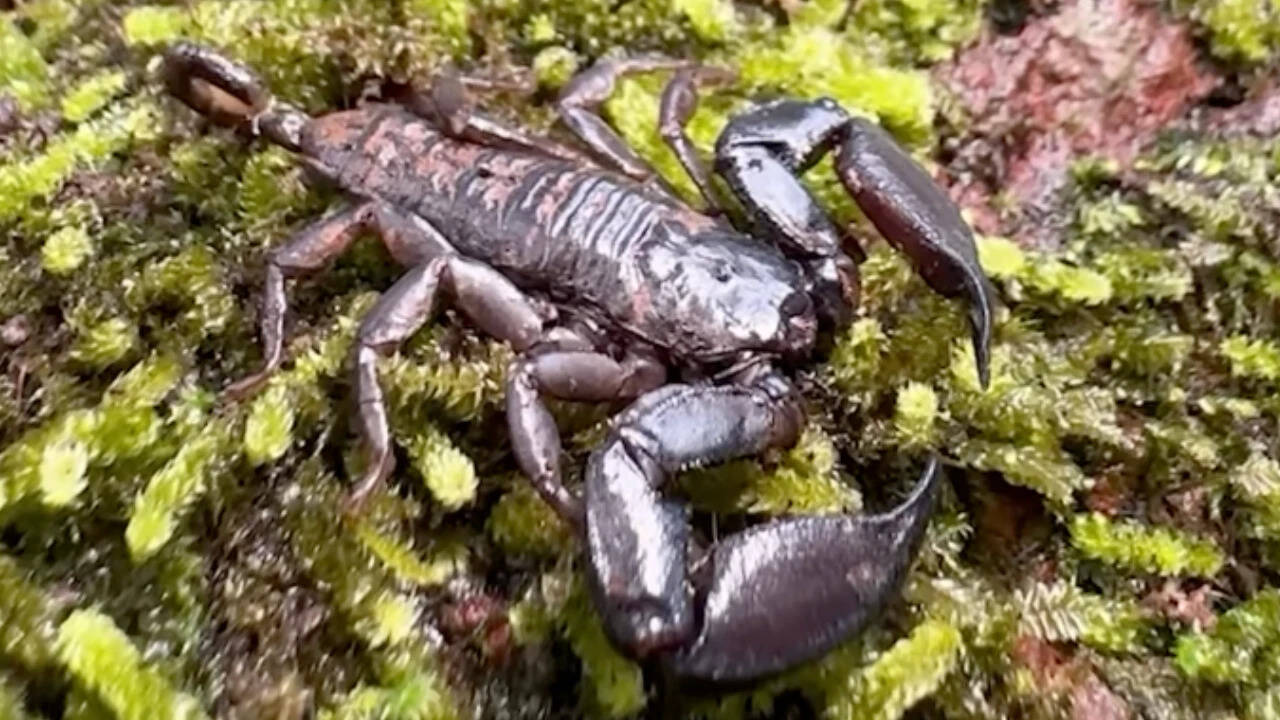
Researchers have formally identified a new species of scorpion inside Odisha's Similipal Tiger Reserve, a massive forested plateau in eastern India long celebrated for its tigers and elephants while its smallest predators went largely uncounted. The discovery, made during targeted arachnid surveys in the reserve's moist deciduous and semi-evergreen tracts, adds a distinct, previously undocumented lineage to India's eastern Ghats-Chota Nagpur transition zone. Yet the real story is not merely that an unfamiliar arachnid was hiding under leaf litter and exfoliating bark in Mayurbhanj district. It is what this late arrival into the scientific record exposes about decades of conservation funding, taxonomic neglect, and the fragility of microhabitats inside India's flagship wildlife reserves.
Wildlife headlines follow charismatic megafauna. Tigers sell conservation budgets, draw political capital, and dominate forest department patrol logs. Meanwhile, ground-dwelling arthropods—the organisms that regulate soil health, control insect populations, and signal early ecological stress—remain trapped in an archival backlog that stretches back to the colonial era. When field biologists finally turn over rocks in a place as heavily studied as Similipal and pull out a species unknown to modern taxonomy, it forces an uncomfortable reckoning with how much of India's natural heritage is disappearing before anyone bothers to name it.
Why Similipal Kept Its Secrets for So Long
Similipal Tiger Reserve spans roughly 2,750 square kilometers across the Mayurbhanj district of northern Odisha, sitting at a biogeographical crossroads where the Eastern Ghats, the Chota Nagpur plateau, and the coastal plains collide. That intersection creates steep microclimatic gradients. Within a few kilometers, sun-baked sal forests give way to damp, mist-trapping valleys, perennial hill streams, and lateritic plateaus. For organisms that do not migrate—scorpions chief among them—those geological folds act like evolutionary islands.
Unlike birds or large mammals, scorpions are intensely philopatric. Most individuals spend their entire lives within a few dozen meters of the burrow, rock crevice, or rotting log where they emerged. Over hundreds of thousands of years, a single ridge or river gorge can isolate two populations long enough for their pedipalps, pectinal tooth counts, metasomal carinae, and venom chemistry to diverge into separate species.
For decades, however, field research in Similipal was overwhelmingly geared toward Project Tiger protocols. Camera traps were strapped to trees at knee height to capture flank stripes. Line transects counted ungulate pellets. Nocturnal surveys, when permitted at all, rarely involved ultraviolet flashlights—the single most basic tool required to spot scorpions, whose cuticles contain fluorescent compounds like beta-carboline and 4-methyl-7-hydroxycoumarin that glow cyan-green under UV light. Without systematic UV sampling and pitfall trapping across different elevations, entire guilds of nocturnal arachnids remained functionally invisible.
The Slow Grind of Modern Scorpion Taxonomy
Finding an unusual scorpion in the field is the easy part. Proving to the global scientific community that it is genuinely new takes months or years of painstaking comparative work, and the process is riddled with bottlenecks.
In the nineteenth and early twentieth centuries, British naturalists like Reginald Innes Pocock described dozens of Indian arachnids from hastily preserved specimens shipped to London, often with vague locality labels such as "Bengal" or "Madras Presidency." Those original type specimens still sit in European museum drawers. To confirm that a scorpion collected in Similipal is not simply a poorly documented variant of a species named in 1900, Indian researchers must cross-reference dozens of morphological traits against aging Latin and English descriptions, often without high-resolution photographs of the holotypes.
Taxonomists examine minute anatomical markers:
- Trichobothriotaxy, the exact geometric arrangement of sensory hairs on the pedipalps, which stays remarkably stable within a species.
- Pectines, the comb-like sensory organs on the underside of the scorpion that brush against the substrate to detect chemical and mechanical cues, where tooth counts and structural shapes help separate closely related taxa.
- Hemispermatophore morphology, the internal reproductive structures in males, which act as a biological lock-and-key mechanism and often provide the clearest diagnostic proof of reproductive isolation.
- Carinal granulation and telson shape, including the curvature of the aculeus (the stinger) and the presence or absence of a subaculear tubercle.
Increasingly, morphology alone is not enough. Modern arachnology demands integrative taxonomy, pairing physical measurements with mitochondrial DNA sequencing—typically the cytochrome c oxidase subunit I (COI) gene—to verify genetic divergence. In India, securing permits to collect even a handful of invertebrate specimens inside a Schedule-I protected area like a tiger reserve requires navigating layers of state wildlife bureaucracy. Researchers often wait longer for collection clearances than they spend at the laboratory bench.
What Makes Scorpions Precision Indicators of Forest Health
To the general public, a scorpion is either a medical nuisance or a creature to be swept out of a rural courtyard. To ecologists, it is one of the most reliable diagnostic instruments in terrestrial biology.
Scorpions sit near the top of the invertebrate food web. They are sit-and-wait predators with extraordinarily low metabolic rates, capable of surviving months without food by dialing down their energy expenditure. Because they live long lives—many forest species take three to six years to reach maturity and can live well past a decade—and rarely disperse across disturbed ground, their presence or absence reflects decades of habitat continuity rather than a single good monsoon.
Sensitivity to Microhabitat Disruption
A healthy population of forest-floor scorpions requires intact leaf litter, stable soil moisture, undisturbed deadwood, and an abundant prey base of crickets, cockroaches, beetles, and smaller arachnids. When those conditions change, scorpions vanish quietly:
- Ground fires strip the thermal buffer. Similipal has suffered recurring seasonal forest fires, many sparked deliberately to clear undergrowth for mahua flower collection or grazing. While large trees survive low-intensity surface burns, fire incinerates the organic litter layer and bakes the top centimeters of soil, wiping out burrowing and bark-dwelling invertebrates across entire hillsides.
- Compaction and edge effects alter humidity. Road widening, pilgrimage traffic to sites inside the reserve periphery, and timber extraction open the canopy, drying out the damp microclimates that specialized forest scorpions need to prevent desiccation.
- Pesticide drift along forest fringes. Agricultural runoff from buffer-zone farms introduces broad-spectrum insecticides into seasonal streams and bordering woodlands, bioaccumulating in predatory arthropods long before vertebrates show symptoms.
A tiger can walk ten kilometers overnight to avoid a burned patch of forest. A range-restricted scorpion cannot. If a species exists only on a handful of moist hill slopes inside Similipal, a single severe fire season or localized landslide can push it to the brink before conservation planners even map its distribution.
The Uncomfortable Truth About India's Conservation Blind Spot
India's Wildlife (Protection) Act, 1972, revolutionized the survival of large vertebrates, pulling tigers, one-horned rhinoceroses, and Asiatic lions back from catastrophic decline. Yet the legal and financial architecture built around that success has created an unintended hierarchy of life.
Conservation budgets in state forest departments remain overwhelmingly tethered to flagship species. Tiger reserves receive centralized funding through the National Tiger Conservation Authority, dedicated anti-poaching squads, and continuous media scrutiny. Outside that umbrella, invertebrate conservation barely registers. Of the more than 140 scorpion species documented across India—spanning families such as Buthidae, Scorpionidae, Hormuridae, and Chaerilidae—the vast majority have never been evaluated for the IUCN Red List. They sit in the Data Deficient limbo, which in policy terms is functionally identical to being ignored.
There is also a stark asymmetry in public perception. When a new frog, gecko, or orchid is discovered in the Western Ghats or Northeast India, regional media celebrate it as ecological treasure. When a scorpion is discovered, the first question from readers is almost always whether its sting is lethal.
Medically, that fear is wildly misplaced in the context of deep-forest species. Out of roughly 2,800 scorpion species worldwide, fewer than 30 possess venom dangerous enough to kill a healthy adult human. In India, clinically significant envenomation is overwhelmingly linked to a single adaptable, open-country species, Hottentotta tamulus (the Indian red scorpion), which thrives in dry agricultural landscapes and human settlements—not inside undisturbed moist forests. Specialized woodland scorpions typically rely on mild, neurotoxic peptide cocktails calibrated to paralyze soft-bodied insects within seconds, posing negligible risk to humans who do not accidentally step on or handle them.
Yet the biomedical value of those venoms is immense. Scorpion venom is not a single toxin; it is a complex library of hundreds of bioactive peptides that selectively target ion channels—sodium, potassium, calcium, and chloride channels—in cell membranes. Pharmaceutical researchers globally screen newly identified arachnid venoms for leads in chronic pain management, autoimmune modulation, antimicrobial resistance, and targeted cancer imaging. Every unstudied species lost to habitat degradation represents a locked chemical archive destroyed unread.
The Counter-Argument Inside Taxonomic Circles
Not everyone in evolutionary biology greets every new species announcement with uncritical applause. Over the past decade, a quiet debate has simmered within arachnology and broader zoological taxonomy over taxonomic inflation versus genuine cryptic diversity.
Skeptics point out that as molecular sequencing becomes cheaper and morphometric tools grow sharper, researchers sometimes elevate geographically isolated populations with minor genetic or structural differences into full species rather than treating them as clinal variations of a single widespread taxon. In poorly sampled regions like central and eastern India, where researchers may have specimens from Similipal and from the southern Eastern Ghats 600 kilometers away—with zero sampling in the corridor between them—what looks like a distinct species can occasionally turn out to be two ends of a continuous gradient once intermediate forests are surveyed.
Proponents of rigorous species splitting offer a sharp rebuttal grounded in conservation triage. Under existing environmental law, undescribed populations receive zero statutory protection. If an mining lease, highway expansion, or dam project is proposed on a hill range in Odisha, environmental impact assessments check for scheduled species and recognized endemics. Calling a distinct, isolated lineage a "mere regional variant" of a common species strips it of any legal shield. Naming it puts it on the map, forces environmental regulators to acknowledge its existence, and creates a baseline against which future population declines can be measured.
The resolution to that tension does not lie in slowing down taxonomy. It lies in funding comprehensive regional surveys across the forested corridors linking Similipal to Kuldiha, Hadagarh, Satkosia, and the broader Eastern Ghats so biologists can see whether these populations are truly isolated endemics or part of a wider meta-population.
What Needs to Change on the Ground in Eastern India
If the discovery in Similipal is to mean more than a brief spike in local news traffic and a PDF tucked into a zoological journal, conservation practice in Odisha and across India's peninsular forests has to adapt in concrete ways.
First, All-Taxa Biodiversity Inventories need dedicated funding inside tiger reserves. Forest departments already employ hundreds of beat guards and field biologists who patrol every compartment of reserves like Similipal on foot. Training existing staff to recognize and log non-charismatic taxa—arachnids, centipedes, land snails, dung beetles, and bryophytes—requires minimal capital outlay compared to satellite collars or heavy machinery, yet multiplies ecological data collection across seasons.
Second, permit bottlenecks for academic taxonomists must be streamlined. When university researchers and institutions like the Zoological Survey of India face multi-year delays to collect voucher specimens of non-threatened invertebrates, the country effectively outsources its own biodiversity discovery to chance encounters. A tiered, transparent permitting track for accredited taxonomic research—coupled with mandatory deposition of type specimens in recognized Indian national repositories—would accelerate documentation without compromising anti-poaching safeguards.
Third, fire management in reserves like Similipal must account for ground-dwelling microfauna. Pre-monsoon controlled burning and fire-line clearing are standard forestry tools, but blanket burning of leaf litter across sensitive moist valleys devastates flightless endemics. Mapping microhabitat refugia—rocky outcrops, perennial stream buffers, and old-growth damp hollows—and shielding them from prescribed burns gives soil and litter communities a fighting chance to recolonize surrounding compartments after dry-season fires.
The Bigger Picture Written in Small Predators
Similipal has long been treated as an island of wilderness holding the line for eastern India's surviving tigers, melanistic leopards, and elephants. That narrative is true, as far as it goes, yet it misses the foundation holding the forest together. Long before a forest loses its top mammalian predators, it loses the quiet architecture of invertebrates working in the dark beneath the canopy.
A newly named scorpion in Mayurbhanj is proof that eastern India's ancient plateaus still harbor evolutionary lineages we are only beginning to read, and a blunt reminder that you cannot protect what you have never bothered to look for in the dark.