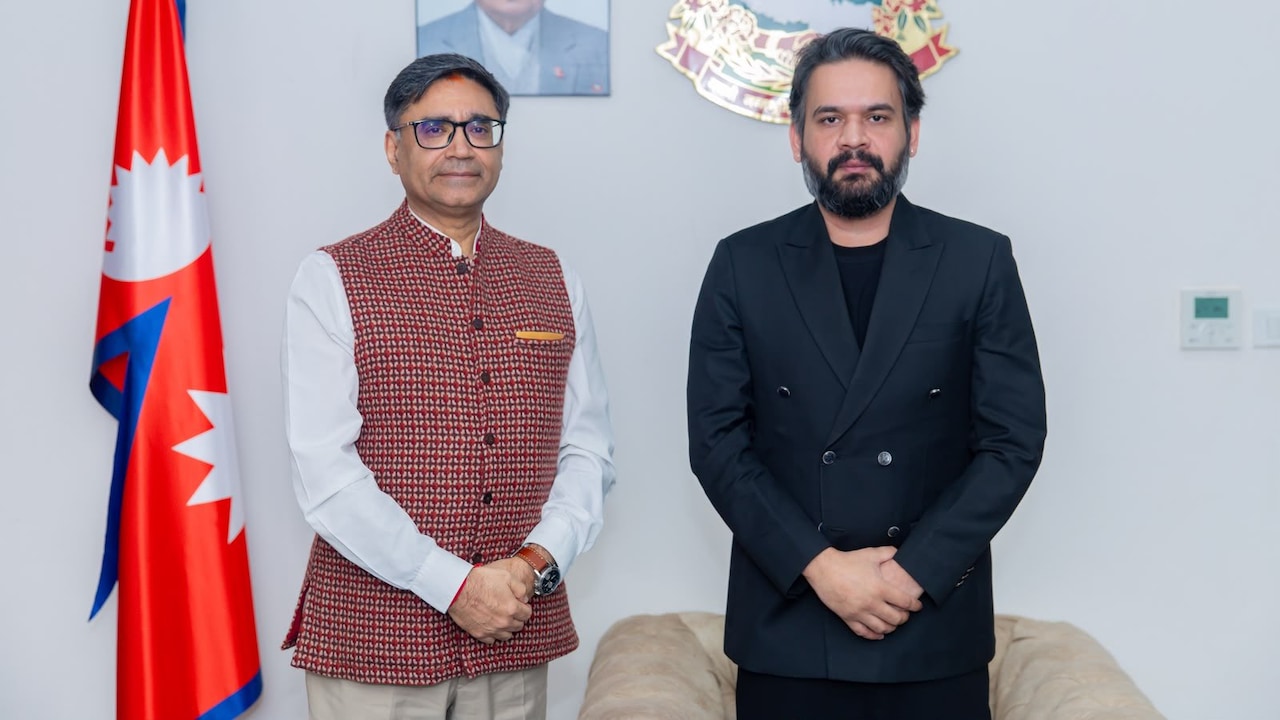
Indian Foreign Secretary Vikram Misri’s high-level diplomatic huddle with Nepal’s Prime Minister K.P. Sharma Oli is not just routine neighborly maintenance; it is a calculated preemptive strike ahead of Kathmandu Mayor Balendra Shah’s first official visit to India. For decades, South Block—the seat of India’s Ministry of External Affairs—operated on a predictable, albeit aging, playbook in the Himalayas. You managed the old guard. You negotiated with the Maoists, the Nepali Congress, and the Unified Marxist-Leninist leadership in smoke-filled rooms in Singha Durbar, trading infrastructure promises and energy corridors for geopolitical alignment. That playbook is officially obsolete.
Balen Shah, the rapper-turned-structural-engineer who hijacked Kathmandu’s municipal politics as an independent outsider in 2022, represents an existential disruption to traditional Indo-Nepal diplomacy. He does not owe allegiance to New Delhi, nor does he take marching orders from Beijing. He answers to a hyper-connected, fiercely nationalistic, and deeply cynical generation of Nepali voters who view traditional party bosses as compromised fossils. When New Delhi’s top diplomat sits down with the Prime Minister days before Shah steps onto Indian soil, the subtext is unmistakable. India is trying to stabilize its institutional guardrails before engaging with an unpredictable populist wildfire.
The Anatomy of a Diplomatic Hedge
To understand why a municipal mayor’s travel itinerary is triggering feverish backchanneling at the highest levels of the Indian foreign service, you have to look past protocol. Technically, a mayor sits several rungs below a prime minister in diplomatic hierarchy. In practice, Balen Shah commands more organic political capital on the streets of the Kathmandu Valley than the entire coalition cabinet combined.
When Foreign Secretary Misri met with Prime Minister Oli, the official readouts focused on the usual talking points. Connectivity projects. Hydropower trade agreements. Cross-border digital payment infrastructure. Transit treaties. Yet anyone who has tracked South Asian geopolitics for more than a decade knows that official communiqués are written to obscure, not reveal.
New Delhi faces a classic diplomatic dilemma. If India rolls out the red carpet too enthusiastically for Balen Shah, it risks alienating Prime Minister Oli and the established political syndicate that still controls Nepal’s federal parliament and security apparatus. Conversely, if New Delhi ignores Shah or treats him like a minor civic functionary, it cements a narrative already popular among Nepali youth—that India is an arrogant hegemon out of touch with Nepal's democratic evolution.
The timing of the Foreign Secretary's visit is a classic hedge. By reaffirming bilateral commitments with the federal government first, New Delhi signals to Singha Durbar that institutional primacy still matters. At the same time, it clears the diplomatic runway so that Indian policymakers, urban planners, and intelligence operatives can take the measure of Shah in person without triggering a coalition crisis in Kathmandu.
Why Balen Shah Terrifies the Establishment
Traditional Nepali politicians are easy to read because their incentives are transactional. They want electoral backing, quiet financial channels, medical visas for family members, and discreet backing during parliamentary no-confidence votes. Both New Delhi and Beijing have spent thirty years mastering the art of catering to these exact desires.
Balen Shah broke the machine because he bypassed the party apparatus entirely. His 2022 victory in Kathmandu was not a fluke; it was a structural indictment of the post-monarchy political order. Since taking office, he has weaponized social media, bulldozed illegal encroachments owned by politically connected oligarchs, and publicly humiliated federal ministers who tried to obstruct municipal clean-up drives.
More importantly for India, Shah has demonstrated a willingness to weaponize cultural nationalism for domestic applause. In 2023, he famously banned the screening of Indian films across Kathmandu’s theaters over a disputed dialogue in the Bollywood movie Adipurush, which implied that the Hindu goddess Sita was born in India rather than Janakpur, Nepal. When the federal government and courts pushed back, Shah doubled down, framing himself as the sole defender of Nepali sovereignty against cultural erasure.
In another flashpoint, Shah installed a map of "Greater Nepal" in his municipal office—a direct, provocative response to the "Akhand Bharat" mural unveiled in India’s new parliament building. While Kathmandu’s federal diplomats scrambled to smooth over the friction with New Delhi, Shah let the image speak for itself, watching his approval ratings soar among young voters fed up with what they perceive as Kathmandu’s chronic subservience to its massive southern neighbor.
Indian diplomats do not forget these episodes. They view Shah not merely as a city administrator, but as the prototype for a new wave of independent, populist leaders who could sweep Nepal’s 2027 general elections. If Shah decides to transition from City Hall to national politics—or throws his weight behind a unified front of independents—the entire geopolitical architecture India has spent decades building in Nepal could fracture overnight.
What New Delhi Actually Wants From Kathmandu's Mayor
Behind closed doors, India’s objectives regarding Balen Shah are pragmatic, unsentimental, and entirely focused on risk mitigation. New Delhi has no illusions about turning Shah into a pro-India loyalist. That is neither possible nor necessary. Instead, South Block has three concrete priorities for his upcoming visit.
Demystifying the Populist Enigma
Intelligence dossiers only go so far. Indian officials have watched Shah from afar through the lens of his viral Facebook posts, aggressive municipal demolitions, and sporadic clashes with federal ministries. They need to sit across a table from him to separate the performative street-fighter from the pragmatic administrator. Is he an ideological hardliner who will reflexively oppose Indian infrastructure investments, or is he a results-oriented engineer who simply wants potholes fixed, garbage cleared, and river corridors revitalized? Knowing which version of Shah shows up in New Delhi will dictate India's posture toward him for the next decade.
Exporting Urban Infrastructure Diplomacy
India has quietly pivoted its neighborhood foreign policy away from grand, slow-moving mega-projects toward high-visibility, rapid-impact urban development. New Delhi wants to showcase its own municipal transformations—from the Sabarmati Riverfront in Ahmedabad to the metro rail networks in Delhi and Bengaluru, and the solid waste management systems in Indore.
Kathmandu’s most glaring vulnerabilities are precisely the areas where India has built scalable technical expertise. Waste management in the Kathmandu Valley is a chronic, politically toxic disaster; the Banchare Danda landfill regularly erupts into blockades by angry locals. Traffic congestion is paralyzing. The Bagmati River remains an open sewer despite billions of rupees spent on cleanup initiatives. By offering Shah direct technical partnerships, municipal grants, and urban engineering exchanges, India hopes to bind his political success to Indian expertise. If Shah solves Kathmandu’s garbage crisis using an Indian municipal model, his anti-India rhetoric becomes significantly harder to sustain.
Neutralizing the China Factor
Every diplomatic move in Kathmandu occurs under the long shadow of Beijing. While Shah has maintained a careful distance from the Chinese embassy compared to some of Nepal’s leftist leaders, Beijing has been aggressively courting local governments across Nepal through sister-city agreements, cultural exchanges, and municipal grants. China understands that local mayors control land acquisition, environmental clearances, and urban zoning—the exact bureaucratic chokepoints that can stall or accelerate Belt and Road Initiative projects. New Delhi cannot afford to cede the municipal tier of Nepali politics to Beijing. Engaging Shah directly is a defensive necessity to ensure that Kathmandu’s urban master plan does not tilt toward Chinese contractors and surveillance tech.
The Trap Awaiting Balen Shah in India
For Balen Shah, this visit is the highest-wire act of his political career. Back home, his brand is built on uncompromising defiance. He refuses to attend routine meetings with federal ministers. He blasts the Prime Minister on social media in the middle of the night. He presents himself as an incorruptible outsider who refuses to play the dirty games of establishment politics.
Stepping onto Indian soil immediately exposes him to the same toxic double-standard that has ruined countless Nepali politicians before him. In Nepal’s hyper-polarized media ecosystem, any leader who visits New Delhi is instantly scrutinized for signs of capitulation. If Shah poses for smiling photographs with senior Indian ministers, his domestic critics—especially the traditional party cadres he has spent two years ridiculing—will accuse him of seeking New Delhi’s blessings to launch a national political party. They will argue that the great anti-establishment rebel is just another politician making the pilgrimage to South Block.
Conversely, if Shah behaves with his usual abrasive defiance while in India, or uses the trip to score cheap nationalist points for his Facebook followers back home, he will burn bridges with a neighbor that controls Nepal’s trade lifelines, fuel supplies, and transit routes. A mayor can afford to be an internet troll; a credible national contender cannot.
Shah’s inner circle knows this. His advisory team—composed largely of young technocrats, urban planners, and digital strategists rather than seasoned diplomats—has kept the details of his itinerary tightly guarded. They are trying to frame the trip strictly around civic governance, waste-to-energy plants, and heritage conservation. They want to project the image of a serious executive studying best practices abroad, not a politician seeking geopolitical patronage.
Yet in South Asia, there is no such thing as a purely technical visit by a high-profile political figure. Every handshake is calibrated. Every dinner invitation is a signal.
The Real Stakes Behind the Diplomatic Choreography
Look closely at the sequence of events unfolding between New Delhi and Kathmandu, and a broader reality comes into sharp focus. Nepal’s political center of gravity is shifting, and both Kathmandu’s ruling elite and New Delhi’s foreign policy establishment are scrambling to catch up.
Prime Minister Oli’s meeting with Foreign Secretary Misri was an exercise in preserving the status quo. Both men represent a generation of statecraft that believes bilateral relations are managed through treaties, joint commissions, and party-to-party understandings. They believe that if the federal governments align, the rest of the country falls into line.
Balen Shah’s very existence disproves that thesis. Today’s Nepali electorate—median age twenty-five, overwhelmingly plugged into global digital networks, and deeply disillusioned by decades of post-civil-war stagnation—no longer defers to traditional authority. They care about service delivery, dignity, and visible accountability. When Shah clears encroached public land or forces private schools to grant scholarships, he delivers tangible results that cut through decades of bureaucratic paralysis.
New Delhi’s decision to engage Shah while simultaneously reassuring the Prime Minister reveals an uncomfortable truth about Indian foreign policy in 2026. South Block can no longer rely on a single power center in Kathmandu. The era of picking a favorite Nepali prime minister and riding that horse for five years is dead. Power in Nepal has decentralized—not just constitutionally through the 2015 federal structure, but culturally and digitally through populist disruptors who operate outside party lines.
If India plays its cards right during Shah’s visit, it could establish a pragmatic working relationship with the most potent political force in Nepal’s capital without blowing up its ties to the federal coalition. If it miscalculates—either by patronizing him or by trying to co-opt him too overtly—it will hand Shah the exact nationalist ammunition he needs to turn his municipal movement into an anti-establishment national juggernaut.
When Balen Shah boards his flight to India, he will not be carrying a briefcase full of bilateral treaties. He will be carrying the expectations of a restless generation that has stopped waiting for permission from either Singha Durbar or South Block.


