The hydraulic arms of the rear-loader groan, a sound like tearing metal, and ten tons of urban life disappear into the hopper. Coffee grounds, flattened cardboard boxes, broken plastic toys, and the quiet, crushing accumulation of human existence vanish into the dark belly of the truck.
Most people never look back. The truck pulls away, the tail lights bleed into the morning fog, and the debris ceases to exist in the collective consciousness. Out of sight, out of mind.
Until the mistake is discovered.
Imagine the sudden drop in the stomach. The cold realization that hits like physical impact. You stand by the curb, staring at the empty space where the bin used to be, knowing that inside that churning mechanical beast lies something irreplaceable. Not money. Not a gadget. A piece of ancestry. Two heirloom rings, passed down through generations, vanished in a heartbeat because of a careless slip of the hand or a mistimed counter sweep.
For most, the story ends there. You accept the loss. You mourn the ghost of a great-grandmother's wedding band.
This is not the story of how those rings were lost. This is the story of where they went next.
Inside the Belly of the Beast
Ten tons. Then twenty thousand pounds.
To understand the scale of what happened next, you have to understand the modern landfill and sorting facility. These are not simple dumps. They are deafening, cathedral-sized caverns of roaring conveyor belts, magnetic separators, laser optics, and the relentless hum of industrial progress.
When a frantic call hits the sanitation department, it usually arrives too late. Dispatchers hear these pleas daily. A misplaced wallet. A set of keys. Sometimes, a bag of trash containing something valuable that accidentally found its way down the chute. The odds are astronomical. You might as well look for a specific grain of sand on a sprawling coastline during a hurricane.
Yet, sanitation workers know something the rest of the world forgets. They know what those mountains of waste actually represent.
To the casual observer, trash is uniform. It is gross, foul-smelling, and uniform in its rejection. But to the sanitation crews who spend their shifts navigating the thunderous noise of the sorting floor, waste is deeply personal. Every shattered plate, every discarded photograph, every crumpled letter tells a fragmented story of human routine.
When the word came down about the two missing heirloom rings, the crew could have shrugged. They had a schedule to keep. Twenty thousand pounds of municipal refuse was waiting on the tipping floor. The mechanical sorters were humming. The clock was ticking toward the end of a brutal shift.
Instead, they stopped the line.
The Anatomy of a Rescue
Picture the sorting floor.
Dust hangs thick in the air, catching the amber glow of high-bay industrial lights. The smell is an aggressive cocktail of decomposing organic matter, industrial lubricants, and old paper. The noise vibrates in your chest, a constant, concussive roar that makes normal conversation impossible.
Here, workers stand shoulder-to-shoulder along elevated catwalks and moving belts, their eyes darting left and right with predatory focus. They look for recyclables, hazards, and jams.
Now, introduce the human element. The crew chief—let us call him Marcus, a veteran of twenty years on the trucks—looks at the ticket detailing the lost jewelry. He thinks of his own mother’s ring sitting safely in a velvet box at home. He looks down at the mountain of grey, uniform refuse dumped from a single neighborhood route.
Twenty thousand pounds. Ten tons.
It sounds impossible because it is. You do not simply walk up to a pile of trash and poke around with a stick. You have to track the truck’s manifest. You have to isolate the exact route, the specific neighborhood, the precise block, and narrow down the dump time to a window of mere minutes.
That is the science of waste management. It is a choreography of logistics, weights, and timestamps.
Once the truck's contents were isolated on the concrete tipping floor, the real work began. This was not automated. Lasers cannot distinguish the glint of vintage gold from a crushed aluminum can or a piece of foil. Only human eyes could do this. Only human patience could parse the chaos.
Through the Grime
Kneeling—or crouching carefully—beside a massive mound of municipal waste requires a specific kind of fortitude.
The work is methodical. It is agonizingly slow. Imagine picking through twenty thousand pounds of your own worst days, your junk mail, your broken glass, your discarded coffee cups. The workers did not use bare hands, of course, but heavy-duty puncture-resistant gloves offer little protection against the sheer psychological weight of the task.
They rake through the debris with small hand tools. They pull apart black plastic garbage bags. They shake out cardboard boxes.
Hour after hour passes. The shift changes. Other workers, off the clock, step up to help. Why? Because hope is contagious, even in a landfill.
In a world driven by speed, automation, and algorithmic efficiency, there is something profoundly jarring about a group of sanitation professionals halting an entire industrial workflow for a sentimental rescue. Economically, it makes no sense. Financially, the labor cost far outweighs the gold weight of the rings.
But value is not always measured in market price.
Value is historical. Value is the weight of a grandmother's promise whispered decades ago in a room that no longer exists. Value is the continuity of a family tree tethered to a physical object that can be touched, worn, and passed down.
The workers understood this. They were not just moving trash; they were guarding history.
The Glint in the Grey
The breakthrough did not happen with dramatic fanfare. There was no cinematic orchestral swell.
Just a flash of dull gold under a halogen work light.
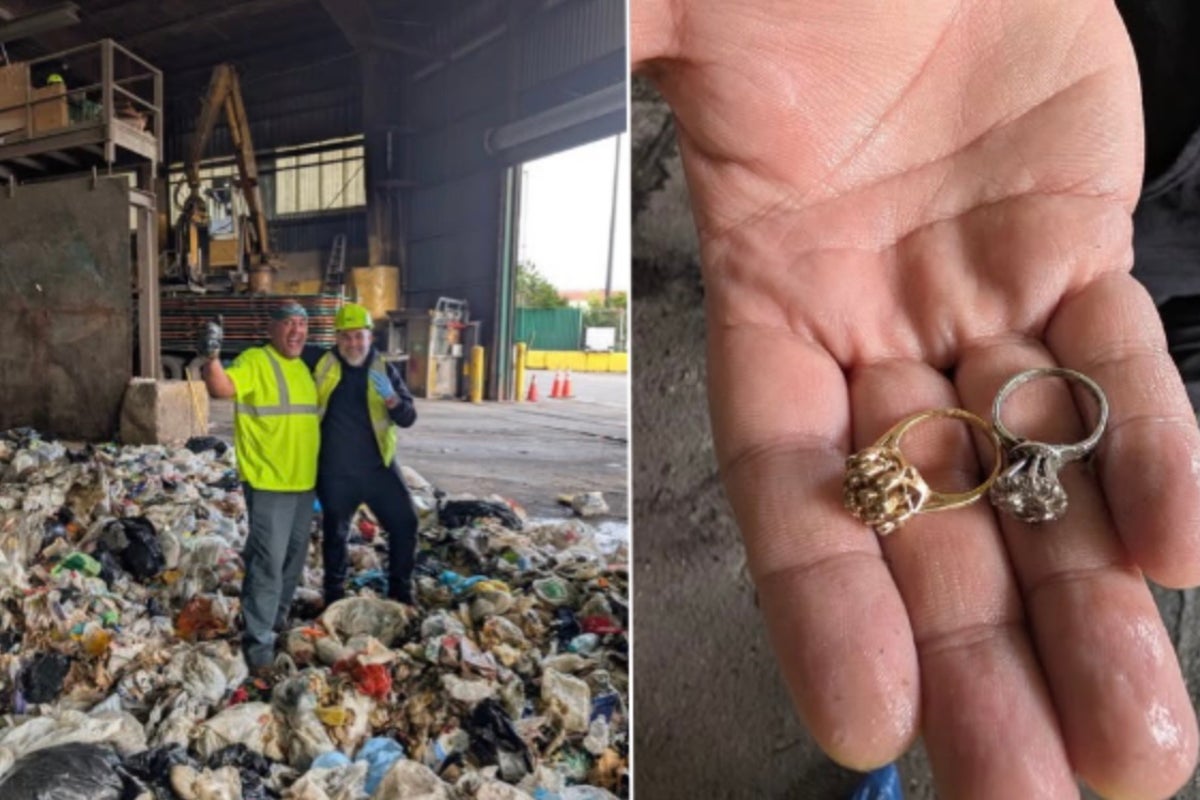
Buried deep within a torn grocery bag, nestled among coffee grounds and junk mail, sat the first ring. Small. Intricate. Worn smooth by decades of skin contact. Minutes later, right beside it, the second ring appeared.
When Marcus held them up to the light, the roaring machinery of the facility seemed to fade into the background. For a brief moment, the chaos of twenty thousand pounds of refuse stood still.
They washed the grime away under a simple utility sink. The metal gleamed, scarred and beautiful, carrying the unmistakable patina of a life well-lived.
The handover was quiet. No cameras flashing. No grand press conference. Just a tired worker handing a small, clean pouch back to a disbelieving owner whose shoulders instantly dropped ten tons of their own.
We live in an era that worships the digital cloud, where we are told that memories are infinite and physical objects are disposable. We back up our photos, we stream our music, and we treat the physical world as a temporary staging ground.
Yet, when the digital fails us, it is the physical world we mourn. It is the tangible loss that breaks our hearts. And it is the physical world—dirt, grease, sweat, and steel—that rescues us in the end.
The trucks roll out tomorrow morning. The hydraulic arms will groan again. Twenty thousand more pounds of modern life will cascade into the hoppers, swallowed by the relentless machine of a city that never stops consuming.
Somewhere in that mountain of discarded days, a small piece of human history is waiting to be found, protected by people who know that even the most broken places still hold things worth saving.