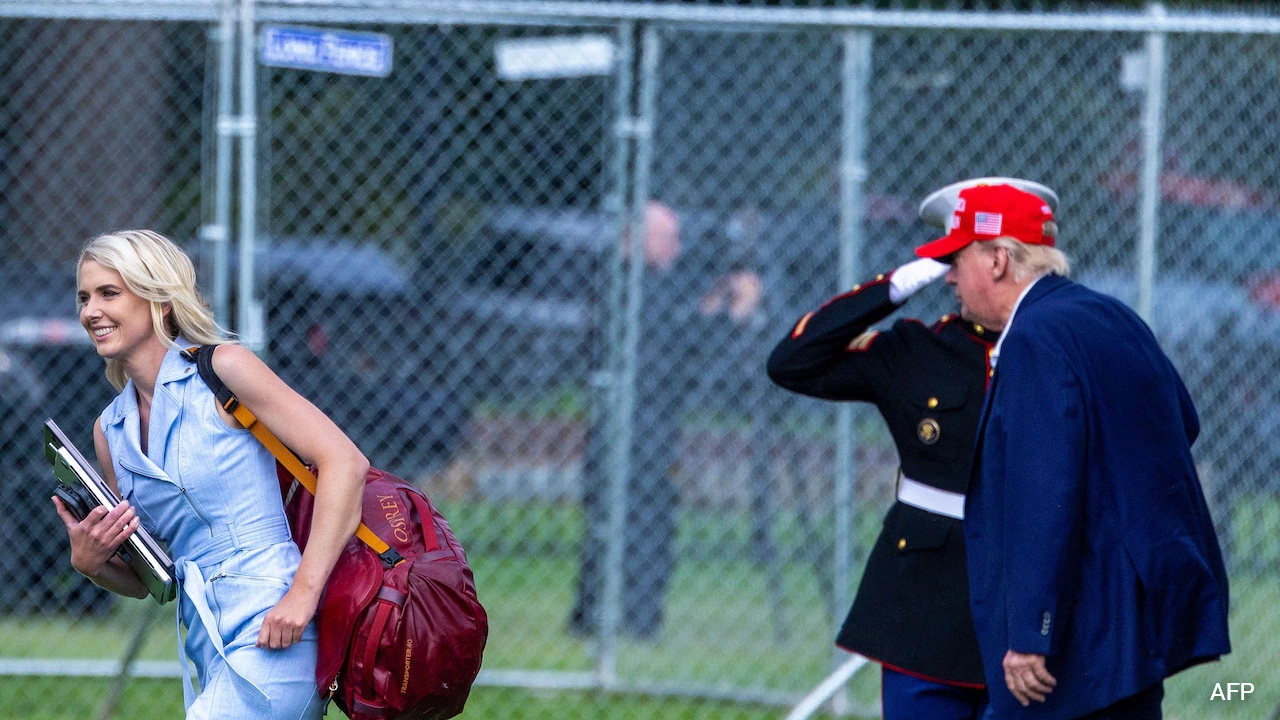
In the brutal, high-stakes ecosystem surrounding the presidency, access is the only currency that matters. Natalie Harp, a thirty-five-year-old former television host turned executive assistant, has cornered the market on that currency through a display of devotion that defies conventional professional boundaries. The recent revelation that she once squeezed herself into the confined, dark space of an SUV trunk simply to remain within the physical reach of Donald Trump during a 2023 courthouse commute is not merely a quirky anecdote. It is a calculated signal of her position in the internal hierarchy.
Her presence has become a flashpoint for those both inside and outside the West Wing. While critics view her rise as symptomatic of an insular administration, her trajectory offers a masterclass in how to engineer an indispensable role within a volatile power structure. She has moved far beyond the traditional duties of an aide, becoming a gatekeeper whose influence radiates through the president’s communications, his social media presence, and his daily information diet.
The trunk incident serves as the perfect metaphor for her professional existence. In that moment, she faced a binary choice: accept the lack of space and cede her proximity, or accept a physical indignity to maintain her utility. She chose the latter. This uncompromising drive to be present—regardless of the logistical or social cost—explains why she has managed to outlast rivals who held more formal titles. Senior officials have long complained about her ability to bypass established bureaucratic channels, yet she remains, effectively reporting only to the man in the Oval Office.
Her ascent began not in the halls of power, but in the realm of personal narrative. After a health crisis involving bone cancer, she leveraged the Right to Try Act to build a platform that caught the attention of Trump. Her journey from a patient seeking experimental care to a campaign surrogate was swift. By the time she joined the administration, she had already successfully synthesized her personal survival story with the political messaging of the movement. She did not just work for the president; she became a vessel for his identity.
This synthesis evolved into her infamous role as the human printer. In an era where digital information is overwhelming, Trump maintains a sharp preference for hard-copy briefs and physical news clips. Harp solved a persistent operational problem for the president by ensuring he was constantly fed a curated stream of data that matched his preferences. She transformed a logistical burden into a source of constant, high-level engagement. If the president wants to see a specific article or social media reaction, she is the one who puts it in his hand, often moments before he needs to process it.
This efficiency, however, is precisely what rankles traditionalists. In any functional government, information flow is supposed to be managed by a structured team of policy experts and communication directors. By consolidating this flow, Harp creates a single point of failure and a singular avenue of influence. It is a system built on total alignment rather than institutional check and balance. For the president, this is a feature of his administration, not a bug. He prizes individuals who offer zero friction and absolute consensus.
The optics of this dynamic have attracted sharp criticism, most notably from political figures who frame her proximity as a distraction from the fundamental duties of the office. When Senator Jon Ossoff invoked her name to characterize the president’s priorities, he was pointing to a perceived shift in the nature of executive governance. He framed her role as a symbol of indulgence, a sign that the administration prioritizes personal comfort and confirmation over traditional statecraft.
Yet, characterizing Harp solely as a sycophant misses the strategic reality of her utility. In a chaotic, high-pressure environment, the ability to anticipate the needs of a principal before they are even articulated is the ultimate asset. When a security threat forced a secret, complex transit through Turkey last year, Harp was there, sitting on a nondescript plane, maintaining the rhythm of the president’s day while the Secret Service navigated a genuine crisis. She does not take vacations from her role. She does not hesitate.
The friction she causes among other staff members is an inevitable consequence of her model. When an aide occupies a space that has no formal boundary, they essentially sit on top of the established hierarchy. She has been known to participate in meetings she was not invited to, and her tendency to communicate directly with lawmakers and donors has made her a target for those who prefer more conventional, slower-moving paths of influence. These efforts to box her out have repeatedly failed because her true employer, by her own design and his preference, is the president himself.
History is littered with aides who attempted to replicate this brand of total-immersion service. Most eventually burn out or are discarded when the principal’s needs shift. The sustainability of her position depends entirely on the president’s continued requirement for her specific type of service. As long as he values the immediate, tangible reinforcement of his worldview, her position is secure.
The danger for any administration relying on such an arrangement is the lack of objective feedback. When the primary conduits of information are vetted for loyalty first and veracity second, the capacity for strategic error grows. The human printer ensures the boss gets exactly what he wants, but that does not guarantee that what he wants is what he needs to navigate the complexities of global policy.
She is, in every sense, a product of the movement she serves. Her existence as a central figure in the administration illustrates a shift away from expertise-based governance toward loyalty-based gatekeeping. For those who watch the machinations of power from the outside, the trunk incident is a story about a person who refused to let an empty seat end her work. For those inside, it is a warning. It signals that in this specific theater of power, traditional titles and formal reporting lines are subservient to the person who can prove, in the most inconvenient ways, that they will never leave the side of the man in charge.