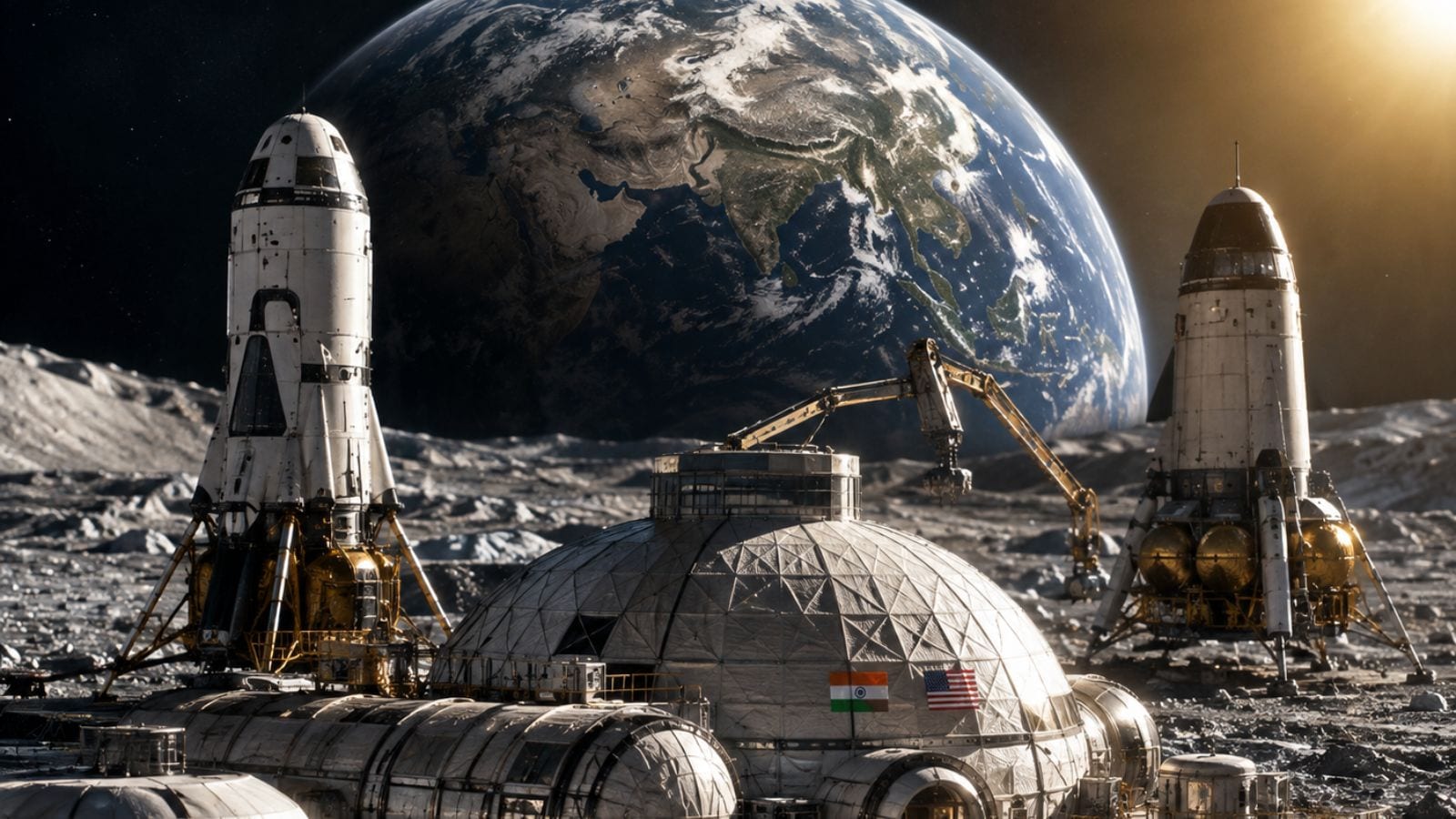
The headlines read like a geopolitical fairy tale. NASA invites India to the Artemis Accords. Space agencies hold hands. Humanity marches toward a sustainable lunar base together, fueled by mutual respect and shared scientific ambition.
It is a comforting illusion. It is also completely wrong. Recently making waves lately: The Anatomy of Commercial Space Entry Why Vingroup and VinSpace Are Betting on Rideshares.
Most analysts look at Washington extending an olive branch to New Delhi and see a grand alliance of democracies uniting against authoritarian space programs. They call it a partnership. They call it mutual cooperation. They are buying the PR package wholesale because the lazy consensus in aerospace journalism is that every handshake is pure, and every memorandum of understanding is an act of altruism.
I have spent years watching the sausage get made in international defense procurement and joint technology transfers. I have seen programs launched with soaring rhetoric about joint development, only to dissolve into bitter disputes over intellectual property, technology export controls, and who actually gets to hold the steering wheel when things break. Further information into this topic are covered by MIT Technology Review.
NASA is not inviting India to the lunar neighborhood out of pure benevolence. Washington is outsourcing the hard math, the tight margins, and the political risk of low-cost lunar exploration to an ISRO that knows how to stretch a rupee further than NASA can stretch a billion dollars.
Let us look at the structural mechanics of this arrangement.
The Myth Of Equal Partnership In Deep Space
When two organizations with wildly asymmetrical budgets and technological maturities sign a joint space agreement, the outcome is never a partnership. It is a subcontractor relationship wrapped in diplomatic velvet.
NASA’s Artemis program is a bloated, congressional jobs program masquerading as an exploration initiative. It relies on legacy contractors, cost-plus contracting models, and a risk aversion that makes launching a weather balloon feel like a moon landing. By the time NASA designs a lunar toilet, three senators have taken credit for it and four states have claimed manufacturing sub-contracts.
India’s space agency operates in an entirely different universe. Chandrayaan-3 landed near the lunar south pole for roughly seventy-five million dollars. That is less than the catering budget for a Hollywood blockbuster or the legal fees for a mid-sized corporate merger. ISRO succeeds because they do not have the luxury of redundancy, infinite budgets, or endless congressional oversight. They rely on lean engineering, frugal innovation, and sheer operational discipline.
So why does NASA want them on board?
Because NASA needs a partner who can deliver cost-effective hardware and validate American-led lunar architecture without exposing American taxpayers to another audit nightmare.
The lazy consensus says India is joining the big leagues. The reality is that India is stepping into a system designed by Washington to lock in global standards, legal frameworks, and orbital traffic rules that heavily favor American commercial interests.
The Artemis Accords Trap
To understand what is actually happening, look past the rockets and look at the paperwork. The Artemis Accords are not a treaty; they are a club with rules written by State Department lawyers.
They establish "safety zones" around lunar outposts. They create precedents for resource extraction. They lay down the legal groundwork for how things will work when someone actually starts mining helium-3 or water ice at the poles.
By signing onto these accords, emerging space powers like India agree to play by a playbook written in Washington. They get the prestige of sitting at the table, but they accept a framework where American commercial dominance is baked into the foundation.
Imagine a scenario where an Indian lunar rover discovers a massive, accessible water ice deposit in the Shackleton Crater. Under the legal architecture of the Artemis Accords, American commercial entities leveraging NASA interoperability standards will have the legal mechanisms to stake claims, demand safety perimeters, and crowd out independent operations under the guise of preventing harmful interference.
You do not need to colonize a nation with gunboats anymore. You do it by writing the operating system of their infrastructure and making your standards the only ones that interoperate.
India’s leadership knows this game. They are not naive participants stumbling blindly into an unequal alliance. They are playing a pragmatic, long-term game of technology acquisition and diplomatic positioning. They want access to American deep-space tracking data, advanced optical communication systems, and heavy-lift logistics insight. They want to fast-track their own human spaceflight capabilities by learning from NASA's decades of life-support engineering mistakes.
It is a transactional marriage of convenience. But let us stop pretending it is a romance.
The Brutal Economics Of The Lunar Gold Rush
Let us talk about what a lunar base actually is. It is not a science station. It is an outpost in a high-gravity well designed to test extraction logistics for cis-lunar dominance.
The media loves to talk about lunar geology, water ice, and the search for ancient microbial fossils. Those are nice talking points for high school field trips. The real driver of lunar interest is positioning. The moon is the high ground of cislunar space. Whosoever controls the refueling depots, the communication relays, and the near-earth orbital insertion points controls the economic highway of the inner solar system.
NASA is behind schedule, over budget, and culturally paralyzed by risk. Their commercial crew program worked for low-Earth orbit, but deep-space logistics are a different beast entirely. They need boots on the ground—or boots on the regolith—to legitimize political timelines before competing nations establish physical and legal facts on the ground first.
When NASA invites India, they are recruiting a high-performance, low-cost engineering engine to help validate the infrastructure before private venture capital loses patience.
And what does India get? Credibility, access, and leverage. They force the West to treat them not as an aid recipient, but as an indispensable pillar of twenty-first-century planetary infrastructure.
Dismantling The Mainstream Narrative
If you read typical aerospace analysis, you will encounter three persistent falsehoods about this alliance. Let us dismantle them one by one.
- Falsehood 1: Joint missions accelerate technical equality. Shared missions do not equalize technological capability; they institutionalize division of labor. NASA will design the complex avionics and core architecture; ISRO will handle specific payload integration or cost-sensitive transport layers. The intellectual property gap remains intact.
- Falsehood 2: Space exploration transcends earthly geopolitics. Space is geopolitics with a better view. Every cooperative agreement is calculated to deny strategic advantage to geopolitical rivals while securing supply chains for rare earths and orbital real estate.
- Falsehood 3: India is just happy to be invited. India's space program has evolved past the point of needing validation from Western agencies. They have an independent heavy-lift capability, an interplanetary track record, and a commercial launch arm that undercuts global competitors. They are at the table because they bring massive leverage, not because NASA felt generous.
The Unspoken Downside
My contrarian stance has its own blind spots, of course. The risk of being this cynical is underestimating the genuine cultural shift that happens when engineers from different cultures are forced into shared operational lockers.
When you spend thirty-six hours straight troubleshooting a telemetry glitch with a counterpart across twelve time zones, institutional paranoia breaks down. Personal relationships form. Junior engineers on both sides build informal networks that outlast the bureaucratic mandates of politicians.
Furthermore, dismissing the cooperation as purely exploitative ignores the reality of climate monitoring and planetary defense. Asteroids do not care about geopolitical trade pacts. Solar flares do not respect copyright law. Global tracking networks require redundancy that no single nation can maintain alone.
Even so, do not mistake shared danger for shared vision.
The Real Playbook Moving Forward
If you are running a space tech startup, an aerospace supplier, or an investment fund looking at the cislunar economy, stop betting on government cooperation models. Ignore the press releases about unity and brotherhood.
Watch the patent filings. Watch the export control exemptions. Watch who owns the spectrum allocation rights for deep-space communication relays.
India and NASA will launch joint payloads. They will share data. They will issue glowing joint statements that make diplomats look like visionaries.
Behind the scenes, the race for lunar dominance is cutthroat, sovereign, and entirely zero-sum.
The moon is not a community center. It is the first outpost of the next colonial era, and the paperwork is being signed right now.