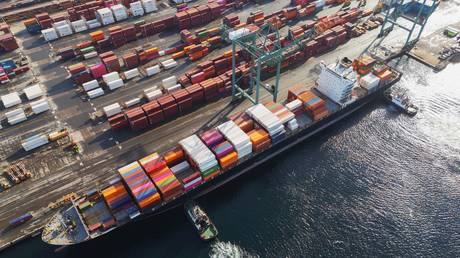
Salt crusts on the eyelashes before the sun even clears the horizon in the Persian Gulf. It is a heavy, punishing heat that does not merely warm the skin; it presses down on the chest like a lead weight. Out on the water, the horizon shimmers, bending light and distorting distance until steel hulls look like mirages floating on glass.
Captain Tariq stands on the bridge of a Very Large Crude Carrier, a leviathan of a ship longer than three football fields, gripping a mug of lukewarm, sweet tea. He has spent thirty years on these waters. He knows every shadow cast by every passing dhow, every sudden shift in the humid wind, and every narrow contour of the Strait of Hormuz.
This narrow maritime choke point is barely twenty-one miles wide at its absolute minimum. Within that narrow band of deep water, shipping lanes are split into two two-mile-wide corridors—one inbound, one outbound—with a two-mile buffer zone separating the superpowers of global commerce from an accidental collision.
Today, that buffer feels paper-thin.
Two UAE-flagged commercial tankers, the A. Mirah and the Andrea Victory, sit miles away, their steel flanks breached by mysterious explosive strikes. The news trickles across the radio waves in clipped, professional tones, but on the bridge, the reality is visceral. Panic does not look like sirens and Hollywood explosions. It looks like silence. It looks like thirty men staring out at a vacant horizon, wondering if the next invisible strike has their name written on it.
We talk about the global economy as if it were a digital abstraction. We speak of gross domestic product, quarterly earnings, and freight index futures as numbers on a glowing screen in a skyscraper thousands of miles away. But the truth is much more fragile. The lifeblood of modern civilization moves slowly, dripping through a handful of narrow marine bottlenecks at twelve knots an hour.
Consider the geography. Roughly one-fifth of the entire world's petroleum consumption squeezes through this exact geographic corridor every single day. If you drive a car in Ohio, heat your home in Germany, or buy plastic goods manufactured in Seoul, a microscopic fraction of your daily life depends on the quiet competence of men like Tariq navigating these exact miles of water.
When explosions tear through commercial hulls in these transit lanes, the shockwave does not just ripple across the Gulf. It registers instantly in boardrooms in Tokyo, insurance offices in London, and gas stations in Chicago.
Security analysts call it geopolitical risk. The sailors call it Tuesday.
(Note: While the specific details of the Gulf tanker incidents reflect documented historical tensions in the region, the internal perspective of Captain Tariq is a hypothetical scenario constructed to illustrate the human reality of maritime trade disruptions.)
The morning paper reports the incident with sterile distance. Two tankers damaged off the coast of Fujairah. No casualties reported. Investigations ongoing.
That is the sanitized version. The human version involves engineers staring at ruptured ballast tanks, smelling the sharp, unmistakable tang of scorched metal mixed with crude oil. It involves frantic satellite phone calls home to families in Mumbai, Manila, and Alexandria, where wives and mothers hear the news on television hours before their husbands can send a brief, reassuring text message: I am safe. Do not worry.
Why do ships keep sailing into the fire?
People often ask why commercial captains do not simply turn around when tensions flare. The answer lies in the unforgiving mathematics of global supply chains. A supertanker does not pull over to the side of the road like a delivery van. Halting a voyage costs hundreds of thousands of dollars a day in charter fees, port dues, and delayed contracts. The economic gravity pulls them forward. The world demands energy, and the ships must move, risk be damned.
This is the invisible tax of our modern lifestyle. We have built a world of astonishing abundance, but we have concentrated its plumbing into vulnerable, narrow corridors. When a single flashpoint flares in the Middle East, the entire global mechanism shudders. Insurance rates for hulls transiting the Strait spike overnight by thousands of dollars per voyage. Refiners scramble for alternative routes. Diplomats trade sharp words in air-conditioned UN chambers while men in sweat-soaked coveralls weld steel plates over jagged holes in the side of a ship under the blazing desert sun.
Tariq looks down at his tea. The cup is cool now. He sets it on the mahogany chart table, right beside an electronic navigation display glowing with green waypoints.
The ship continues forward, carving a slow, steady wake through the Persian Gulf. Behind him, the crew moves with quiet, practiced efficiency, checking valves, monitoring radar screens, and watching the water. They are afraid, yes. But fear is a luxury reserved for those who are not currently responsible for keeping the lights on half a world away.
Out here, the margin for error is measured in millimeters of steel and the steady heartbeat of a thousand men who keep the world turning while it sleeps.