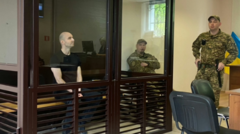
The headlines are lazy. "Scottish Military Instructor Spied for Russia." It’s a clean narrative. It’s an easy villain. A man named Robert Deans—a former British soldier turned "instructor"—gets caught sending coordinates of military targets to the GRU from the heart of Ukraine. The court hands down a fifteen-year sentence, and the public breathes a sigh of relief. The bad guy is behind bars. The leak is plugged.
Except it isn’t.
If you think this is a story about one man’s moral bankruptcy, you’ve already fallen for the distraction. The Deans case isn't a fluke of human nature; it is a systemic indictment of the "volunteer instructor" industrial complex that has emerged since 2022. We aren't looking at a single traitor. We are looking at the catastrophic obsolescence of traditional military vetting in an era of decentralized, digital warfare.
The Volunteer Instructor Scam
Mainstream reporting focuses on the "instructor" title as if it confers some level of inherent prestige or scrutiny. It doesn't. Since the invasion began, Ukraine has become a magnet for "war tourists" and "contractor-lites." I have spent years tracking the movement of private security personnel through conflict zones, and I can tell you: the barrier to entry for a "military instructor" in a high-intensity conflict is often little more than a camouflage jacket and a convincing CV.
Deans wasn't a high-level operative embedded by a mastermind. He was a low-level asset who realized that the Western obsession with "assisting the war effort" created a massive, unvetted blind spot.
While the UK and its allies boast about the sophistication of their intelligence networks, a former corporal can fly to a foreign nation, claim expertise, and get proximity to sensitive locations with less background checking than a high school janitor in London. We’ve built a system that prioritizes the optics of "support" over the mechanics of counter-intelligence.
The Coordination Trap
The competitor articles love to list the "cooperates" of his crimes: he sent locations of military airfields, fuel depots, and troop movements. They treat these as isolated data points. They aren't.
What Deans exploited was the Information Asymmetry of Proximity.
In modern warfare, you don't need a high-ranking general to flip. You just need the guy who stands near the gas trucks. Russian intelligence has pivoted away from the "James Bond" model of deep-cover illegals. Why spend twenty years building a legend when you can find a disgruntled veteran with a gambling debt or a grudge against the "globalist West" on Telegram?
Russia isn't looking for quality; they are looking for volume. If you recruit a hundred "instructors" and ninety-nine are useless, but one—like Deans—is actually standing in a logistics hub in Lviv, you’ve won.
Why Your Vetting is Garbage
Standard military vetting (the SC or DV clearance levels in the UK) is designed for a world that no longer exists. It’s a static snapshot. It checks your debt, your family, and your past. It is incredibly poor at detecting Radicalization-in-Motion.
The consensus view is that Deans "was" a spy. The reality is he likely became one.
The transition from a disillusioned veteran to a Russian asset is often a digital-first process. Russian intelligence services (the GRU and SVR) have mastered the art of the "soft approach" on encrypted messaging apps. They don't start by asking for the coordinates of an airfield. They start by asking for "opinions" on the front line. Then they offer "expenses." By the time the asset realizes they are a traitor, they’ve already accepted the first $500.
If the UK and Ukraine were serious about stopping this, they would stop relying on paper background checks and start looking at the Digital Exhaust of every foreign national in the country. But they won't. It’s too expensive, it’s a privacy nightmare, and it would slow down the flow of volunteers that makes for good PR.
The Myth of the "Professional" Spy
We need to kill the idea that spying requires intelligence. Deans was sloppy. He used a phone. He took photos. He was caught because he was an amateur.
The terrifying takeaway isn't that he was caught; it's how many others are doing the exact same thing but are just 10% more competent. If Deans had used a dedicated offline device and dead-drops, he’d still be "instructing" today.
We are currently operating under a Success Bias. We see the spies who get caught and assume our counter-intelligence is working. In reality, we are only catching the idiots. The professionalization of the "volunteer" sector has provided the perfect camouflage for mid-tier intelligence gathering.
The Actionable Truth for Defense Policy
If we want to stop the next Robert Deans, we have to stop the romanticization of the independent volunteer.
- Mandatory Digital Monitoring: Any foreign national providing "instruction" in a conflict zone must forfeit the right to unmonitored digital communication. If you want to help, you use a state-issued device. Period.
- Financial Forensic Tracking: Vetting isn't a one-time event. It’s a continuous monitoring of crypto-wallets and offshore accounts. If a volunteer "instructor" suddenly has a 5,000% increase in their Monero balance, they shouldn't just be questioned—they should be detained.
- The End of Private Instruction: All training must be centralized under official state-to-state programs like Operation Interflex. The "freelance instructor" is a security vulnerability we can no longer afford.
The Collateral Damage
The irony is that by allowing the "Deans" of the world to operate, we are actually endangering the genuine volunteers. Every time an "instructor" is revealed as a GRU asset, the level of trust between Ukrainian forces and Western volunteers erodes.
This isn't just about Russian missiles hitting airfields. It’s about the Social Sabotage of the alliance. Russia knows that every headline about a British traitor makes a Ukrainian commander look at his British advisors with suspicion. That friction is exactly what Moscow wants.
The Scottish instructor wasn't just a spy; he was a symptom of a West that is too lazy to vet the people it calls heroes.
Stop looking at the man in the cage and start looking at the open door he walked through. It’s still wide open. If you’re waiting for the next arrest to feel safe, you’ve already lost the intelligence war.
Turn off the cameras, stop the PR tours, and start the forensic audits. Or get used to the sound of Russian missiles hitting exactly where they aren't supposed to.