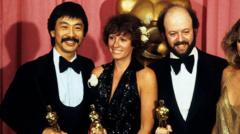
The passing of Academy Award-winning film editor Marcia Lucas at age 80 from metastatic cancer marks the end of an era for New Hollywood, but more importantly, it strips away the comfortable myth of the solo cinematic auteur.
To casual observers, the original 1977 Star Wars was the singular immaculate conception of George Lucas. The industry reality is much messier, much more collaborative, and infinitely more fascinating. Marcia Lucas was not merely an editor or a supportive spouse during the franchise's nascent years. She was the narrative anchor that kept her former husband’s sprawling, sometimes sterile space-fantasy concepts grounded in human emotion. When she passed away on May 27 at her home in Rancho Mirage, California, the film world lost the definitive "secret weapon" behind the modern blockbuster. Her death highlights an uncomfortable truth that the entertainment industry still struggles to acknowledge: the greatest directors of the 1970s and 1980s were frequently rescued in the editing room by women whose contributions were systematically minimized in the decades that followed.
The Post Production Rescue of a Broken Masterpiece
The first rough cut of Star Wars was a legendary disaster.
George Lucas had originally hired British editor John Jympson to assemble the film, but the initial result was lethargic, lacking the kinetic energy and emotional urgency required to make a bizarre tale of space wizards and moisture farmers believable. The pacing was ponderous. The story dragged. It was a critical juncture where the entire project risked collapsing into a multi-million-dollar punchline.
George fired Jympson and brought in a new team: Richard Chew, Paul Hirsch, and his wife, Marcia. It was this trio—eventually winning the Academy Award for Best Film Editing in 1978—that reshaped the raw material into a masterpiece.
Marcia's specific genius lay in her emotional intelligence. She possessed a rare ability to read an audience's tolerance for world-building versus their need for character investment. She understood that special effects meant nothing if the viewer did not care about the people inside the cockpits.
Restructuring the Death Star Trench Run
The climactic battle at the end of Star Wars is widely considered a masterclass in cinematic tension. In the original script and the initial footage, however, the sequence lacked stakes. The rebel pilots made several runs at the thermal exhaust port without a clear sense of mounting peril.
Marcia tore the sequence apart and rebuilt it from scratch using whatever scrap footage she could find. She implemented several structural changes that defined the sequence:
- Fabricated Urgency: She created a ticking clock by constantly cutting back to the Death Star moving into range to destroy the rebel base on Yavin 4.
- Artificial Stakes: If a pilot died in the original cut, it felt like an administrative box being checked. Marcia reordered the deaths of Biggs and Wedge to maximize Luke's isolation and vulnerability.
- The Power of Silence: She adjusted the timing of Obi-Wan Kenobi’s disembodied voice telling Luke to "let go," ensuring the moment landed with spiritual weight rather than sci-fi camp.
The result was a breathless, cross-cut sequence that became the blueprint for every blockbuster finale that followed. She literally manufactured suspense out of a pile of mismatched cockpit close-ups and model shots.
The Fate of Obi-Wan Kenobi
The decision to kill off Obi-Wan Kenobi during his lightsaber duel with Darth Vader was not part of George Lucas’s original master plan. Alec Guinness’s character was initially supposed to survive the escape from the Death Star and accompany the heroes to the rebel base.
Marcia saw the narrative dead end this created. She argued tenaciously that Obi-Wan served no functional purpose in the third act of the film; he would simply stand around watching Luke fly a starfighter. By killing him, his sacrifice would provide a profound emotional catalyst for Luke, elevating the stakes of the final battle. George resisted, but Marcia’s narrative instincts won out. It is a creative choice that fundamentally altered the trajectory of the entire franchise, transforming Obi-Wan from an aging mentor into a mystical, omnipresent guide.
The Invisible Matriarchy of New Hollywood
Marcia Lucas’s career trajectory underscores a broader historical phenomenon: the New Hollywood movement of the 1970s, which celebrated the hyper-masculine, rebellious male director, was quietly built on the backs of female editors.
Hollywood in the mid-20th century was aggressively hostile to women in senior creative roles. Directing, screenwriting, and producing were heavily guarded boys' clubs. Editing, however, was an anomaly. Because the process originated in the early days of cinema as a physical, meticulous task resembling sewing or cataloging—cutting celluloid strips and gluing them together—studio executives initially viewed it as "women’s work."
This patriarchal oversight allowed brilliant women to seize control of the most critical part of the storytelling process.
| Editor | Key Collaborations | Major Impact |
|---|---|---|
| Marcia Lucas | George Lucas, Martin Scorsese | Defined the rhythm of Star Wars, injected emotional realism into Taxi Driver |
| Dede Allen | Arthur Penn, Sidney Lumet | Invented the aggressive, fractured editing style of Bonnie and Clyde and Dog Day Afternoon |
| Verna Fields | Steven Spielberg, Peter Bogdanovich | Rescued a broken mechanical shark by using suspenseful cutting to create the pacing of Jaws |
| Thelma Schoonmaker | Martin Scorsese | Shaped the chaotic, kinetic energy of Raging Bull and Goodfellas |
Marcia began her career as an apprentice film librarian with zero formal training, enduring an eight-year apprenticeship in the Motion Picture Editors Guild before earning full editor status. Her instinct was her currency. When legendary editor Verna Fields hired her as an assistant for a government film project in 1967, Marcia was paired with a quiet University of Southern California graduate named George Lucas. They married in 1969.
From that point forward, her editing table became the filter through which some of the era's most aggressive male egos had to pass.
Fixing Martin Scorsese
Marcia’s influence extended far beyond her husband’s filmography. She was a vital creative partner to Martin Scorsese during his most fertile creative period. She served as an editor on Alice Doesn't Live Here Anymore (1974), the supervising editor on Taxi Driver (1976), and a co-editor on the sprawling musical New York, New York (1977).
On Taxi Driver, Marcia was responsible for managing the psychological descent of Travis Bickle. Scorsese's raw footage was hallucinatory and chaotic. Marcia brought a disciplined, jarring rhythm to the assembly, using jump cuts and slow-motion inserts that made the audience experience Bickle's unraveling internal state. While Scorsese was celebrated as the gritty wunderkind of American cinema, it was Marcia who ensured that his grit didn't devolve into incoherent noise.
The Erasure of the Secret Weapon
If Marcia Lucas was so pivotal to the creation of modern cinema, why did her name vanish from the cultural lexicon for decades? The answer lies in the intersection of a bitter divorce and the deliberate construction of a corporate mythos.
The couple divorced in 1983, just as Return of the Jedi—which Marcia also edited—was hitting theaters. The split was messy and expensive. As Lucasfilm grew from an independent production company into a multi-billion-dollar corporate empire, the narrative surrounding the creation of Star Wars began to shift. The corporate machinery required a singular, visionary god-figure to market to fans and shareholders. George Lucas became the lone genius who willed a universe into existence.
Marcia was effectively written out of the official history.
For years, official Lucasfilm documentaries and retrospectives downplayed her role, often reducing her to a supportive wife who offered occasional feedback at the kitchen table rather than an Oscar-winning technician who rebuilt the movies in the trenches.
[The Auteur Myth: Director Only] ──(Incomplete)──> [Box Office Failure or Narrative Mess]
[The Reality: Director + Editor] ──(Complete)───> [Cohesive Cinematic Landmark]
This erasure had real consequences for the franchise. After the divorce, George Lucas surrounded himself with yes-men, executives, and technicians who were unwilling to challenge his ideas. The results speak for themselves. When George returned to the director's chair for the Star Wars Prequel Trilogy starting in 1999, he no longer had Marcia in the editing bay to tell him when a scene was cold, when a character was irritating, or when the plot made no sense.
The prequels suffered from precisely the flaws that Marcia had spent the 1970s correcting: excessive world-building, flat emotional stakes, and a catastrophic lack of narrative pacing. They were movies made by a lone genius who had successfully eliminated the only voice capable of saving him from his own worst impulses.
The Brutal Truth of Modern Franchise Filmmaking
Before her death, Marcia Lucas made a rare public return to the spotlight to voice her profound frustration with the modern state of the franchise she helped birth. She did not hold back. In interviews conducted for the 2021 book Icons Unearthed, she took aim at Lucasfilm president Kathleen Kennedy and director J.J. Abrams for their handling of the Disney-era sequel trilogy.
"They don't get it," she stated bluntly, criticizing the narrative decisions to kill off Han Solo and Luke Skywalker without establishing a coherent emotional foundation for the new characters. "The storylines are terrible. Just terrible."
Her critique was not born of jealousy, but of a deep, fundamental understanding of story mechanics. She recognized that the modern studio system has reversed the lessons of the New Hollywood era. Today, blockbusters are engineered by committees, heavily reliant on pre-visualization software and corporate mandates, long before an editor ever sits down at a machine. The contemporary system prioritizes brand management over cinematic rhythm.
Marcia Lucas understood that a great movie is not designed on a whiteboard during a shareholder meeting. It is discovered in the dark, frame by frame, by someone willing to cut away the fat to find the human heart buried underneath the spectacle. Her death leaves the film industry without one of its most honest critics, and a stark reminder that the solitary genius is a fiction we choose to believe because the alternative—that great art requires brutal, compromising collaboration—is too difficult to market.


