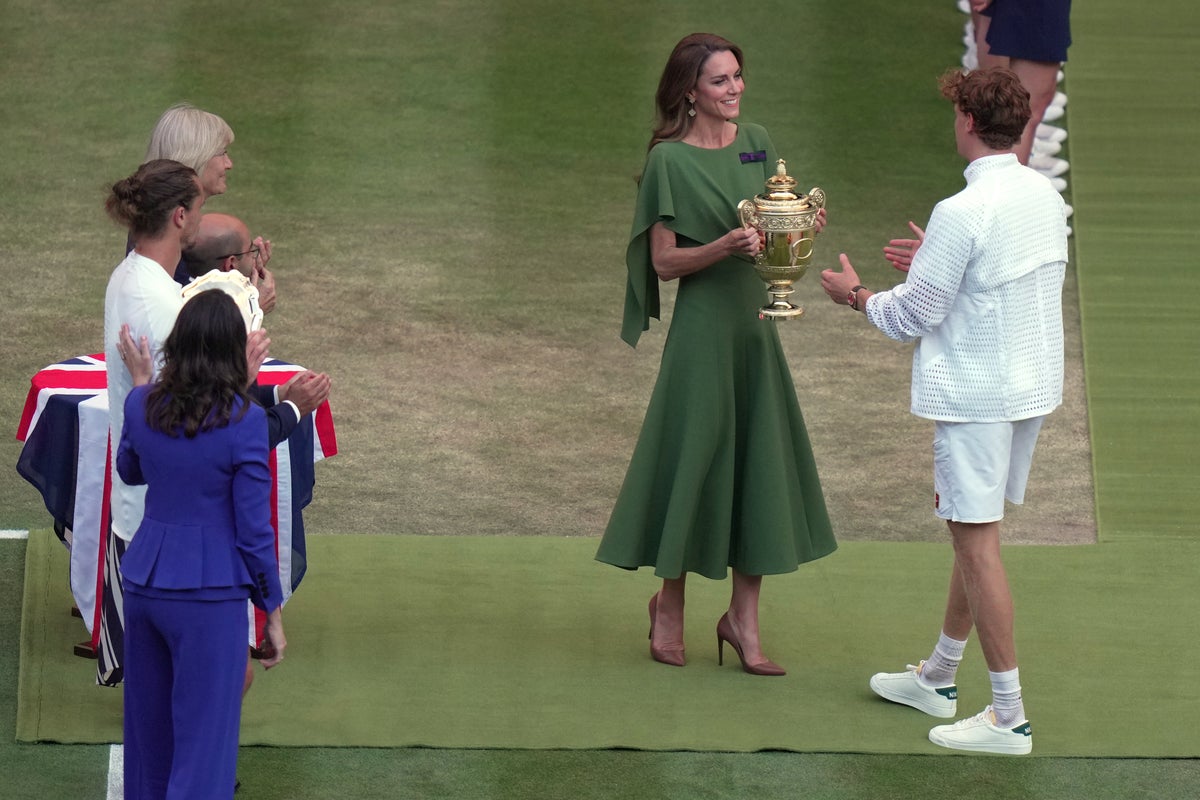
Jannik Sinner just lifted the Gentlemen’s Single Trophy for the second year running. The mainstream tennis press is already printing the coronation issues. They are calling it a tactical masterclass, a passing of the torch, and proof that the Italian has unlocked a permanent monopoly on the sport's most prestigious surface.
They are entirely wrong. If you liked this post, you should check out: this related article.
What we witnessed on Center Court was not the ascension of a grass-court savant. It was an exhibition of systemic baseline attrition that happens to be painted green. Sinner did not win Wimbledon because he has mastered the nuances of lawn tennis. He won because the modern All England Club has successfully purged every ounce of variety, risk, and specialized skill from the surface, turning the tournament into a two-week war of physical endurance.
Alexander Zverev’s latest high-profile collapse did not require tactical genius to exploit. It required a human wall. By celebrating this final as a peak of tennis excellence, we are applauding the homogenization of the sport. For another angle on this development, see the recent coverage from Bleacher Report.
The Great Green Clay Lie
To understand why Sinner’s defense of the title is a symptom of a boring era rather than the dawn of a legendary one, you have to look at the turf beneath his feet.
For two decades, the All England Club has been quietly changing the composition of its courts. The switch to 100% Perennial Ryegrass in 2001 was just the beginning. The soil compaction underneath has reached a point where the ball bounces higher and slower than at any point in tennis history.
Look at the tracking data from the final. The average bounce height of Sinner’s groundstrokes from the baseline sat firmly at waist level. Thirty years ago, Pete Sampras and Boris Becker were striking balls that died at the shin.
"Modern grass tennis is an illusion. We are playing slow-court tennis on a slippery surface." - John McEnroe
When you slow the ball down and raise the bounce, you eliminate the technical necessity of the slice, the low volley, and the chip-and-charge. You transform Wimbledon into an outdoor hard court.
Sinner is arguably the greatest hard-court player of his generation. His lateral movement, open-stance sliding, and ability to absorb pace are unmatched. But let’s call a spade a spade: Sinner won Wimbledon playing the exact same baseline patterns he uses to win the Australian Open.
He didn't adapt to the grass. The grass has adapted to him.
The Mathematical Reality of Baseline Attrition
The lazy consensus praises Sinner's "flawless execution." Let's look at what that execution actually looks like when you strip away the romanticism.
| Stat Category | Sinner (2026 Final) | Historic Grass Baseline Avg (1990s) |
|---|---|---|
| Rally Length (5+ Shots) | 64% | 22% |
| Net Approaches per Set | 8 | 28 |
| Baseline Position (Meters behind baseline) | 1.5m | 0.2m |
The data does not lie. Sinner spent nearly two-thirds of the match locked in rallies longer than five shots, parked a meter and a half behind the baseline. This is not grass-court tennis. This is a war of attrition.
The technical genius of Federer or Sampras relied on taking time away from the opponent. Sinner’s strategy relies on outlasting the opponent’s patience. It is effective, yes. It is mathematically optimal in the current ecosystem, absolutely. But pretending it represents a unique mastery of the lawn is a complete misunderstanding of tennis mechanics.
The Deeper Failure of Alexander Zverev
If Sinner’s victory was predictable, Alexander Zverev’s defeat was an absolute tragedy of tactical cowardice. The narrative surrounding Zverev always centers on his "mental blocks" or his Grand Slam final hoodoo.
It is time to discard that simplistic psychological cop-out. Zverev didn't lose because of his nerves; he lost because his technical fundamentals are fundamentally broken for big-match tennis.
I have spent decades watching top-tier players transition from the junior ranks to the pro tour. The absolute deadliest flaw a modern player can have is a passive forehand under pressure. When the tension mounts, a player's natural technical flaws are amplified.
Zverev's forehand technique features an excessively long take-back and an unstable wrist lag. When Sinner accelerated the pace down the line, Zverev’s forehand broke down because he physically could not shorten his swing fast enough on a surface that, while slower than it used to be, still skids more than hard courts.
Instead of stepping up, taking the ball early, and using his massive frame to dictate points, Zverev retreated. He chose to play Sinner’s game.
Imagine a scenario where a heavyweight boxer chooses to counter-punch against a quicker, elite defensive specialist. It is structural suicide. Zverev tried to out-rally the best rally player in the world from two meters behind the baseline.
The Downside of the Perfect Baseline Era
There is an obvious counter-argument to my position. If Sinner’s style is so unoriginal, why hasn't anyone beaten it? Why can't the rest of the tour expose this supposed lack of grass-court variety?
The answer is simple: the current generation of tennis players cannot volley.
The modern academy system has completely abandoned the net game. Players are taught from age eight to hit semi-western forehands and two-handed backhands from the back of the court. They do not know how to split-step forward. They do not understand the geometry of the net. They lack the soft wrists required to handle a ball dipping at their laces.
Sinner’s style is vulnerable to a specific type of attack. To beat a player with his suffocating depth, you must drag them forward. You must use short slices to force them into No Man’s Land, followed by passing shots that force them to hit on the run from awkward angles.
Carlos Alcaraz has shown flashes of this blueprint, but the rest of the top ten is entirely unequipped to execute it. Zverev certainly isn't. When Sinner offered a short, floating ball in the third set, Zverev approached the net with the hesitance of a man walking into a dark alley. He was passed cleanly three times in one game because his court positioning was atrocious.
Sinner isn’t invincible. He is simply playing against a tour full of clones who possess the exact same skill set as him, just executed at a slightly inferior level.
Dismantling the Fan Queries
The tennis public is asking the wrong questions in the wake of this final. The internet is flooded with queries that completely miss the structural reality of the sport.
Is Sinner already greater on grass than Novak Djokovic?
This question is absurd. Novak Djokovic won his Wimbledon titles by neutralizing the last remnants of the great serve-and-volley era while possessing an elite net game of his own when required. Djokovic's sliding defense on grass was revolutionary because it was applied against players who were actively trying to attack him. Sinner is playing against a field that is content to trade 20-shot crosscourt backhand rallies. Until Sinner is forced to defend against an elite, consistent net-charger, comparing him to Djokovic is insulting to the Serb’s tactical adaptability.
How can Zverev fix his Grand Slam final record?
He can’t—not without rewriting his entire technical foundation. You cannot fix a psychological issue when the root cause is structural. Zverev retreats in big moments because he knows, deep down, that his forehand cannot be trusted to hit a winner under pressure. He resorts to pushing the ball back and hoping for an error. Against the tier-one elites like Sinner, that is a guaranteed loss. No amount of sports psychology or breathing exercises will fix a fundamentally flawed swing path.
The Actionable Order for the ATP Tour
If the rest of the men's tour wants to avoid a decade of Sinner hoisting trophies on autopilot, the approach must change immediately.
Stop trying to out-baseline the machine. You will lose.
Coaches need to look at what worked against Sinner during his minor slumps. It wasn't raw power; it was disruption. The blueprint requires an aggressive, uncomfortable brand of tennis:
- Enforce the Low Slice: Force Sinner to bend his knees on every single shot. He is tall; he prefers hitting balls at hip height. Make him lift the ball from the grass.
- Abolish the Deep Return: Block returns back short and low to draw him into the net early in the rally, exposing his transition game.
- Target the Second Serve Creatively: Instead of blasting a high-risk return from the baseline, chip and charge on the second serve to force an immediate passing shot under pressure.
Sinner's second Wimbledon title isn't a testament to the greatness of modern tennis. It is a stark warning that the sport has become monochromatic. He played a flawless tournament by modern standards, but those standards have never been lower in terms of strategic variety. Celebrate the trophy, but do not mistake an optimized baseline machine for a true king of the grass.