Silence.
That is the thing nobody ever tells you about an emergency inside a twenty-one-thousand-seat arena. You expect screaming, or the cinematic roar of a panicked crowd surging toward narrow concrete exits like water bursting through a cracked dam, because that is how movies train us to imagine disaster. Instead, when the house lights snap on and the bass cuts out mid-chorus, what hits you first is a sudden, suffocating vacuum where a shared euphoria used to live.
I have stood inside that exact kind of stillness before, staring at an exit sign that suddenly looked less like a piece of building code and more like a lifeline. Your ears ring from the sudden absence of noise. The cold air from the rafters drops onto sweat-dampened shoulders. You look at the stranger standing two inches to your left—someone you were singing alongside thirty seconds ago—and watch their pupils dilate as both of you try to decode the expression on a teenage steward's face.
On the night emergency services declared a major incident at the Manchester arena and ordered thousands of concertgoers into the damp northern chill, the headlines reduced a profound human rupture to a tidy, clinical sentence. Police cordons went up. Trains were halted. A perimeter was established. In the cold calculus of breaking news, thousands of people became a single collective noun, moved from point A to point B without serious injury, allowing the rest of the world to scroll past before their morning coffee went cold.
Yet anyone who has ever gripped a child’s hand in a darkening concourse knows that "evacuated safely" does not mean untouched.
The Architecture of Trust
To understand what actually breaks when an arena empties in a hurry, you have to understand the unspoken contract every ticket buyer signs at the turnstile.
Think of a modern entertainment venue as an intricate emotional clockwork. You hand over your bag to be searched, walk through a magnetometer, surrender your water bottle cap, and accept the mild indignities of modern security because you are trading vigilance for vulnerability. Once you cross that threshold, you give yourself permission to stop scanning the room. You let your guard down so you can lose yourself in light, rhythm, and collective joy.
Consider a hypothetical scenario that played out in variations across hundreds of rows that evening. Picture Claire, a forty-two-year-old nurse from Stockport, sitting in the upper tier with her twelve-year-old daughter, Maya. It is Maya’s first real gig. She spent three weeks choosing an outfit, agonizing over glitter, and memorizing every lyric on the album. For two hours, Claire watches her daughter’s face lit up by stage strobes, feeling that rare, ache-inducing pride of giving a kid a memory she will carry into her thirties.
Then the rhythm fractures.
A security supervisor steps onto the side of the stage, speaking urgently into a headset. Within ninety seconds, the house lights flood the bowl with harsh, clinical white. A voice—calm, rehearsed, deliberately stripped of inflection—instructs everyone to leave their belongings and proceed immediately to the nearest exit.
Notice what happens inside Claire’s chest in that exact second. In Manchester, an arena evacuation does not exist in a historical vacuum. Every adult in that building carries the phantom weight of May 2017—the memory of another night, another concert, another moment when young people walked out of a foyer expecting to find their parents and found tragedy instead. Even when a major incident turns out to be a false alarm, a suspicious package, or a technical failure, the nervous system does not distinguish between a drill and a detonation. It only knows that the contract has been voided.
Why "Major Incident" Means Something Specific
When Greater Manchester Police or the North West Ambulance Service declares a "major incident," the phrase triggers panic among readers refreshing their phones at home, largely because the public hears "major" and assumes "catastrophic."
In reality, emergency planners use the term as an operational key rather than a casualty report. Under the United Kingdom's Joint Emergency Services Interoperability Principles, a major incident is simply any event whose scale, location, or complexity requires extraordinary resources—meaning standard patrol cars and routine ambulance shifts are not enough, so command structures must merge into a unified tactical response. It is the civic equivalent of an airline pilot declaring an emergency not because the engines are on fire, but because clearing the airspace guarantees an unobstructed runway.
That distinction matters deeply, yet it offers zero comfort when you are shuffling down a concrete stairwell in a river of three thousand silent people.
Crowd psychology during an evacuation behaves much like fluid dynamics under sudden pressure. When a pipe narrows, velocity spikes, and friction turns dangerous. Venue designers spend millions calculating egress times—how many minutes it takes to drain a full bowl onto the surrounding streets—banking on the hope that human beings will move like water rather than like frightened animals.
What keeps a crowd from crushing itself at the bottlenecks is rarely the steel barriers or the fluorescent paint on the floor. It is social contagion. People mirror the emotional temperature of the person directly in front of them. If twenty people near a concourse door begin to sprint, panic ripples backward faster than any loudspeaker announcement can travel. If, instead, stewards maintain steady posture and clear, low voices, the crowd absorbs that borrowed calm and keeps walking.
The Invisible Aftermath on Trinity Way
By the time Claire and Maya step out onto the pavement near Victoria Station, the cold Manchester drizzle is already soaking through thin cotton hoodies.
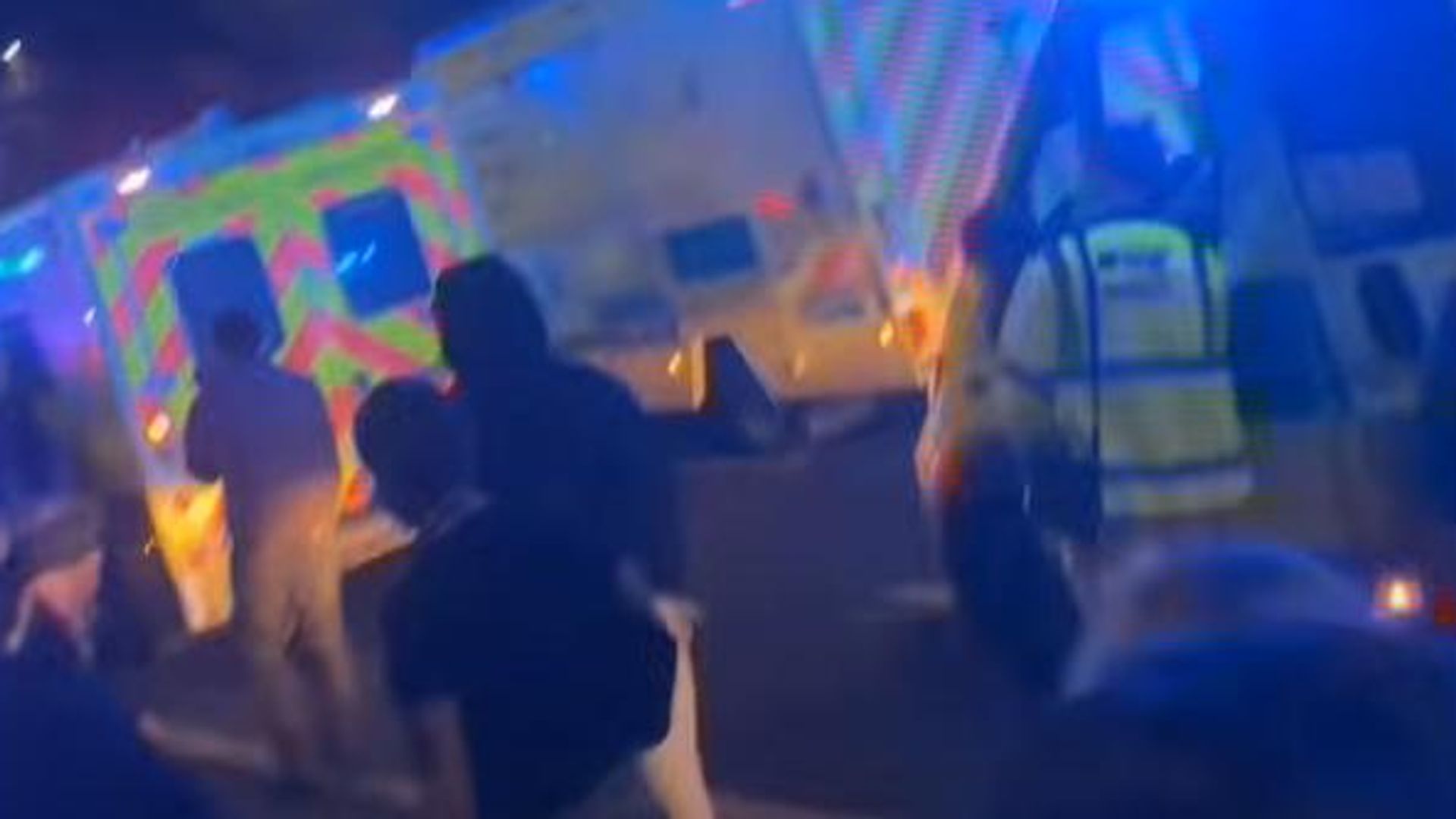
Around them, thousands of people are standing in clusters under flickering streetlights, holding dead or dying phones, trying to remember which multi-story car park holds their vehicle while police tape flutters across the road closures. The immediate physical danger—whatever triggered the alarm—is behind them. The official timeline will record this moment as a successful containment.
Look closer at the edges of the crowd, though, and you see the quiet wreckage that never makes a police blotter.
You see teenagers sitting on damp curbs hyperventilating, clutching foil emergency blankets handed out by paramedics because shock drops body temperature faster than winter wind. You see parents frantically refreshing railway apps only to discover that Victoria Station has been shuttered as part of the security cordon, stranding families miles from home with no cash, no coats, and dead batteries. You see the subtle, lingering hypervigilance taking root in Maya, who will spend the next six months checking the exit signs every time she walks into a cinema, a shopping center, or a train carriage.
We have a habit of measuring public safety exclusively by what did not happen. No structural collapse. No mass casualties. No fatalities. And thank heaven for that—every single protocol worked as designed, proving that lessons learned in blood years earlier had hardened into muscle memory among Manchester’s first responders and arena staff.
But honesty requires admitting that safety and peace of mind are two entirely different currencies.
The Weight We Carry Into the Dark
I used to think that robust security protocols made people feel safer. After enough nights watching crowds file through metal detectors and past armed patrols, I realized the opposite is often true: visible armor reminds you constantly of the threat it was built to stop. We live in an era where gathering in large numbers to sing, laugh, or watch a match requires an invisible infrastructure of threat assessments, bomb-sniffing dogs, and rehearsed evacuation scripts running silently beneath the floorboards.
Consider what happens next on the morning after an arena empties out.
Maintenance crews walk the empty tiers with black bin liners, collecting thousands of abandoned drinks, dropped handbags, car keys, and half-eaten tubs of popcorn left behind when the announcements told people to drop everything and walk. Each abandoned object is a frozen snapshot of an interrupted night—a jacket draped over a seat back, a program folded neatly under a chair, a phone charger still plugged into a concourse outlet.
Meanwhile, across Greater Manchester and towns scattered down the M62, thousands of people wake up with sore throats not from singing, but from cold air and adrenaline hangovers. They read brief, sanitized news updates confirming that the cordon has been lifted, the investigation is complete, and normal operations will resume before the weekend. Life, as civic leaders always promise, goes on.
Yet somewhere in Stockport, a twelve-year-old girl stares at the glitter still clinging to the sleeves of her jacket, trying to reconcile the brightest two hours of her life with the coldest twenty minutes she has ever known—standing under a streetlight in the rain while blue lights spun across wet brick, waiting for someone to tell her it was safe to go home.